The Holy Family with a Lamb
1507. Oil on panel.Room 049
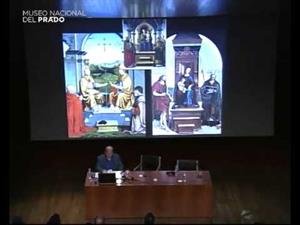
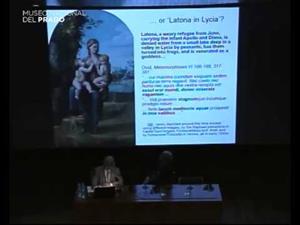
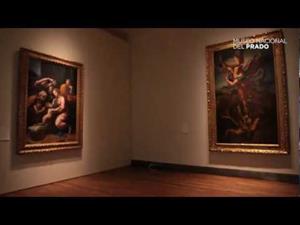
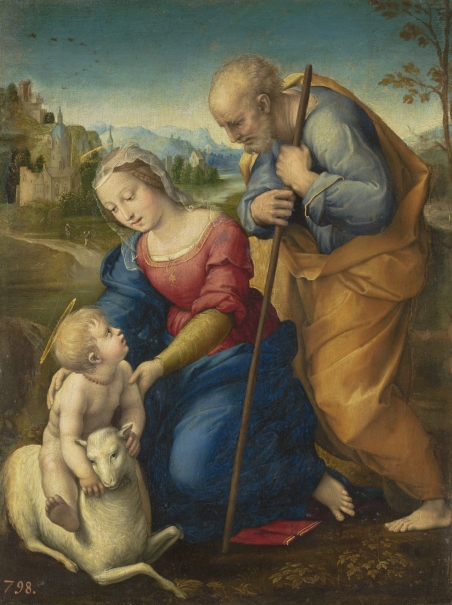
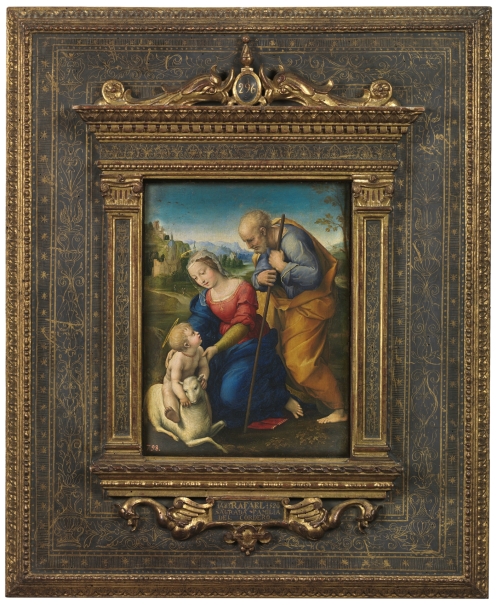
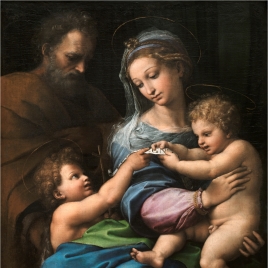
In 1504, after training with Perugino, Raphael moved from Perugia to Florence, where he remained for four years to absorb the work of Leonardo and Michelangelo. His gradual mastery of classicism is visible in a series of Madonne that constitute a delicate series of variations on the subject of motherly love. One of these is the Holy Family of the Lamb, which is based on a preparatory drawing by Leonardo da Vinci for the main altar at the church of La Annunciata in Florence. While the drawing has been lost and the altar was never made, we know from a letter dated in April 1501 that the composition showed Saint Anne gripping the Virgin, who tries to keep her son from embracing the lamb. This double action was interpreted by the letter’s author, Friar Pietro de Novellara, as the Church -personified by Saint Anne- accepting Christ’s sacrifice -symbolized by the lamb- despite the efforts of the Virgin, who is reluctant to allow it. Like Leonardo’s drawing, of which there is a copy in a private collection in Geneva, Rapahel’s panel shows the Virgin, Christ child and lamb, but Saint Anne has been replaced by Saint Joseph. More important than this change is Raphael’s modification of the scene’s implications by depicting the Virgin helping her son embrace the lamb as Saint Joseph looks on with an attentive, meditative expression that reveals his awareness of the action’s premonitory significance. The communication among the characters is emphasized by their postures and the direction of their gazes. The inclusion in the middle ground of a secondary scene with the flight to Egypt suggests that the main subject alludes to a rest on the way.
The landscape is filled with architectural elements that, while present in other contemporaneous works by Raphael, are not Italian, and were probably taken from Northern engravings. In that same sense, the meticulous depiction of nature, especially the plant life in the foreground, suggests that young Raphael had been studying the works of Hans Memling that were in Florence at that time, especially the Pagagnotti Triptych (ca. 1480, Florence, Galleria degli Uffizi). The Virgin’s facial features are unique among Raphael’s works, resembling those of the Madonna dei Garofani, and are explained by the fact that both works draw on models by Leonardo. Fra Bartolomeo has also been suggested as an influence on the depiction of Saint Joseph.
The preparatory drawing for this painting is at the Ashmolean Museum in Oxford. X-rays have revealed changes in the position of the lamb and the Christ child’s hand, as well as the late inclusion of a tree behind Saint Joseph.
In 1703 the work was in fact in the hands of the Falconieri family in Rome, cited as ‘Una Madonna con il Bambino che cavalca un agnello e San Gioseppe di Raffael d´Urbino con paesino di palmi 1 1/3 in circa con la cornice nera fregiata d´oro [...] stimato scudi 1.500’ (Frascarelli 2012: 202-203). In turn, the Falconieri acquired it from a certain Federico Rorsi ‘soap-maker’ for two hundred and sixty scudi (Frascarelli 2012: 101-106). Prior to that owner it is uncertain who owned it, although it may have been in the hands of Cardinal Mattei di Paganica, whose posthumous inventory of his possessions in Rome in 1650 mentions a similar work. The painting was probably sent to the Cardinal by his brother General Giuseppe Mattei di Paganica, who may have obtained it in Ferrara (Curti 2025). In that city the Holy Family of the Lamb must have been in the hands of the Duchess Margherita Gonzaga d´Este, who in turn had received it as a gift from Alfonso d´Este, until at least 1597. It would have come into the latter´s hands following an enquiry to recover the painting from an anonymous priest of Reggio, who in turn obtained it from Gregory XIII´s master of chambers, Monsignor Ludovico Bianchetti. This prelate bought it for little money at the auction of the estate of Cardinal Luigi d´Este in 1587, who in turn inherited it from his uncle, also Cardinal Ippolito d´Este. Ippolito would have had the painting in his villa in Tivoli, and a ‘quadro dipinto della Madonna con un puttino a cavallo dell´agnello’ (painted painting of the Madonna with a horse on horseback) was among the works of art mentioned at his death in 1572. The Cardinal commissioned a copy of the painting for his palace at Montegiordano in Rome, which led to a considerable number of replicas of the painting circulating in the papal capital during the papacy of Gregory XIII. (Information updated by the Department of Italian and French Painting up to 1800 on 5/12/2024).
El Prado en el Hermitage, Museo Estatal del Hermitage: Museo del Prado, 2011, p.70-71