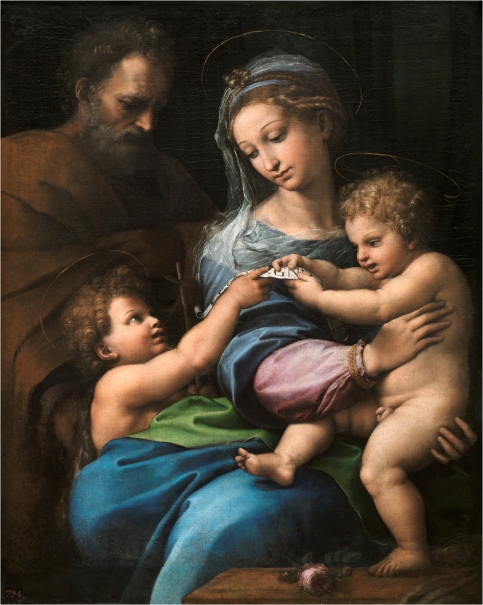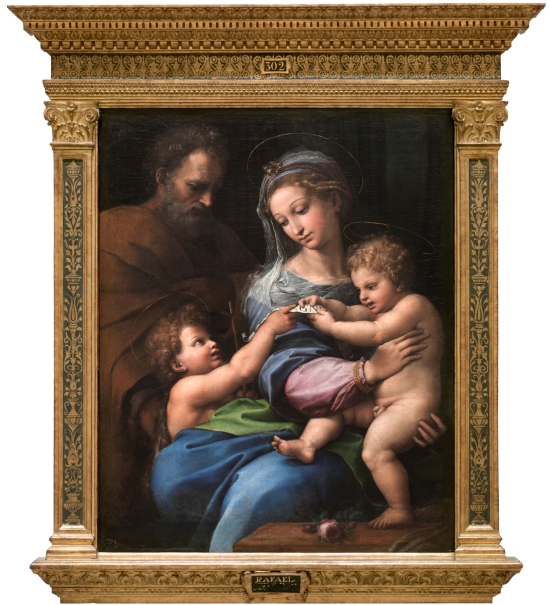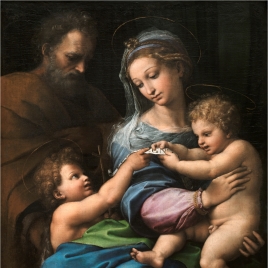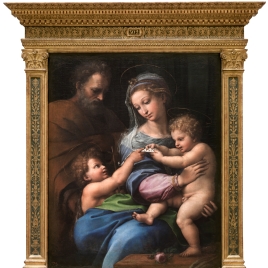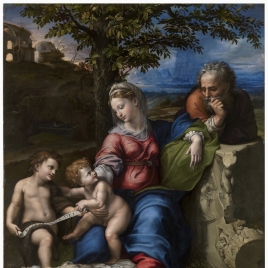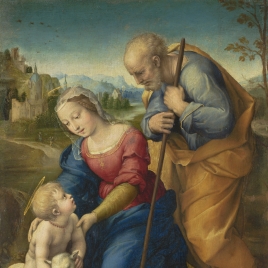
The Holy Family with the Infant Saint John the Baptist, or Madonna of the Rose
Ca. 1517. Oil on panel transferred to canvas.Room 049
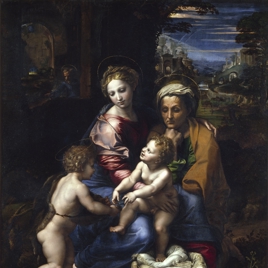
It is not known who commissioned the Madonna of the Rose, the last medium-format Madonna painted by Raphael for a private setting. The arrangement of the figures recalls the first cartoon for Leonardo’s Virgin and Child with Saint Anne, and it also refers us back to drawings by Raphael himself dated to the years around 1505. It was a successful composition, and versions of it were soon made. The best known are the painting known as the Munro of Novar Madonna by Giulio Romano (ca. 1518-20; National Galleries of Scotland, Edinburgh) and a Holy Family with Saint John painted by Daniele da Volterra during the 1530s (Galleria Doria Pamphilj, Rome).
Although Vicente Carducho makes mention in 1633 of a Holy Family by Raphael in poor condition in the collection of the Count of Monterrey, which might be the Madonna of the Rose, the first verifiable record of the painting’s presence in Spain dates from 1667, when Francisco de los Santos cites it as located in the prior’s chapter house in the Royal Monastery of San Lorenzo de El Escorial. In any case, it was already known in Spain in 1588, when a version of it was painted by Gabriel de Cárdenas Maldonado. Several copies of it were made around that time, including one by an Anonymous painter of the sixteenth century, kept at the Museo Nacional de Escultura in Valladolid, and those mentioned by the painter Benedito Rabuyate (1527-1592) in his testament of 1589 inventorying reproductions in his workshop. The rose is not present in any of these copies.
The painting entered the collection of the Prado in 1837. The documentation of the ensuing years is confused, but study of the archive in combination with imaging analysis has allowed its material history to be traced out, albeit still hypothetically. We believe that the transfer of the support was carried out at the Prado between 1838 and 1839. During the operation, the original ground and priming were almost completely stripped away, causing a weakening of the material which, together with the application of a dark gray enduit, altered the aesthetic appearance of the painting. The painting must have deteriorated at a very early date. If it is the one mentioned by Carducho in 1633, it is already described as “somewhat mistreated,” while Johann David Passavant wrote in 1853 that “it has suffered a great deal and is almost unrecognizable owing to a layer of colored varnish.” This latter observation raises the suspicion that the replacement of the support in 1838-39 was not a success -as is further suggested by the material losses and the abrasion and contraction of the painting- and that a colored varnish was applied to disguise this. This would appear to be confirmed by the fact that in 1859, only twenty years after the intervention, it had to be relined.
It had been known for some time that neither the rose which gives the picture its title nor the table on which it rests are original to the piece, and that the left foot of the Christ Child was partially repainted in an early restoration. The latest studies have contributed two new pieces of data which reveal that this occurred before the work entered the Prado. First, we have discovered in a new X-radiograph that these elements are painted on a wooden slat nailed to the transfer canvas and the current stretcher. Secondly, laboratory analysis has dated the pigments of this addition between the late seventeenth and early eighteenth centuries. This information prompts us to propose the following hypothesis: the lower edge of the original panel, as is appreciable in the X-radiograph, must have been damaged before its arrival at El Escorial. While it was in the monastery, it was repaired and extended downward, with a wooden slat inserted to complete it. Upon this, the Christ Child’s foot was repainted and the rose and table were added. When the time came for the transfer from panel to canvas at the Prado, the added wooden piece became separated from the original support but was kept and made thinner to be nailed to the stretcher, and the same occurred during the relining of 1859. The painting now rests on the unrefined grayish layer added by the museum. The removal of the original base strata, on which Raphael would have traced the preparatory drawing, explains why it is barely visible in the infrared radiation images. The underdrawing is normally very clear in infrared reflectograms of Raphael’s works, even those which were transferred to a new support.
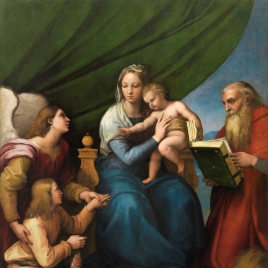
The figure of Saint Joseph, whose authenticity has occasionally been questioned, was part of the design from the start, as shown by a drawing preserved at the Musée du Louvre, Paris, which was based on the original cartoon or the earliest phase of the composition. This design corresponds to the initial composition of the scene shown by the X-radiograph and the infrared reflectogram, which was slightly modified when the painting process was considerably advanced, as occurred with the Madonna del Pesce (Museo del Prado, P297). The only black outlines visible on the IRR image correspond to this phase, when Raphael, before making adjustments, drew them on the painted surface. As in the Louvre drawing, in the initial design the Christ Child was in profile and Saint John’s hair was gathered on his forehead with a band, also evident on the X-ray fluorescence (XRF) map of copper. Upon finishing the work, Raphael added plaits to the Virgin’s hair, fabrics to her veil, and folds to her mantle, and furthermore reduced the length of her neck. The combination of the XRF maps of copper and iron shows how Joseph’s right hand and sleeve, now hidden by the Baptist’s pelisse, were modified twice after completion.
By contrast with the Madonna del Pesce, these variations enriched and dynamized a composition that was originally simpler and more static. On another score, the new imaging makes it possible to refute one of the reasons adduced for doubting the originality of the figure of Saint Joseph, his lack of a halo. Part of the outline of his halo can be made out on the XRF map of gold, suggesting that it eroded during the transfer process.
In spite of the damage suffered and the fact that the dark tone of the base affects the perception of color on the surface, the Madonna of the Rose preserves its original charm. Stratigraphic analyses and X-ray fluorescence mapping have contributed data on the sophisticated method of chromatic construction Raphael employed in its creation, in consonance with the more intimate distance from which it was to be viewed. The pigments used are of high quality and the superimposition of layers and the mixtures of pigments are complex. For example, the blue of the Virgin’s mantle rests on two layers of red lake upon which a layer of azurite and a velatura of ultramarine are superimposed, both with the addition of some lead white. The construction of the mantle in the Madonna del Pesce is simpler, and although it too begins with a base of red lake, the only blue pigment it contains is azurite. Common to both works is the presence of a copper-based blue in the whites of the eyes of all the figures, together with Raphael’s use of green curtains as a backing for adjusting the outlines and making the final touches to the heads. They also share the formal simplicity of the bodies and the assurance of their arrangement in the space, indicating that both works, despite their stylistic differences, were painted rapidly on the basis of learned models.
González Mozo, Ana, En: Raphael. Sublime Poetry, Nueva York, The Metropolitan Museum Of Art; Yale University Press, 2026, p.348