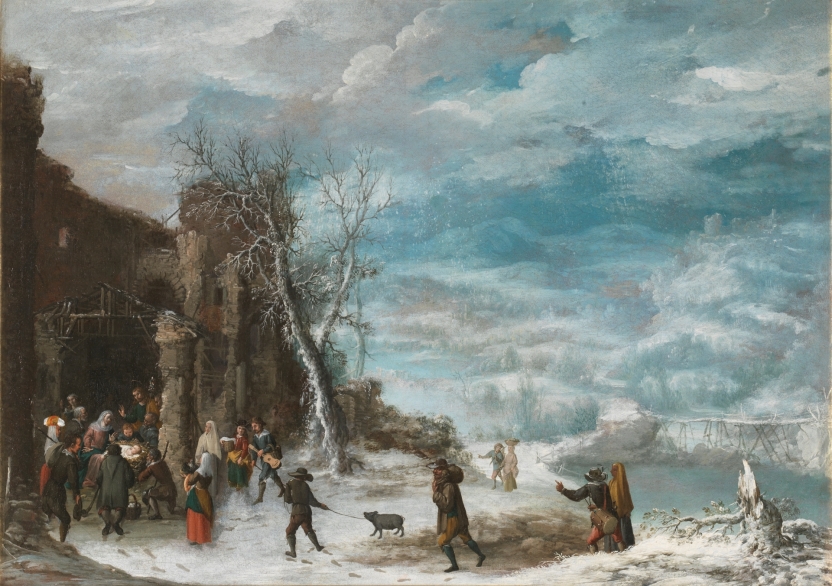
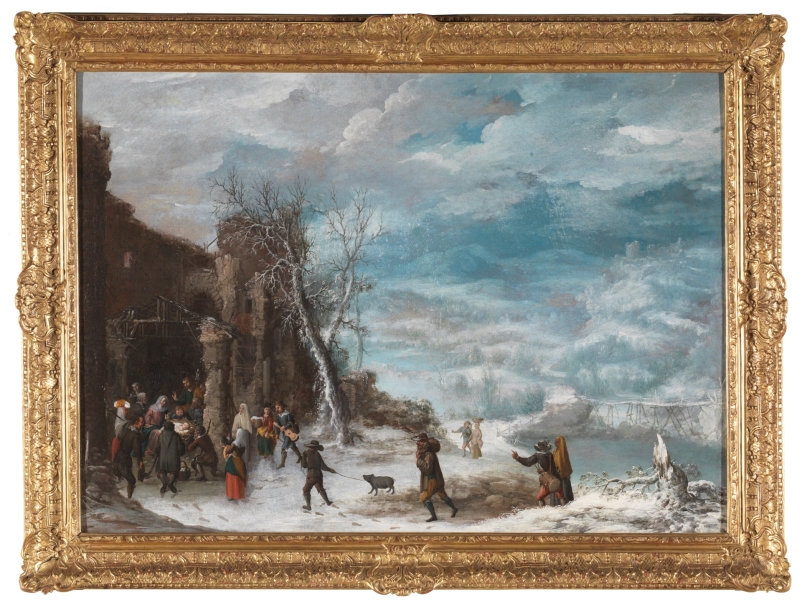
Winter Landscape with the Adoration of the Shepherds
1630 - 1650. Oil on canvas.Not on display
The composition is dominated by a great winter landscape, recognizable not only by the lifelessness of the vegetation, but also by the snow that covers mountains and valleys as well as by the falling snow. The action of snowfall also provides a clue as to the date, since it portrays the shepherds worshipping the Christ Child during the days closer to winter solstice. Men and women bring gifts in baskets and sacks, and some of them have musical instruments. The painter has depicted these characters in meticulous detail, as they are dressed in a significant variety of attires and –as in a Nativity scene – they follow the road either in twos or on their own. The painter has thoroughly portrayed this winter setting in order to emphasise the warmth and intimacy of the scene in which the Nativity unfolds. This becomes the narrative focus of the painting, and despite being located left of centre, it imbues the white landscape with meaning.
This work was brought to light in 2007, and it was catalogued as having been by Francisco Collantes (around 1599–1656), one of the first Spanish painters who specialised in landscape painting, in which he often included small narrative scenes.
The attribution is based on the numerous affinities with some paintings attributed to Collantes or signed by him, namely Landscape with huts (signed, private collection), Landscape (signed, Wallraf-Richartz Museum in Cologne), and some of his works in the Museo del Prado. Of all of the landscapes by Collantes, the interest in this work stems from the fact that it is his only known winter scene and from the attention to narrative: its description is of great documentary value, since the artist seems to have drawn the characters from life in order to imbue the scene with greater authenticity.
Museo Nacional del Prado, Memoria de Actividades 2008, Madrid, Museo Nacional del Prado, 2009, p.20-21