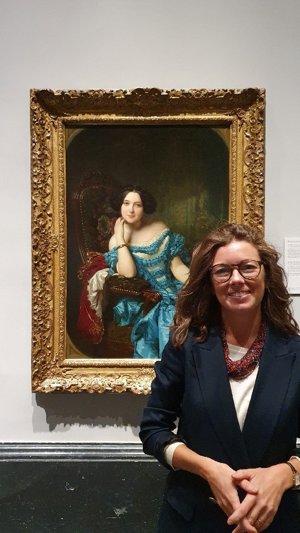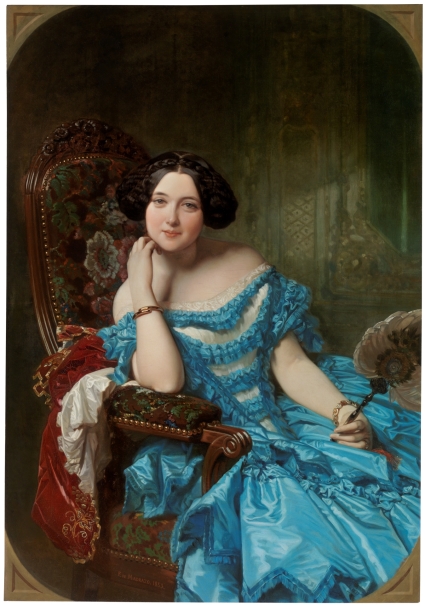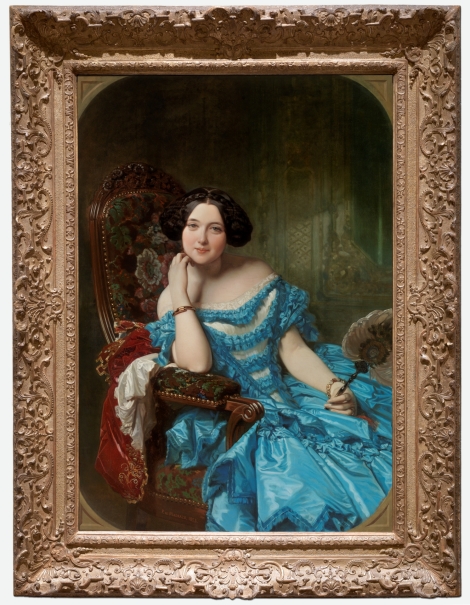
Amalia de Llano y Dotres, Countess of Vilches
1853. Oil on unlined canvas.Room 061
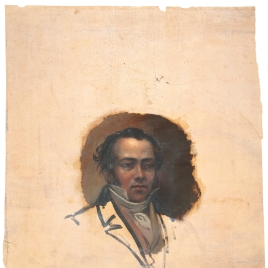
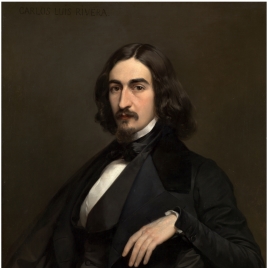
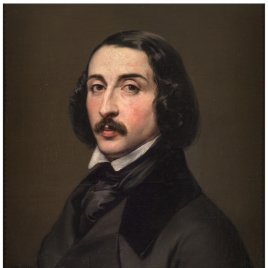
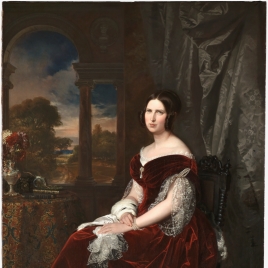
This is a masterpiece of Spanish Romantic portraiture and the most attractive of Madrazo’s female portraits. It is undoubtedly the most emblematic work of the 19th-century collections of the Museo del Prado. Amalia de Llano y Dotres (Barcelona, 1821–Madrid, July 6th 1874) was thirty-two years old when Madrazo painted her portrait. On October 12th 1839, she married Gonzalo José de Vilches y Parga (1808–1879), who was to become the first Count of Vilches in 1848. Two portraits of him (P002879 and P002887) are located in the Museo del Prado. The Countess of Vilches was an outstanding defender of the monarchist cause since the fall of Isabella II, Queen of Spain. Furthermore, she was an amateur writer and also published the novels Berta and Ledia. She was a close friend of Federico de Madrazo, which could explain the unique beauty and exquisite refinement that the painter achieved in this portrait. The Countess frequented the Madrazo house, especially on their musical soirées, in which she even sang accompanied by the piano.
In this portrayal, Madrazo succeeds in perfectly combining all the artistic resources he had developed throughout his mature period. The artist, with this painting, reached his most painstaking refinement, at the service of one of the most beautiful and charming women of Isabelline Madrid. The portrait is imbued with a distinctive French flair, very much suited to the elegance of the model. Madrazo learnt this technique during his training period in Paris with French painter Ingres. The lady’s pose conveys a degree of sensuality quite foreign to the Spanish tradition. However, the model’s flirtatious pose is informal, which provides the work with a sense of graceful movement duly calculated detail by the artist. Due to the illumination used by Madrazo, the whiteness of the female complexion both stands out against the marked darkness of the background and highlights the chromaticism in the overall tone. The culmination of the accomplishments of this superb portrait lies in the subtlety of some of the model’s gestures, such as the delicacy with which she holds the fan, the almost imperceptible contact of her fingers with her oval face and her charming smile, mirrored by her seductive gaze.
Díez, José Luis, 'Federico de Madrazo. Amalia de Llano y Dotres, condesa de Vilches'. El siglo XIX en el Prado, Madrid, Museo Nacional del Prado, 2007, p.172-175 n.25