Appearance of the apostle St. James to saints and knights of the military orders
1885. Oil on canvas.On display elsewhere
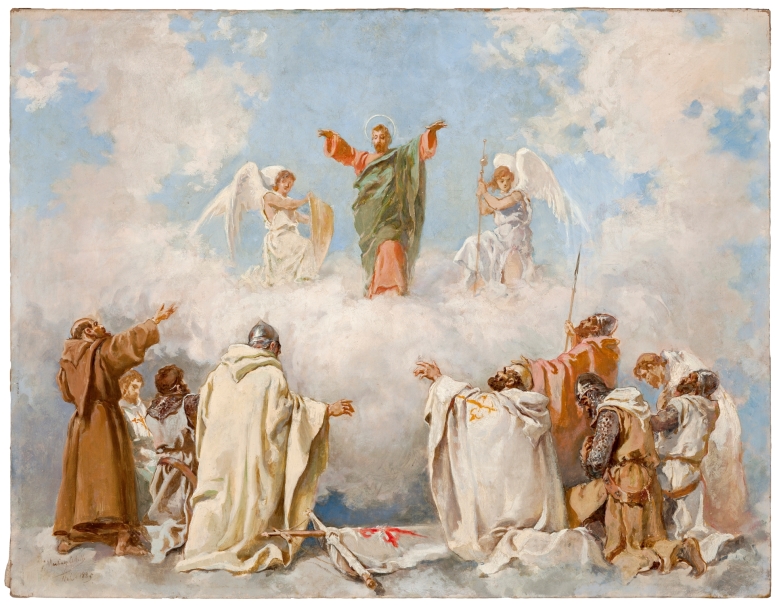
This is a preparatory sketch intended for the decoration of the Royal Basilica of Saint Francis the Great, in which Salvador Martínez Cubells participated in the pictorial representation of the cupula interior of the chapel of the Sacred Hearts, of which some studies on canvas of parts of that work have survived (all of them unknown until 2003) which allow us to imagine the final state of this painting, which is practically imperceptible.
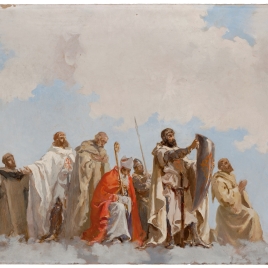
The composition has a historical development along the copula interior and is polarised by two figures that diametrically mark its axis: Saint John the Baptist and Saint James. The figure of the patron saint of Spain appears in this preparatory sketch surrounded by figures representing the Apparition of Saint James to saints and knights of military orders. In this sketch, the rest of the composition can already be distinguished: numerous figures of sacred appearance, but almost impossible to identify, arranged almost like figurants, and of whom we also have three private studies on canvas, one also in the Museo del Prado, Saints and Bishops with Knights of Military Orders (P7577) and a pair in the Basilica of San Francisco itself, Knights and Monks with a Standard and a detail of A Monk and Two Knights which is preparatory to one of the groups of figures that appears in the last mentioned sketch in the Prado.
This is composed of parallel figures, arranged in mirrored pairs. The titular figure, Saint James, extends his open hands over the heads of the figures at his feet, imploring protection. On either side of the saint, one angel holds a staff and the other a shield, thus affirming his dual status as a pilgrim and a warrior. In the foreground there are two groups of figures, all in an attitude of expectation, whose distribution coincides. In the inner part is a pair of knights in white cloaks, and behind them, a small group of figures, made up of other knights and a Franciscan, all kneeling and marked by another standing individual. In general, the entire group of these sketches provides us an approximate idea of the prospective result of one cupola interior, now practically lost.