Boudoir Scen
1772 - 1773. Oil on canvas.Room 087
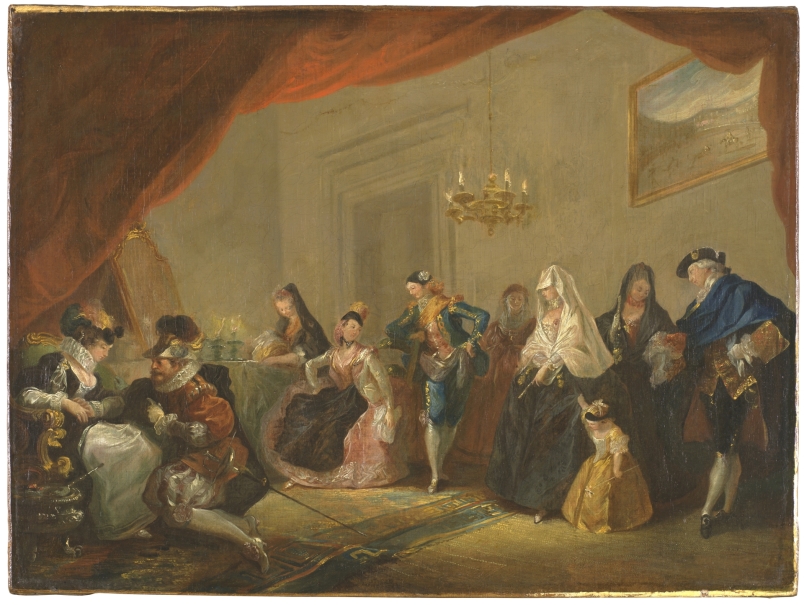
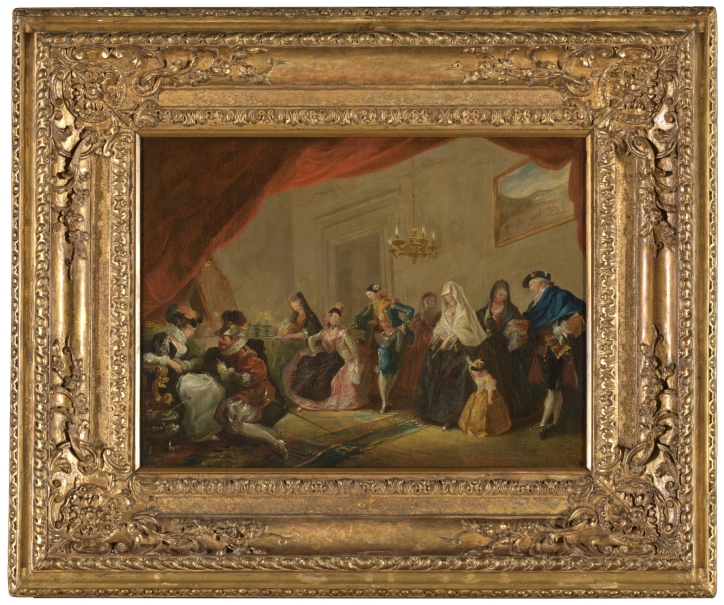
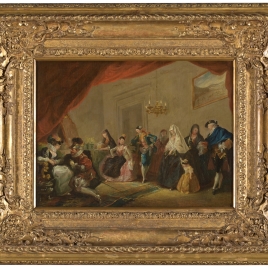
This work came to light in 1955 at the Hallsborough Gallery in London, where it was considered to be of the Italian school. That same year, Xavier de Salas published it as being by Paret and as a possible theatre scene or a scene from a costume ball with figures wearing attire from different time periods and participating ‘in an act that is difficult to understand’. Due to the appearance of the figures, it entered the Museo del Prado as a ‘theatre scene’. It was also interpreted as representing an intermission during a performance and as an example of the revaluation of authentic tradition against French fashion, although it was repeatedly noted that it was difficult to read.
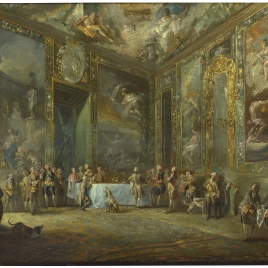
The scene unfolds in a softly lit boudoir that is furnished with a mirrored table, in addition to chairs, matting, a rug, and a painting with bullfighting as its subject, specifically the thrust of the picador. However, recent radiography of the work reveals a lavishly decorated interior as well as a perspective similar to that of Charles III, King of Spain, dining before the Court (P002422): the corner where both walls meet has been displaced to the right, thus coinciding with the central axis of the canvas. This shift left of one of the ceiling corners – which appeared sumptuously decorated with stucco – visible, whilst another candle chandelier – hanging higher and further to the left – suggested a space of greater depth. To the left of the bullfighting painting hung a cornucopia and, below it, a clock with a glass cover. On the left wall, a drawn curtain revealed the light of a candle or a window, above which hung another painting or mirror. Further to the left, a large painting of the Immaculate Conception stood out, which was revealed by the red drapery that is currently visible. Behind the drapery was a door or window through which light entered.
On the other hand, the figures remain unmodified. To the left, a couple dressed in the courtly fashion of 1600-33 appear to be engaging in an affectionate manner, also reflected in the burning embers of a brazier. However, the lady’s sadness seems to be an indicator of an unhappy love, probably because she is engaged, as can be deduced by her ring. Further to the right, a seated girl dressed in popular clothing has aroused the interest of a young majo (dandy). A maidservant, who appears to have offered her one of the shawls in her basket, observes her from the mirrored table with a knowing smile. As she haughtily rests her arm on her hip, the girl melancholically looks towards a child who has arrived with her mother, who is elegantly dressed in French fashion, wearing a white mantilla, as well as chatelaines with a golden pocket watch and a golden perfume bottle. Behind the majo, a nursemaid is wearing peasant clothing and a veiled headdress like those worn by the village women of Cantabria, where the court’s wet nurses also came from. The mother points her closed fan downwards in a pensive expression, whilst behind her a richly attired gentleman – who appears to be her husband – flirts with a young lady wearing a mantilla and a black cape. She has placed her hand in that of her lover’s, which the nursemaid observes out of the corner of her eye. With the other hand she raises her closed fan, from which dangles a decenary rosary – an object used to pray Hail Marys, but which was also worn by matchmakers – made of blue beads and adorned with gold medallions. Meanwhile, the child, holding a toy windmill made of cut playing cards (a three of hearts and a three of clubs), pulls at her mother’s skirt, as if she wanted to leave.
The boudoir – whether in a private home, the theatre or a shop – was a place to display the secret and deceptive gestures of courtship. Objects such as paper windmills, playing cards, and watches traditionally represented the unpredictability and transience of love, fortune, and happiness. The couple dressed in older fashion may symbolise the repetitiveness of the dark side of love, which would contrast with the virtues represented in the image of the Virgin. It is likely that it was this image – most certainly considered inappropriate in such a setting – that prompted the recipient of the work to request the artist to repaint it along with the rest of the flamboyant decoration. As a result, the interior was left more neutral in style with the painting of the picador’s thrust, a subject that gave rise to the examination of the bull’s virtues and flaws and that might be key to understanding the depicted scene.
Maurer, Gudrun, 'Luis Paret y Alcázar. Escena de tocador' En:. Paret, Madrid, Museo Nacional del Prado, 2022, p.88-91 nº 10