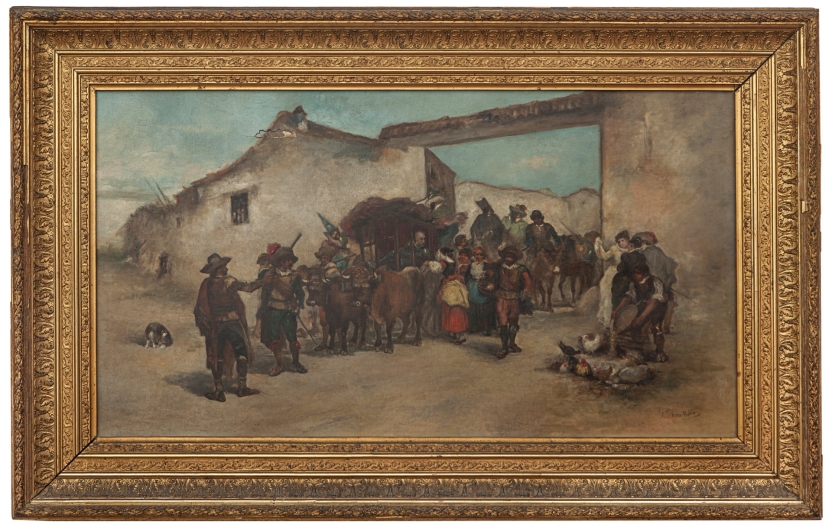
Don Quixote leaves the inn bewitched with the whole entourage
Ca. 1887. Oil on canvas.On display elsewhere
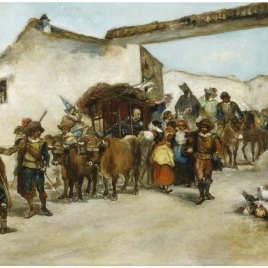
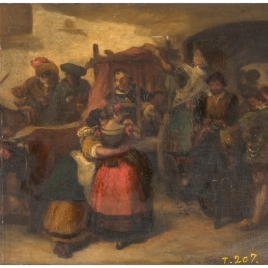
The painting depicts an episode from chapter XLVII of the first part of Cervantes´ work, in which, under the delusion of believing himself bewitched, Don Quixote is humiliatingly removed from an inn caged in a cart, in accordance with a plan hatched between the priest and the barber Cardenio, with the agreement of the innkeeper. Pérez Rubio rigorously follows Cervantes´ text and so, the members of the squad, with whom ‘the priest had made an agreement’, were escorting the cart. On the far right, the ladies Dorotea and Luscinda bid farewell to the nobleman, and next to them there is a lad who is feeding the chickens. On one side of the cart, one of the characters from the inn is disguised as the magician under whose spell the knight-errant believed himself.
Despite certain technical oversights common in Rubio’s work, the painting is a good example his artistic personality and of his fiery, sketchy style, which leaves the figures blurred and the details of their features and clothing loosely suggested. Both the medium-sized format and the type of composition, which groups the figures in the centre forming a wide triangular strip and resolves the spatial setting in the form of a mere backdrop of visibly conventional flatness and simplicity, are inherent characteristics of the artist´s style in this type of scene. The pictorial fullness with which the small figures are resolved, and his anecdotal sense of narration are undeniable. The painting was included in the National Exhibition of Fine Arts of 1887, although Pérez Rubio had already dealt with the same theme years earlier in another smaller painting entitled Don Quixote in the cart leaving the inn, which was included in the 1866 edition.
El mundo literario en la pintura del siglo XIX del Museo del, Madrid, Centro Nacional de Exposiciones y Promoción Artística, 1994, p.144 nº11