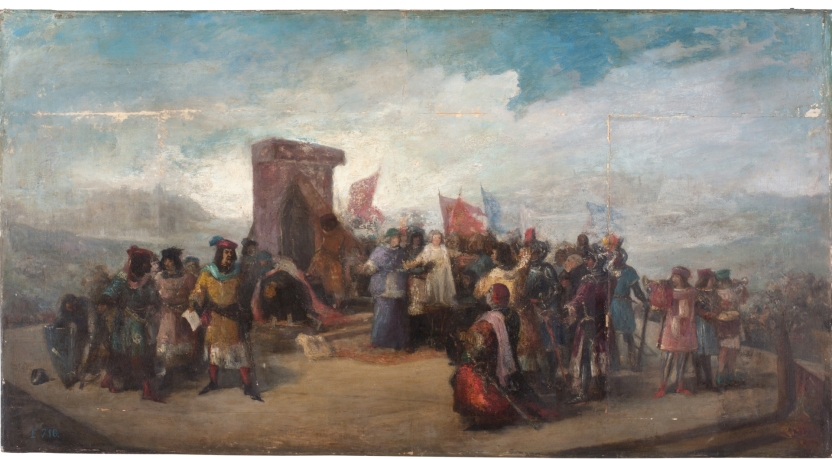
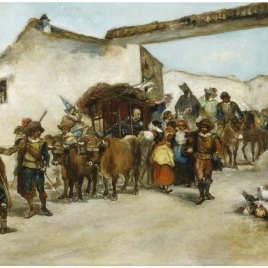
The Farce of Ávila
Ca. 1881. Oil on canvas.On display elsewhere
Queen Isabella the Catholic was born on 22 April 1451 in Madrigal de las Altas Torres (Ávila). She was the third daughter of John II, King of Castile, who was remarried to Isabella of Portugal, the mother of the future Catholic Queen. She spent her childhood in Arévalo, where she moved with her mother and her brother Alfonso shortly after her mother became a widow. Her stay in Arévalo was not very pleasant, as her mother soon began to show signs of insanity. In 1464 King Henry IV, her half-brother, took her to his court, endowing her with rents, grants and a villa in Casarrubios del Monte. Relations between the siblings were quite close, and King Henry showed affection towards the young infanta as well as towards her other brother, Alfonso. The situation at Henry’s court was not very gratifying, as the nobles intrigued to take even more power away from the legitimate monarch. This led to a hidden confrontation between those in favour of a strong monarchy and those who opted for a pliable monarch.
It was in this atmosphere that a noteworthy event took place, known as the ‘Farce of Ávila’. In a grotesque ceremony, the nobles deposed Henry IV and named Prince Alfonso King of Castile. They claimed that the heiress – Joana, daughter of Henry and his second wife Joana of Portugal – was illegitimate as she was the result of the love affair between the queen and her favourite, Beltrán de la Cueva, hence the name Beltraneja by which the infanta became known to posterity. Isabella was not involved in all these manoeuvres, but soon came into the picture. Her brother Alfonso died of poisoning, but she managed to get her half-brother Henry to grant her the title of Princess of Asturias over her niece and goddaughter by baptism, Joana la Beltraneja.
The painting was submitted to the National Exhibition of Fine Arts of 1881 (No. 541). In its catalogue it was accompanied by an excerpt from Lafuente’s Historia de España: ‘Nobles and knights conspired in Ávila, and led by the Archbishop of Toledo, Alfonso Carrillo, figured in the dethronement of King Henry IV and proclaimed as King of Castile the child Prince Alfonso, the King’s younger brother’.
Díez, José Luis (dir.), Pintura del Siglo XIX en el Museo del Prado: catálogo general, Madrid, Museo Nacional del Prado, 2015, p.463