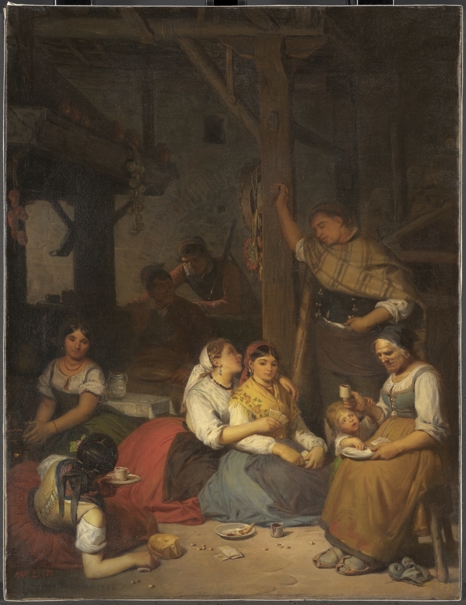
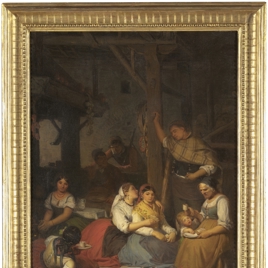
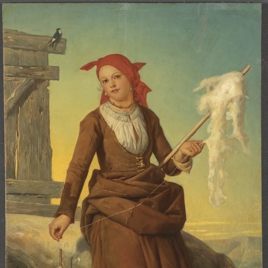
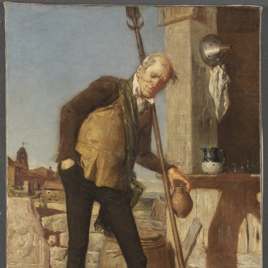
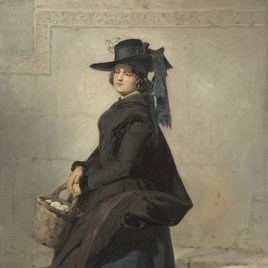
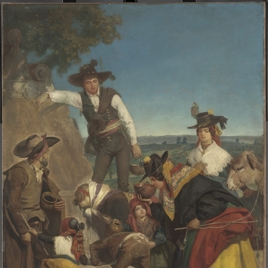
Interior of a house in a village in Aragon, when the family gathers in the afternoon to have hot chocolate
1866. Oil on canvas.Room 060
During the reign of Isabella II, the Crown continued the tradition that had arisen during the Enlightenment of promoting artistic projects that compiled collections of the country’s wealth in its most varied manifestations – whether architectural, geographical, gastronomic or anthropological – in the form of commissions for series of paintings with a primordial iconographic value based on the encyclopaedic interest in and agglutination of universal knowledge. It was in this spirit that some of the most interesting pictorial ensembles commissioned by Spanish kings from the last third of the 18th century onwards were created. Although on an ad hoc basis, Isabella II also promoted – either from her own money or through official commissions from her ministers – various series of paintings depicting aspects of the lands and people of her kingdom. In the same context, Her Majesty’s Government, by Royal Order of 6 February 1865, granted the Sevillian painter Valeriano Domínguez Bécquer a pension for the following purpose: ‘Bearing in mind the convenience of the National Museum to have as complete a collection as possible of paintings that recall in the future the current characteristic costumes, uses and customs of our provinces, and in view of the special circumstances of Don Valeriano Bécquer, the Queen has granted him the pension of ten thousand reales a year, so that by collecting the necessary data and studies in these localities, he may send the aforementioned Museum two paintings each year under the conditions indicated’.
Thus, to fulfil the first instalment of the pension, corresponding to the 1865–6 academic year, Valeriano delivered this painting titled Interior of a house in a village in Aragon, when the family gathers in the afternoon to have hot chocolate and the painting The present. Festival in Moncayo (Aragon), on the eve of the patron saint’s day, both the result of his trip to Aragon. (El siglo XIX en el Prado [The 19th century in the Prado], Museo del Prado, 2007, pp. 188–9.)
Regarding the iconography, the author notes: ‘A painting of customs in Aragon, in which I have tried to give an idea of the interior of the rooms and their use, very widespread in certain places among the women of the village, of gambling chocolate at cards at afternoon snack time.’