Portrait of a girl
1852. Oil on canvas.Not on display
This portrait was painted at the age of 18, when the painter was in the midst of his formative years in his native Seville under the artistic tutelage of his uncle Joaquín Domínguez Bécquer, who was a discreet history and royal painter to Queen Isabella II, while an excellent and renowned pioneer in the development of Andalusian costumbrist painting. In turn, he was trained by the young painter’s father, José Domínguez Bécquer, who did not exert his paternal inclination to teach him due to his early death in 1841.
The close personal and professional contact he maintained throughout his life with his brother, the poet Gustavo Adolfo Bécquer, and their eventful lives full of disappointments and hardships, together with their respective premature deaths, define the prototypical picture of the Romantic artist marked by misfortune. He was known particularly for his picturesque and costumbrist scenes of the Castilian, Aragonese and Basque provinces.
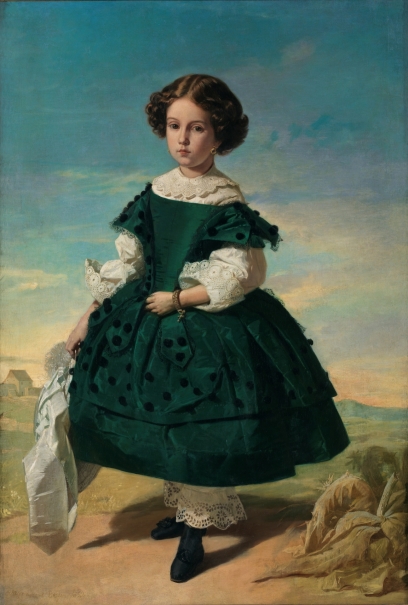
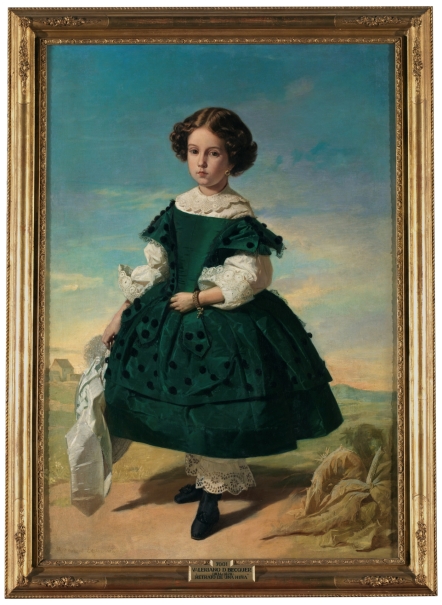
Nevertheless, portraiture is the genre in which he displays his most refined drawing technique: within his palette, the chromatic intensity of clothing rendered in detail stands out against the light and diluted backgrounds of the natural surroundings. To these descriptive resources should be added the introspection characteristic of Bécquer’s portraiture, mostly expressed through the model’s gaze fixed on the viewer in a suggestive challenge of spiritual enquiry, as in the case of the suggestive and emblematic Romantic portrait of his brother Gustavo Adolfo kept in the Museo de Sevilla. Nonetheless, in this full-length portrait of a girl, set in a middle ground, this introspection is obscured by the prominence of elements that are external to her spirituality and that confer upon the work a certain coldness emphasised by the static pose and without any reference to the natural attributes and accoutrements of childhood. Thus, against a rural landscape background, this distinguished girl is depicted in an elegant green satin dress, adorned with black madroños. Underneath her dress, a white blouse with an embroidered wave collar and wide sleeves topped with lace ruffles can be seen. The ruffles also adorn the little trousers that peep out from under the skirt, which is held up in a bouffant by the so-called crinoline, a fashionable undergarment that was all the rage in the 1850s to accentuate the waistline and increase the volume of the lower part of the female body. In her right hand, she holds a straw pamela adorned with a wide pinkish satin ribbon, an essential part of walking attire, as were the ankle boots that cover her feet. As accessories, a braided bracelet is on her left hand, and her earrings adorn a face illuminated from the left, highlighting her curly hair against the intense cloudscape in the background.
In the foreground, a dried-out pita plant becomes the main feature, giving a certain exotic character to the portrait. It is set on a sunny summer afternoon on the rural plain surrounding a country estate, suggested briefly by the architecture and the rural fence in the background. This type of framing was a compositional model that spread among national and foreign Romantic costumbrist painters. They identified this type of vegetation with the arid, semi-desert environment of the Andalusian countryside: the prototype of the exoticism of an extolled image of Spain due to its proximity to the Eastern world. Thus, painters and illustrators who travelled around Spain – such as David Roberts, Pharamond Blanchard, Francisco de Paula van Halen and José Roldán himself – used these clichéd compositions, which remained in use until the last third of the century by some painters who occasionally approached the Orientalist world, as was the case of Ricardo de Madrazo, among others.
Gutiérrez Márquez, A., Retrato de niña (1852). En Barón, J.: El retrato español en el Prado. De Goya a Sorolla, Madrid, Museo Nacional del Prado, 2007, p.122, n. 34