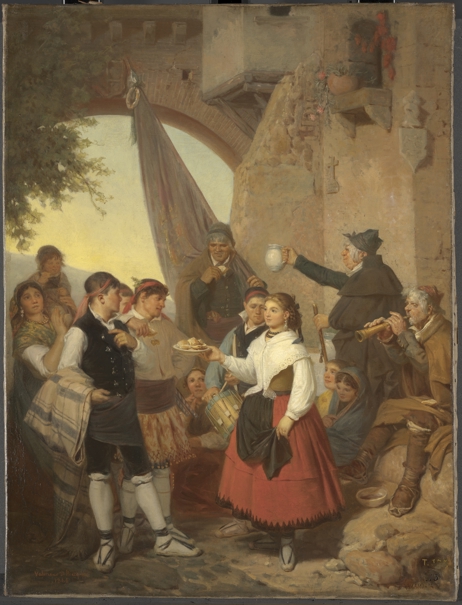
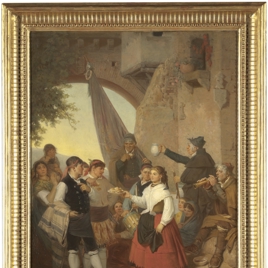
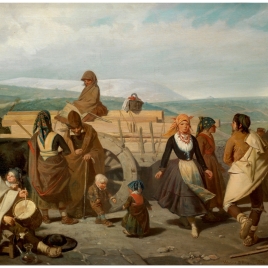
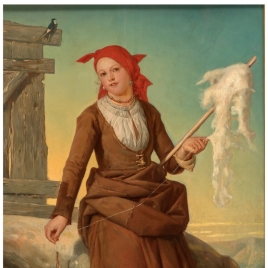
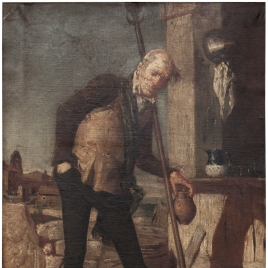
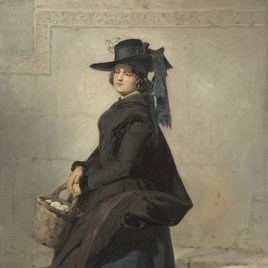
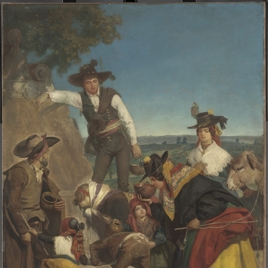
The Offering. Festivities in Moncayo (Aragon), on the eve of the patron saint's day
1866. Oil on canvas.Room 060
The Crown During the reign of Isabella II, maintained the commitment it had developed during the Enlightenment, to promoting artistic projects. These projects compiled appraisals of the country´s wealth in its most varied manifestations, whether architectural, geographical, gastronomic or anthropological. They took the form of commissions for a series of paintings primarily of iconographic value, encyclopaedic in documentation and universal in scope. This was the culture of patronage under which the most interesting pictorial ensembles commissioned by Spanish monarchs from the last third of the 18th century onwards came into being. Although occasionally, Isabella II in addition patronised, either out of her own pocket or through official commissions from her ministers, various series of paintings that depicted aspects of the lands and people of her kingdom. It was in this spirit that Her Majesty´s Government, by Royal Order of 6 February 1865, granted the Sevillian painter Valeriano Domínguez Bécquer a grant for the following purpose: "Bearing in mind the convenience of the Museo Nacional having a collection of paintings that is as complete as possible, which in the future will recall the current characteristic costumes, uses and customs of our provinces, and in view of the special circumstances of don Valeriano Bécquer, the Queen (whom may God preserve) has granted him a grant of ten thousand reales a year, so that by collecting the necessary data and studies in these localities, he may send the aforementioned Museum two paintings each year under the conditions indicated".
Thus, to fulfil the first instalment of the grant, corresponding to the academic year 1865-1866, Valeriano handed over two paintings, both the result of his journey through Aragonese lands: "The offering. Festival in Moncayo (Aragon), on the eve of the patron saint´s day" and "Interior of a house in a village in Aragon, when the family gathers in the afternoon to have chocolate".
Regarding the iconography of the painting in question, the author notes: "In some of the villages in the part of Mount Moncayo that belongs to the aforementioned province, the local youths traditionally go out to walk through the streets on the eve of the patron saint. They are accompanied by the brotherhood´s religious administrator and drummers and bagpipers, who occasionally perform a very ancient dance they call the "paloteo". When the procession stops in front of the house of one of the brothers of the brotherhood, the latter comes out to offer the members of the brotherhood a few jugs of wine while a girl from his family offers them several pieces of bread on a plate, which they call ´The offering´".
Museo Nacional del Prado, Catálogo de las pinturas del siglo XIX, Madrid, Ministerio de Cultura, 1985, p.31