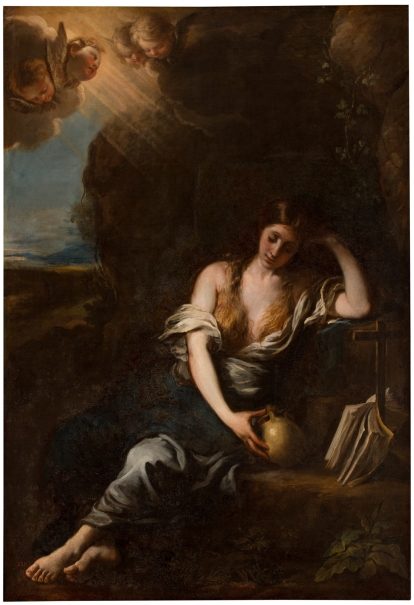
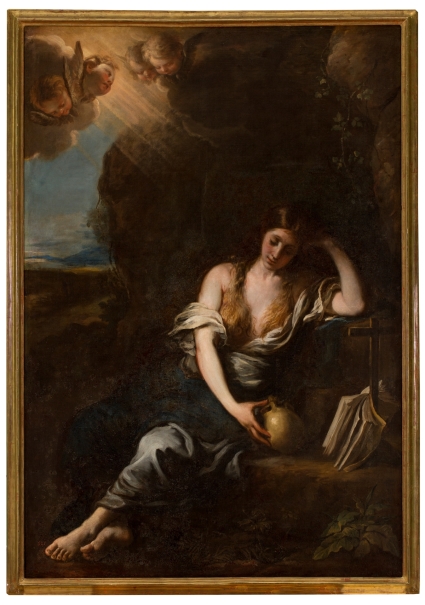
Mary Magdalene in the desert
1675 - 1680. Oil on canvas.On display elsewhere
The general composition of the work derives from prototypes by Carreño de Miranda, such as the painting in the academy of Saint Ferdinand in Madrid, signed and dated 1654. However, the inclined position of the head and the introspective gaze are taken from the master´s earliest version, from 1647, now in the Museo de Bellas Artes of Asturias. On the other hand, some details, such as the skull, in perfect opposition to the saint´s head, or the book with open pages under the crucifix, are practically identical to those of the Magdalen in the Museo Casa Natal of Jovellanos in Gijón. Ruiz signed and dated this painting in 1670. The modelling of the flesh and the fabrics, especially the arm holding the skull and the shirt, depicted with tight and close brushstrokes, and the winged heads in the upper left corner, are closer to Ruiz´s works than those of Cerezo, whose brushstrokes are always looser and more broken. The saint´s head, although it differs from the model most commonly used by Ruiz, with a plumper face, reappears in the Virgin of the Rosary with Saint Dominic in the parish church of Saint Rose of Lime in Venta de Baños (Palencia). This canvas was signed as the king´s painter, that is, after 1689. Due to its style, The Magdalen in the Museo del Prado should be considered a relatively early work by the painter, still close to the style and models of his master Carreño. However, it should be painted later to the version in the Museo de Gijón and to another, in a private collection, with a composition more similar to this one, attributed to Carreño, but which should also be considered by Ruiz.
Zapata Fernández de la Hoz, Teresa, Francisco Ignacio Ruiz de la Iglesia (1649-1703) en el Museo del Prado: revisión y nuevas atribuciones. Boletín del Museo del Prado, Museo del Prado, 2013, p.82-95 [84 f.3]