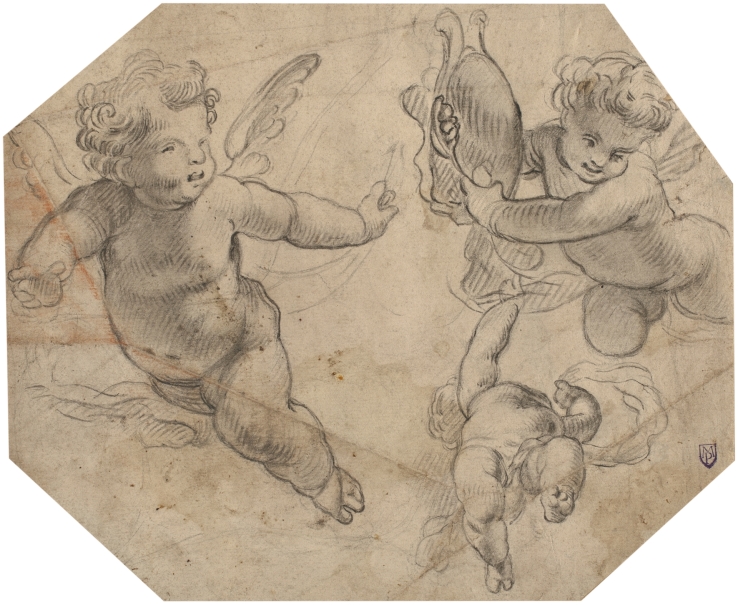
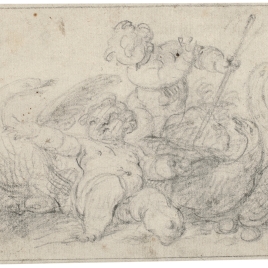
Three Flying Cherubim
1685 - 1690. Pencil on laid paper.Not on display
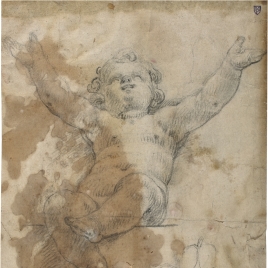
Even though it cannot be considered one of the artist’s most successful works, the drawing Three Flying Cherubim should certainly be attributed to him. The winged angel on the left holds in his left hand a humeral veil that is very lightly sketched and that seems to extend to the lower register, where another angel (rendered with forced foreshortening) holds in his left hand another humeral veil that covers his body. The little angel on the left resembles the one holding the scapular in the painting Our Lady of Mount Carmel Delivers the Scapular to a Knight of Santiago, currently held in a private collection. It also recalls of one of the figures in the drawing Two Children in the Air in the National Library of Spain. The nature of the drawing and the finished aspects of the figures indicate that they were neither part of a preliminary study nor studies for a painting devoted to the Immaculate Conception in particular. Instead, as Pérez Sánchez suggests, they form a repertoire of angelic figures gathered by the artist from his own works to be employed in other compositions. This was a usual working method employed by the painter. The way in which he modelled the volumes – by using short, slightly curved strokes with the same colour pencil – shares similarities with that used in the little angels that appear in the National Library drawings Two Children in the Air (mentioned above) and Two Pairs of Flying Children. Nevertheless, the drawing preserved in the Prado is a little rougher in execution. In addition, the eyes, nose and mouth of the figures are drawn in the same way. This can be observed when comparing the face of the angel holding the mirror with that of one of the two angels on the left in Two Pairs of Flying Children.
Zapata Fernández de la Hoz, Teresa, Francisco Ignacio Ruiz de la Iglesia (1649-1703) en el Museo del Prado: revisión y nuevas atribuciones. Boletín del Museo del Prado, Museo del Prado, 2013, p.82-95 [89 f.16]