Male Head
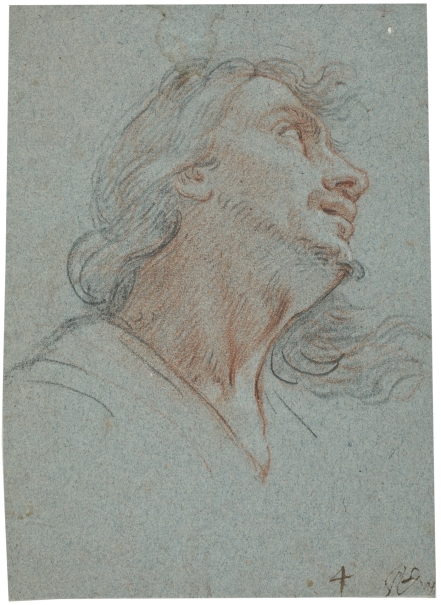
Ca. 1688. Black chalk, Red chalk on blue laid paper.Not on display
The drawing depicts a male head, raised and in right profile. The figure has a pleading expression, a short beard and long hair that partially covers his ear and cascades over his left shoulder, as if blown by the wind. The face and neck are executed almost exclusively in red chalk that has been applied with soft, blended strokes. Black pencil is solely used for occasional touches, namely those used to sketch the beard or underline the shadows in the character’s eyes, nose and mouth. The hair and the shoulders have been drawn with black chalk. The figure is the same model employed by the artist for the central figure in the painting of The Calatrava Martyrs of Alarcos – which was produced for the convent of the Concepción Real de Calatrava in Madrid – even though this figure is in profile and faces the opposite direction. The commission in 1686 of the painting for the high altar of said convent marked the definitive recognition of Ruiz de la Iglesia. It narrates the episode of the beheading of the members of the Order of Calatrava when, surrounded by the Muslims three days after their victory at Alarcos on 20 July 1195, they went out into the open, unarmed, flying the banner of the Order and offering their bodies. The main figure, the standard bearer, is about to have his throat slit when he looks up to heaven where the Virgin and Child and their angels are awaiting the martyrs with crowns and palm branches. The importance of the commission, the size of the canvas, the complexity of the composition and the number of figures must have compelled the artist to prepare the scene in detail as well as to make various preparatory drawings. Among these, this magnificent Male Head may be included as an example, whose features, expression and hairstyle are identical to those of the figure on the canvas.
Zapata Fernández de la Hoz, Teresa, Francisco Ignacio Ruiz de la Iglesia (1649-1703) en el Museo del Prado: revisión y nuevas atribuciones. Boletín del Museo del Prado, Museo del Prado, 2013, p.82-95 [88 f.12]