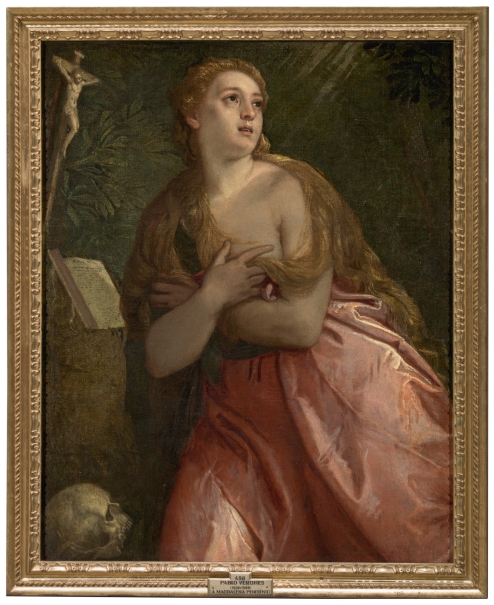
Penitent Magdalen
1583. Oil on canvas.Room 043
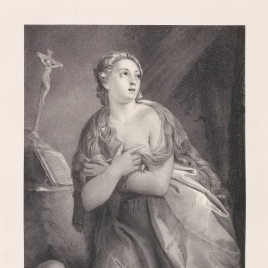
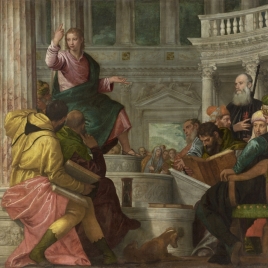
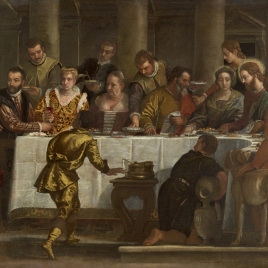
Paolo Veronese`s Penitent Magdalene, 1583, reflects the change occurring in Venetian religious painting around 1580. On one hand, the new order of priorities imposed by the Council of Trent (1545-63) emphasised subjects such as the Eucharist, penitence and the martyrdom of the saints. On the other, the Inquisition began to zealously protect decorum in the treatment of sacred subjects. Veronese had already experienced this rigour in 1573, when he appeared before the Inquisition to justify certain liberties in his setting of the Feast in the House of Levi, 1573 (Galleria dell`Accademia, Venice). While all painters adjusted their work in response to these demands, each did so in their own way. Veronese chose to abandon the sumptuous theatricality of his earlier compositions in favour of a more intimate and tranquil spirituality. He changed formal aspects of his work, progressively simplifying his compositions and introducing a darker palette and sketchier style. The new works had a focused, emotional content made all the more powerful by the stripping away of accessory details that would only have distracted believers.
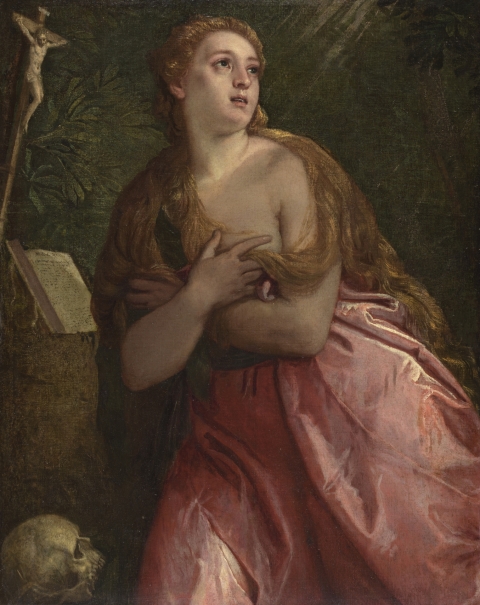
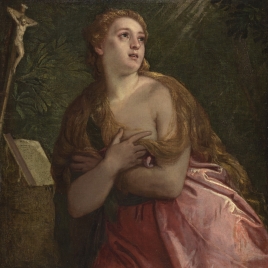
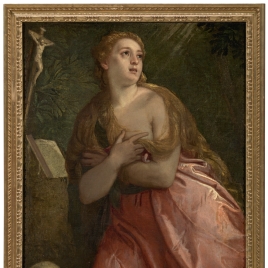
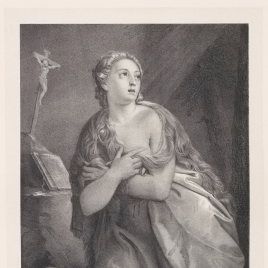
All of this is visible in the present Magdalene, which is resolved with a considerable economy of means. A crucifix, a skull, a book and a few branches are all Veronese needed to set the scene, and while the palette is still rich in bright colours, the canvas is imbued with a tranquillity resulting from the celestial light illuminating the saint`s serene visage. She is shown at the moment of revelation and her emotion is visible in her tremulous lips and upturned gaze. In L`arte de Cenni (1616), Giovanni Bonifazio offers the following description: Occhi volti al cielo. Quando si prega, overo si ringratia Dio si rivoltano gli occhi al Cielo (Turn your eyes to heaven. When you pray, and give thanks to God you turn your eyes to Heaven). Mary Magdalene accepts the will of God with sincere humility, placing her open right hand on her bosom in a common gesture from religious paintings whose prototype is the figure of the Virgin Mary in depictions of the Annunciation. The tears of repentance and devotion that run down her cheeks are especially significant. According to Saint John Chrysostom, they wash away sin and are the outer manifestation of the contritio (contrition) necessary for the confesio (confession) that leads to satisfaction, the three stages of the sacrament of penance, a cornerstone of Catholic dogma.
The Inquisition`s emphasis on decorum in the treatment of sacred subjects is also visible in another aspect of this painting. During the Renaissance, Mary Magdalene was depicted with an eroticism that provoked the criticism of orthodox sectors that viewed such depictions as more likely to awaken desire than prompt contrition. Here, despite the saint`s beauty, Veronese covers her with a silken robe that barely reveals one shoulder, and a part of her bosom is chastely covered with her hands and hair. He thus hides much more of her anatomy than in earlier versions, such as that in the collection of the National Gallery of Canada, Ottawa.
Carlo Ridolfi saw this painting at the residence of the French ambassador to Venice in 1648. It is not listed among the works of Charles I of England, but that is where the Count of Fuensaldaña purchased it for Luis de Haro. It entered the Spanish Royal Collection by way of Queen Elisabeth Farnese (1692–1766) and appears in the 1746 inventory of the Royal Palace of La Granja, Madrid, and the 1794 inventory of the Palace of Aranjuez. It entered the Museo del Prado in 1819.
Falomir Faus, Miguel, 'Paolo Veronese. Penitent Mary Magdalene'. Italian masterpieces from Spain's royal court, Museo del Prado, National Gallery of Victoria Thames & Hudson, 2014, p.84