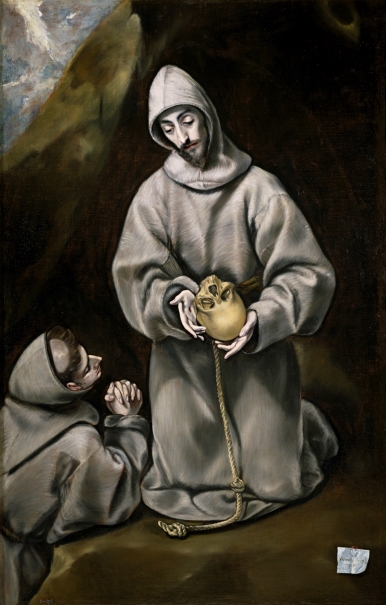
Saint Francis of Assisi and Brother Leo meditating on Death
1600 - 1614. Oil on canvas.On display elsewhere
Sheltered in a cave, Saint Francis of Assisi kneels thoughtfully while holding a skull in his hands bearing the stigmata. The saint kneels on a sort of stone pedestal that elevates him above Brother Leo. To the right of the saint, Brother Leo is also depicted kneeling and foreshortened. He is praying while contemplating the skull, the object that centres the composition. The two monks wear the grey Franciscan habit and cover their heads with a tight hood. A spectral light surrounds the figures, in stark contrast to the chestnut background of the grotto, which opens up to the exterior in the upper left corner where a small fragment of a stormy sky can be discerned.
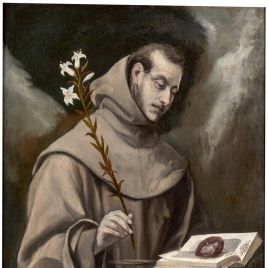
El Greco was undoubtedly the artist who best constructed an image of the ascetic, meditating saint. He focused on the final episodes of the Franciscan’s life, representing him with a sharp face and an emaciated body in a baggy, somewhat miserable habit. The saint is represented as such in this canvas that illustrates the retreat of Saint Francis of Assisi in 1224 on Mount La Verna in the Italian valley of Casentino. There, Saint Francis experienced episodes of stigmata and the vision of the torch. These events suit a figure that Franciscan literature tried to turn into a second Christ, as they are imitations of the Christian vigil in Gethsemane. After receiving the stigmata, the saint reflects on his approaching death. This key theme in Counter-Reformation culture is emphasised by the prominence of the skull, which becomes the very centre of the composition and relates to the recommendations of Saint Ignatius of Loyola in his ‘Spiritual Exercises’. On some occasions, it has been compared with the meditative vision of Hamlet. In any case, the meditative and hermit-like treatment of Saint Francis links it to the traditional iconography of other saints such as Saint Jerome and the Magdalene.
Ruiz Gómez, Leticia, El Greco en el Museo Nacional del Prado: catálogo razonado, Madrid, Museo Nacional del Prado, 2007, p.120-124