The Veil of Saint Veronica
1586 - 1595. Oil on canvas.Not on display
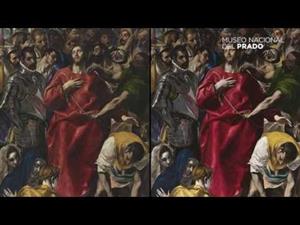
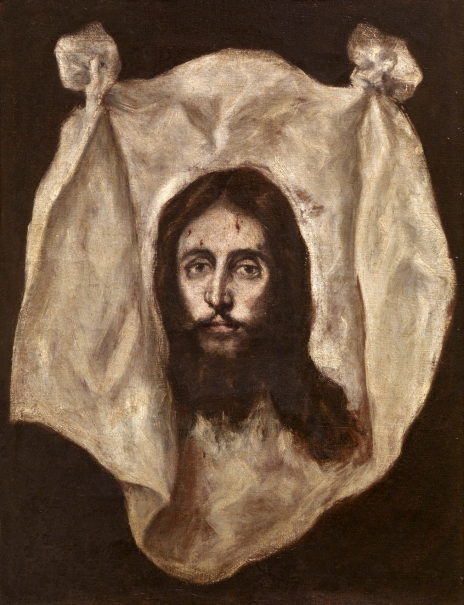
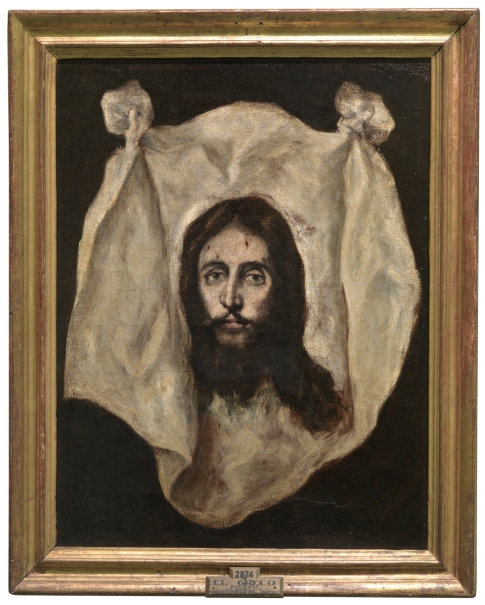
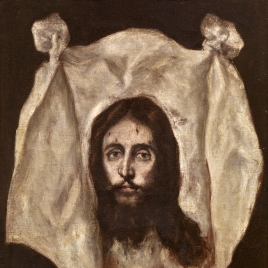
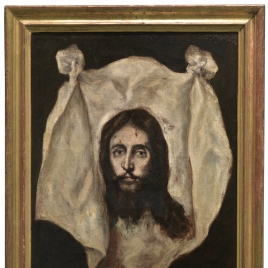
El Greco executed various versions of the Holy Face on the Veil of Veronica, an iconographic motif that became very popular at the end of the Middle Ages. According to the story that developed during the medieval period, on His way to Calvary a woman offered Jesus a white cloth to wipe the sweat and blood from His brow, and the features of His face became imprinted on the cloth. There is no biblical account of this event, although the story may be remotely connected to the woman who is healed by touching Jesus´ garment in Luke 8:43-48 and who, in one of the apocryphal gospels, is called Veronica, though this episode is not related to the Passion. Rather, the connection between the name Veronica and the legend of the veil, appears to have more to do with wordplay: the name may be a personification of the cloth itself, a vera icona or true image of Christ´s features, constructed in blood and sweat and a symbol therefore of the human nature of the Son of God. Some compositions present the figure of the woman holding up the cloth imprinted with the face of Jesus; others present only the veil. El Greco painted both types of image. (There is a record of him having worked, for instance, on a Veronica with angels, an unfinished painting that is listed in the inventory of the artist´s possessions after his death in 1614, a reference that suggests a connection with a print from 1513 by Albrecht Dürer, whose engravings were very important in El Greco´s work). The canvas in the Museo del Prado derives from a painting that El Greco executed for the central altarpiece of the church of Santo Domingo el Antiguo in Toledo, painted on a wood panel and in an oval format (now in a private collection). In this painting, Christ does not wear a crown of thorns, though traces of blood are present. His facial features -a serene expression with an intense gaze that recalls Byzantine models- reflect the precedent of El Greco´s The Disrobing of Christ 1577-79 (also known as El Expolio), in the Cathedral of Toledo. The panel for the altarpiece in the Toledo church was situated fairly high above the viewers, an atypical placement for such an image, which would usually be hung closer to the level of the viewer, allowing the faithful to kneel before the image or even kiss it. By contrast, this canvas -from a parish church in Móstoles, near Madrid- was recorded in 1787 as hanging on a pillar. The Veil of Saint Veronica varies from the original panel in Toledo, principally owing to its rectangular format. It must have been painted soon after the original, but before that work was hung in the Church of Santo Domingo el Antiguo. The two paintings also differ in terms of the quality of execution. While the first is entirely the work of El Greco, his workshop was involved in the creation of this canvas: it has been executed more summarily and is less nuanced, though it maintains a hypnotic capacity to attract the viewer´s gaze. During the Spanish Civil War, this canvas was moved to the Museo del Prado, and acquired by the Spanish State in 1945 (Ruiz, L.: Portrait of Spain. Masterpieces from the Prado, Queensland Art Gallery-Art Exhibitions Australia, 2012, p. 120).