Saint John the Baptist and Saint John the Evangelist
1600 - 1610. Oil on canvas.On display elsewhere
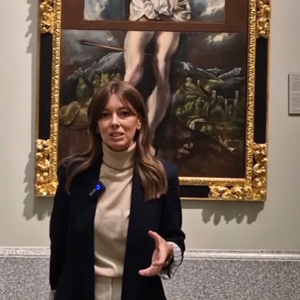
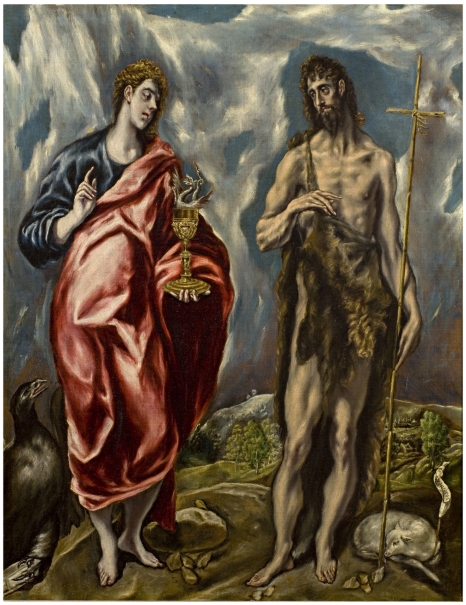
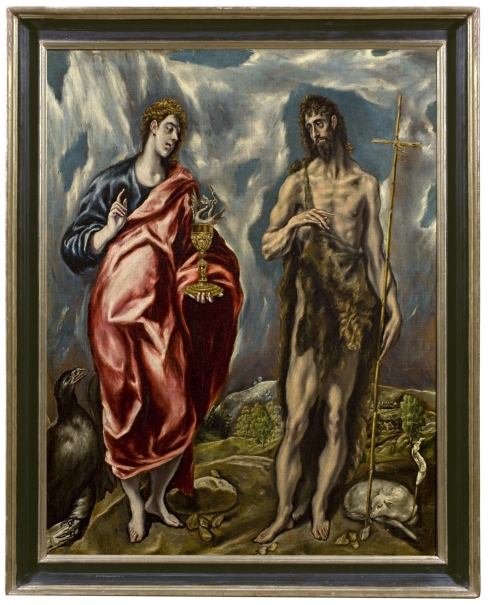
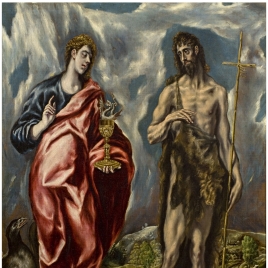
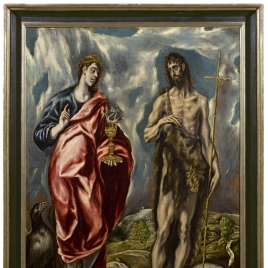
Amidst a rocky landscape and under the threat of a stormy sky, Saint John the Evangelist and Saint John the Baptist are depicted in the foreground and as though they were in dialogue. Each appears with the garb and attributes of his own traditional iconography: the Evangelist is a callow youth wearing a blue tunic and a large pinkish cloak and blessing the chalice from which a little dragon emerges – a reference to the attempted poisoning from which he escaped unscathed. Very close to him, perched on the right side of the floor, is the eagle that distinguishes him as the author of one of the canonical gospels. The apostle turns his head to his left, towards John the Baptist, the last of Christ’s prophets and the first saint of the New Testament. The man considered to be the forerunner of the Messiah is covered with the camel´s skin he wore during his retreat in the Judean desert, where the physical ordeals he suffered gave him an ascetic and emaciated appearance. He is also accompanied by two Christological symbols: the cross of reeds and the lamb with the phylactery that would signify (the usual inscription is not entirely perceptible) the redemptive status of Jesus Christ: AGNUS DEI.
Summarily depicted in the distance, there is a landscape of rolling hills with some trees and a large sketched-out building to the right of the Baptist, probably an image of the monastery of El Escorial, it has been said. The cloudscape becomes enveloping forms that surround the two figures: a disquieting shadow around the Baptist and a vertical aborrascamiento (vertical squall), as Camón referred to it, when placed around the Evangelist.
Ruiz Gómez, Leticia, El Greco en el Museo Nacional del Prado: catálogo razonado, Madrid, Museo Nacional del Prado, 2007, p.135-139