Sketch of a cupola interior
XVIII century. Grey-brown wash, Black chalk on laid paper.Not on display
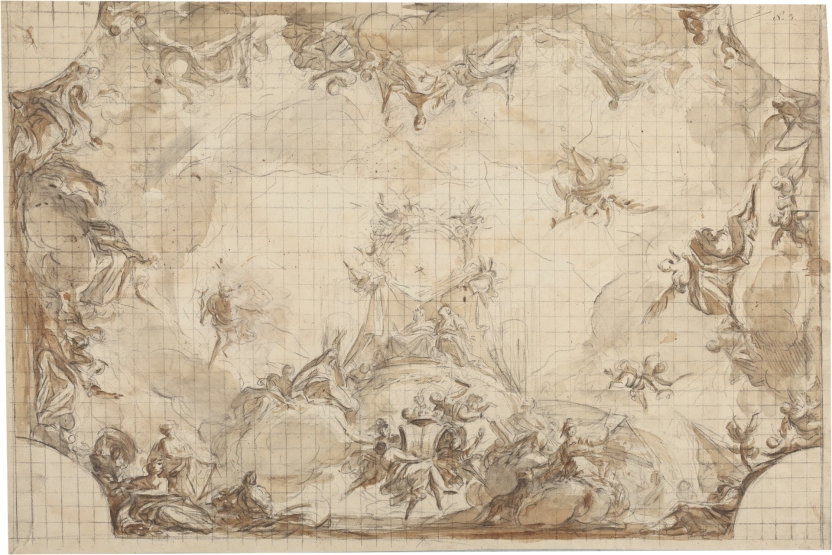
This is a preparatory study for a sketch of a cupola interior. A canopied throne and a crown of palm leaves held by children are in the centre of one of the larger sides. A female figure approaches a matron (?) seated on the throne. In the lower area, a veiled figure embraces a cross (Faith), and underneath it, flying angels hold a crowned coat of arms. On the opposite side, in the centre, three seated female figures can be perceived, who appear to be the three major arts (Painting, Sculpture and Architecture). On one of the shorter sides, Time can be seen seated. His back holds up the book that History, winged, is writing. On the other side, we see a crowned female figure who possibly represents the Spanish Monarchy. Other allegories, as well as flying mercury and fame, are in the corners.
It is closely related to one of the ceilings of the Palacio Real, the so-called Salón de la Cámara oficial (Hall of the Official Chamber), for which the Museo de Valencia keeps a three-dimensional sketch as a model. In this hall, the Apotheosis of Hadrian crowned by the Glory is depicted. He is surrounded by allegories alluding to Spain, his homeland. The drawing is vague, as if it were a first idea or an analogous composition with a different central motif intended for its adaptation to a still unspecified destination. The side groups generally coincide with the fresco, even in some details such as Time and History, identically resolved.
This drawing is characteristic of Maella’s ornamental style, still abundantly reminiscent of Corrado Giaquinto and Giordano, rather than Mengs’ coldness. Nevertheless, his style appears to correspond to those of works made earlier than 1797, when the fresco was painted. It is most likely a drawing from an earlier date, some of the elements of which he would later make use during a more neoclassical phase.
Pérez Sánchez, Alfonso E., Catálogo de Dibujos. Vol. III. Dibujos Españoles, Siglo XVIII. C-Z, Madrid, Museo Nacional del Prado, 1977, p.71