Still Life with Artichokes, Flowers and Glass Vessels
1627. Oil on canvas.Room C
This magnificent painting once belonged to Diego Mexía Felípez de Guzmán, Marquis of Leganés, in whose collection it was inventoried in 1655. This collection of nearly 1300 paintings comprised works by some of the most important European painters of the time, including a great number of Flemish still lifes and genre paintings. Van der Hamen was represented by nine still lifes, probably acquired after the artist´s death, whose great quality testifies to the discerning taste of their distinguished owner.
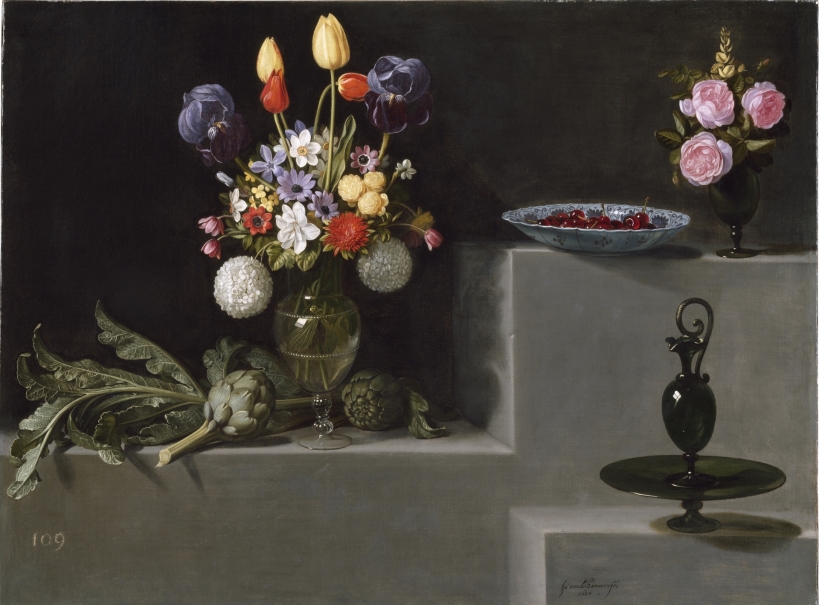
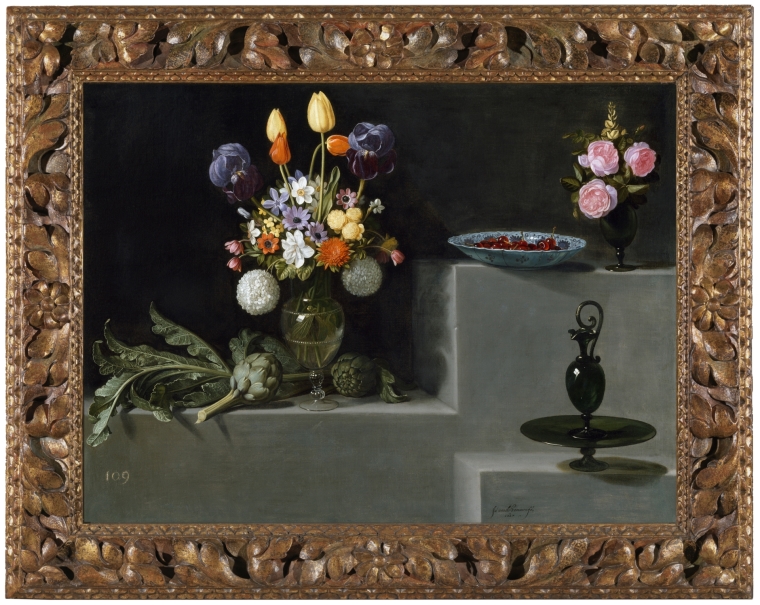
In the painting, the main subject, a large glass vase of flowers, is accompanied by a smaller glass vase with pink roses on the uppermost surface. The larger vase of flowers presides over two artichoke heads and their leaves, the contrast between these two faces of Nature being intentional; the beauty of the flowers is enhanced by the presence of the more commonplace green vegetable below them, and the senses of sight and smell are pitted against the sense of taste. Van der Hamen has given the same painterly attention to all of the motifs, however, drawing and modelling the leaves of the artichokes with as much attention to detail as the blooms themselves. The flowers are painted with the artist´s customary finesse; each bloom is carefully painted and the rose petals are modelled using thin glazes of red lake over white.
One of the features of Van der Hamen´s still-life painting for which he was best known lay in the depiction of expensive luxury glassware, such as the pieces represented here. A tone of elegant refinement is set by these motifs, as well as by the imported ceramic bowl, which appealed to the taste of Van der Hamen´s socially distinguished and cultivated clients. The artist appears to represent accurately the stems and leaves of the flowers through the glass vase, as well as the reflections of the studio window on its surface and light passing through the water. The green glass ewer and stand is a beautiful luxury object in itself and, standing as it does in the foreground and directly above the artist´s signature, also represents a tour de force of the artist´s skill in painting this transparent, reflective material. In this picture, Van der Hamen appears to have been more interested than usual in his still-life paintings in the representation of cast shadows, that here acquire a fascinating abstract presence.
Part of the compelling beauty of this picture depends on its spare composition of relatively few still-life elements, a quality that is so different from contemporary still-life painting in Italy and the Netherlands. The impression that the objects have been observed directly from nature is so powerful that the viewer forgets how unlikely it was that they were all present in front of the artist when he painted the work. The still-life elements rest on the different levels of a stepped stone ledge, with a lower attached ledge in the foreground, in a form of composition that Van der Hamen developed in his later paintings. These ledges gave the artist greater scope to create intriguing compositions than the window frame that he inherited from the still lifes of Juan Sánchez Cotán (1560-1627) and allowed him to invent complex asymmetrical interrelationships between the elements staged at different heights and planes in the picture. In this painting, forms and voids are harmonised with great subtlety. It is unlikely, however, that the stone ledges existed. Van der Hamen appears rather to have painted the still-life elements individually on a surface other than the ones depicted in the picture. This is shown, for instance, by the marked inconsistency in the drawing of the highest surface, the lines of whose front edge, interrupted by the plate of cherries, do not match up. Nor has the artist described the material quality or detail of these surfaces, that are painted with a thin coat of a neutral grey tone and show only a token damage in the corner of one of the vertical planes. In this way, the surfaces remain a stage for Van der Hamen´s artistic performance in the still-life elements, that are the real focus for his extraordinary naturalism (Text drawn from Cherry, P.: Spanish Flower Painting in the Golden Age, Museo Nacional del Prado, 2002, pp. 88-89).