Suerte de Varas (Lancing the Bull)
Ca. 1855. Oil on canvas.Room 061
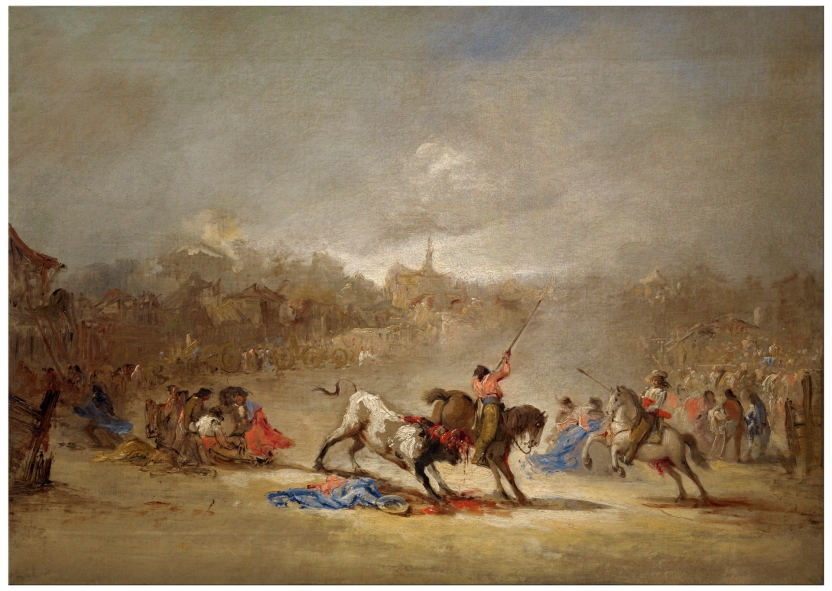
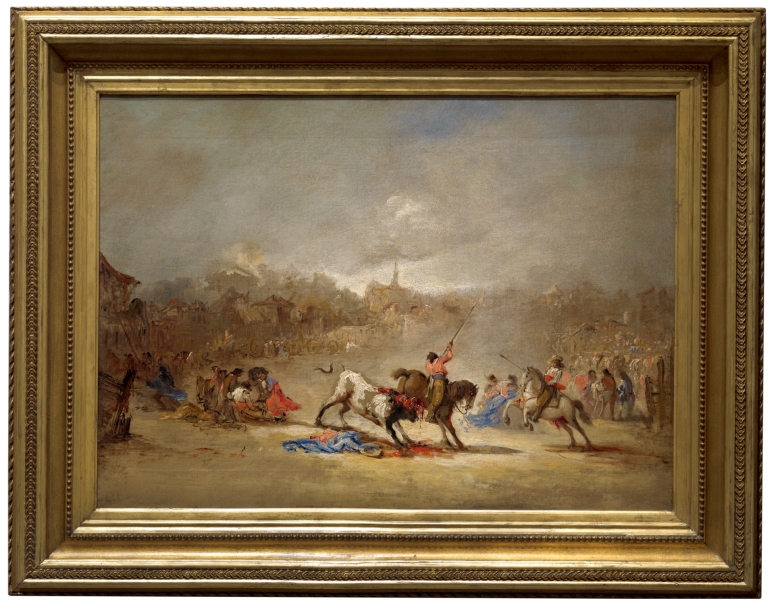
Among the multiple sources of inspiration that Eugenio Lucas found in Goya’ works, bullfighting played a very substantial role in his painting career. As a bullfighting connoisseur and friend of bullfighters, he reflected his knowledge of that activity in a plethora of paintings of the widest variety, ambition and interest, always with the energetic and passionate approach that characterized his personal style, with a vibrant, sketchy touch that already marked him in his time as the most legitimate follower of Goya’s language among the limited clientele that appreciated his work in the mid 19th century. The present work is a splendid example of that facet of Lucas’s art. It depicts a bloody episode in which a fierce, wide-horned bull that has already gored the bullfighter -attended at the left by his retinue- does the same to the horse on which the picador attempts to carry out the suerte de varas, gutting the animal and drawing abundant blood. Another picador on horseback gallops over to help his colleague, while the rest of the assistants attempt to distract the bull with their capes. The bullfight takes place in a large, village plaza with carts and other barriers set up in a circle to form an improvised bullring.
This is one of Eugenio Lucas’s richest bullfighting paintings, both in the atmospheric and panoramic conception of the scene, and in its technical treatment. The brushstrokes are extraordinarily free, and the very summary presentation is resolved with a modern approach that eschews the meticulous description customary in other similar works by Lucas. Most of the figures are suggested with just a few very light scratches, while others are defined with heavy impastos in order to mark the highlights and touches of color that concentrate all of the composition’s expressive strength in the main group. The architectural landscape is treated in the same way, reflecting Lucas’s mastery of that genre. The sky and houses are practically abstract, and the priming shows through in some places. In bullfights, the suerte de varas is carried out when the picador from the bullfighter’s retinue attempts to stab the bull in the fleshy part of the back with a pike or vara in order to weaken or provoke his attack. Until well into the 20th century, this part of the bullfight was carried out without any protection for the horse on which the picador rode. This led to the death of many horses by goring, as Lucas so dramatically depicts here (Text drawn from Díez, J. L. in: El siglo XIX en el Prado, Museo Nacional del Prado, 2007, pp. 142-144).