The Bivouac
1640 - 1650. Oil on panel.Room 077
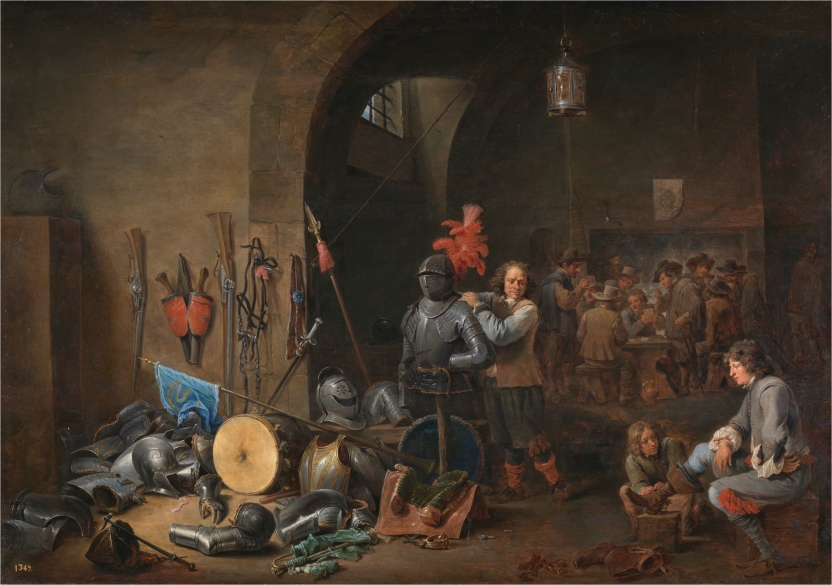
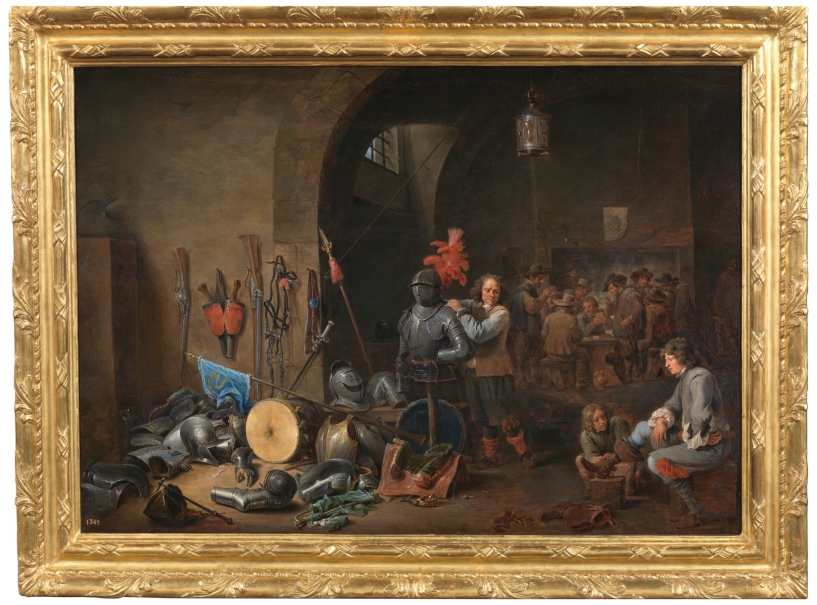
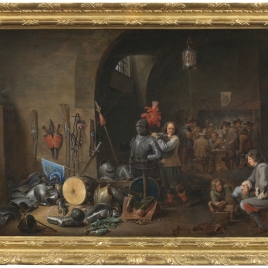
Of the artists who painted war scenes in the 17th century, none was as interested as David Teniers II in capturing images from behind the lines. With his customary tactile rigor, he depicts a plethora of military objects lying in the foreground with no apparent order and a handful of figures hanging cuirasses or helping their colleagues to remove their footgear. At the same time, he draws on one of his habitual compositional resources to depict the protagonists of war -the soldiers- in the distant middle ground. Smoking, drinking or chatting, they appear distracted from the customary fighting. In these works, he repeated certain motifs over and over again, including the scratched cuirass, the armor on a hanger and the snare drum whose smooth head acts almost like a luminous counterpoint or mirror to revive the light that bathes the composition from the left. The cellar light typical of his famous indoor settings brings a uniform tone to the scene, broken only by touches of color and the multiple reflections of the metal surfaces. In fact, metal weapons are the visual protagonists of this work, and they constitute a magnificent still life. Teniers’ skill is clear in their depiction, as the artist was able to study such arms meticulously in the armory of the Brussels court, where he was a chamber painter. And those elements always have the sense of vanitas that is inevitably linked to still lifes, as they indirectly allude to the fleeting nature of life in the context of war, violence and death. Moreover, weapons themselves are related to force and power, and thus, like scepters and crowns, they can be interpreted in terms of their brief and ephemeral value. It is not surprising that this painting arrived in Spain in the mid 17th century, given the relevance of its military subject matter and the growing interest in cabinet scenes popularized by Teniers. By 1666, it was listed in the Galería del Cierzo, which was one of the most representative halls at Madrid’s Alcázar Palace. There, it hung alongside Velázquez’s Triumph of Bacchus (P1170), which offers the same naturalist and everyday reading of human existence. It was also accompanied, however, by esthetically sophisticated works such as Annibale Carracci’s Venus, Adonis and Cupid (P2631) or Guido Reni’s Hippomenes and Atalanta (P3090), which were the Royal Collection’s leading new acquisitions at that time. This group of works eloquently exemplified the specific value still assigned to both pictorial creation and military action (Text drawn from Pérez Preciado, J. J.: El arte del poder. La Real Armería y el retrato de corte, Museo Nacional del Prado, 2010, p. 128).