formularioRDF
The itinerary <em>TITULORECORRIDO</em> has been successfully created. Now you can add in works from the Collection browser
<em>TITULOOBRA</em> added to <em>TITULORECORRIDO</em> itinerary

Close Continuar a ficha de la obra Continuar a ficha de la obra
02-06-2026
Guido Reni

Calvezzano, Bologna, Emilia-Romagna, 1575 - Bologna, Emilia-Romagna, 1642

See author's file

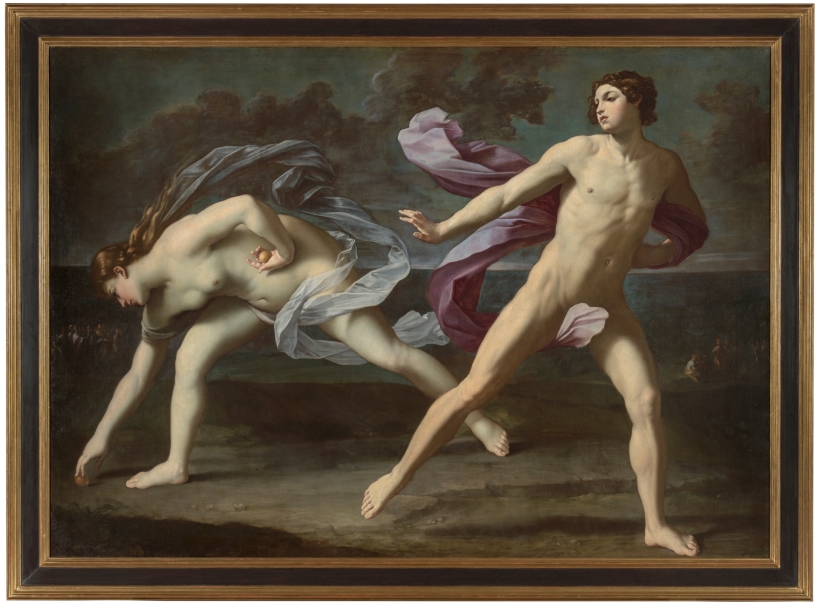
Hippomenes and Atalanta

1618 - 1619. Oil on canvas.
Room 026

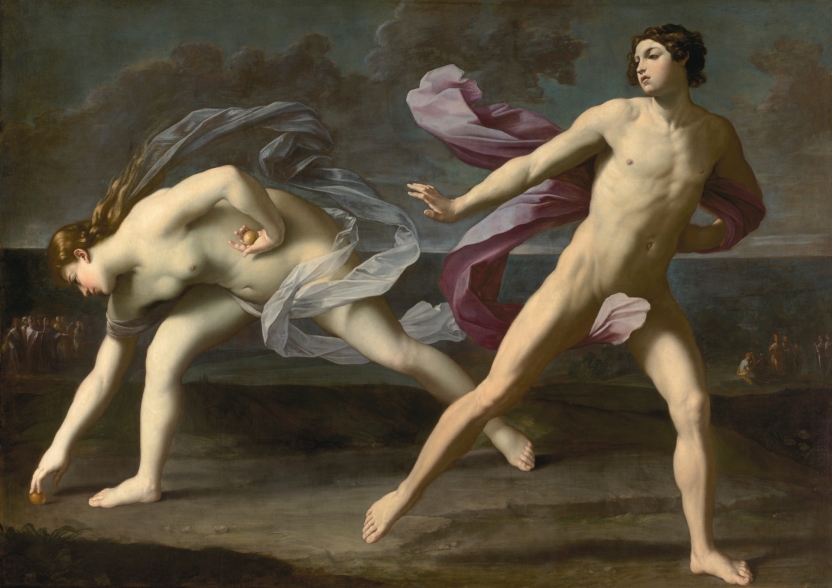
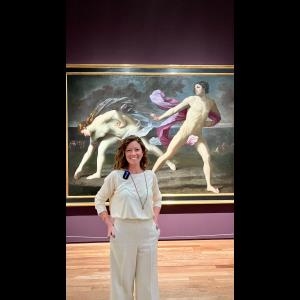
The painting depicts a scene from the classical myth of Hippomenes and Atalanta as recounted in Ovid’s Metamorphoses (Book X, verses 560–707). The episode had already been narrated by earlier writers – among them Hesiod, Sophocles, Euripides, and Apollodorus – whose accounts, though differing in minor details, were essentially the same.

The young Atalanta, daughter of King Schoeneus, had been warned by an oracle that marriage would be her undoing. Her childhood had not been easy, having been abandoned in the woods by her own father, who refused to have a female heir. There, nursed by a she-bear sent by the goddess Diana, she survived until she was rescued by hunters. Having resolved to devote her virginity to Diana, she steadfastly refused to marry; at her father’s insistence, however, she later agreed to receive suitors. But she established one harsh condition: as a swift runner herself, she would only marry the man that could beat her in a race, demanding that unsuccessful suitors be put to death. Young Hippomenes, great-grandson of the god Neptune, who had gone to watch the contest, fell in love with Atalanta at first sight. He therefore urged the maiden to race against him, arguing that – since he was descended from the gods – this would be a real challenge for her. Even so, aware of the difficulty and the risk involved, Hippomenes appealed for help to Venus, goddess of love and beauty, who devised a stratagem by which he could win the race. The goddess gave him three golden fruits, brought – depending on the version of the myth – either from the mythical Garden of the Hesperides or from Venus’ own garden on Cyprus. Hippomenes should drop the fruits one by one in the course of the race to distract his beloved rival, thus enabling him to overtake her. For her own part, Atalanta had also felt some stirring of desire for the youth, and even as the race started was perhaps not unwilling to be outrun. Whenever Atalanta drew level with him, Hippomenes dropped one of the fruits at her feet, duly distracting her. Reni chooses to focus on the crucial moment just before Hippomenes drops the third apple (hidden behind his back), which Venus made much heavier than the rest. The youth thus gained the lead which would ensure his final victory, allowing him to claim Atalanta as his wife. The lovers’ story, however, was to end in tragedy: as Hippomenes was taking Atalanta to his home, the couple was seized by a fit of passion and stopped to make love in a temple devoted to Cybele, thereby arousing the wrath of the goddess. In divine punishment, they were turned into lions, forever doomed to draw the chariot of the deity whom they had offended.

Since Ovid’s Metamorphoses was almost certainly the main literary source for Reni’s interpretation of the myth, his composition may conceivably owe something to prints made for illustrated versions of that writer’s famous account, including one by Antonio Tempesta (1555–1630) for an edition published in Amsterdam in 1606, which – like Guido’s painting – is notable for its marked diagonals. He may also have seen the title page of Atalanta fugiens (1618) – a complex book of emblems, alchemy, and music by the German physician Michael Maier – the lower portion of which depicts the race. This book, published at around the time Reni’s painting is thought to have been produced, sparked such fierce controversy in Italy due to its heterodox message that it had to be republished immediately with a reinforced Christian reading. In both prints, however, the position of the two figures is inverted with respect to the painting.

In the coastal landscape stretching out behind Hippomenes and Atalanta, land and sky each occupy half the canvas. Groups of figures placed at either edge of the central area would appear to represent, respectively, the judges of the race and the spectators, including Atalanta’s other suitors. The recent restoration of the Prado canvas has shed new light on Reni’s treatment of the horizon and shown how the deterioration of the pigment used for the sky – enamel blue – has irreversibly darkened the composition; restoration work has also confirmed that Guido applied subtle white glazes (now mostly lost) enveloping the clouds, giving them a much more fleecy appearance. Taking into account these alterations over time, we may conclude that this was not intended to be an artificially lit piece à la Caravaggio, but rather a much brighter painting, closer in that respect to the Bacchus and Ariadne in the Roland Römer collection. This view is borne out by the only known early copy of the work, a small-format painting on copper (Gallerie degli Uffizi, inv. 1890 no. 9983), although it lightens the composition somewhat radically. Two strips of canvas have been added to the left and lower edges of the Madrid painting. Though not added by the artist himself, they were painted at an early stage. Both are now covered by the new frame that accompanies the painting, thus enabling the viewer to appreciate the master’s original work.

Technical studies of the Madrid Hippomenes and Atalanta performed at the Museo del Prado on the occasion of this show have revealed that Reni’s execution was, from the outset, both highly confident and precise. This is confirmed by the infrared reflectogram, which suggests that the artist may well have used a preparatory cartoon or ‘veil’; if so, it must also have been used in the Capodimonte version (no. Q 349), where only the figure of Hippomenes is apparently very slightly displaced with respect to its Prado counterpart. Debate has long raged among Reni scholars as to which of the two is the ‘original’. The technical research mentioned earlier, as well as a visual comparison with the Naples canvas, would appear to confirm Stephen Pepper’s view that the Madrid version is the ‘original’, though this does not rule out the possibility that the Capodimonte canvas is an autograph repetition by Reni himself, produced some time later. Pepper dates the Prado work to 1618–19, based on a comparison with contemporary pieces which he regards as closely related, such as the Labours of Hercules cycle in the Louvre, while he believes that the Capodimonte version was painted in around 1625.

García Cueto, David, 'Guido Reni. Hippomenes and Atalanta'. In: Guido Reni, Madrid, Museo Nacional del Prado, 2023, p.313-320 nº 61

Multimedia

Technical data

Imagen del carrusel
Imagen del carrusel

Related artworks

Inventory number
P003090
Author
Guido Reni
Title
Hippomenes and Atalanta
Date
1618 - 1619
Technique
Oil
Support
Canvas
Dimension
Height: 206 cm; Width: 279 cm
Provenance
Collection of Marquis Giovan Francesco Serra, Milan, 1656; Giuseppe Serra, Naples, 1664; acquired that year by the 3rd Count of Peñaranda for Philip IV; Royal Collection (Galería del Cierzo at the Real Alcázar, Madrid, 1666, no. 176; saved from the fire at the Real Alcázar, 1734; Casas Arzobispales, Madrid, 1747; court painter's workshop at the Palacio Real Nuevo, Madrid, 1772, no. 94; Casa de Rebeque, Madrid, 1794, no. 94; Sala Reservada at the Real Academia de Bellas Artes de San Fernando, Madrid, 1817; Museo del Prado, 1827)
Entry date
1827

Bibliography +

Malvasia, Carlo Cesare, Felsina Pittrice.Vite Dei Pittori Bolognesi., I, Domenico Barbieri, 1678, pp. 116.

Inventario Palacio de Madrid. Adiciones a las Relaciones Generales de 1686. Galería del Cierco, VI, Madrid, 1686, pp. nº5083.

Inventario Real Palacio de Madrid. Pinturas que se hallaron en las Bóvedas de Palacio, VI, Madrid, 1734, pp. 25.

Inventario Real Palacio de Madrid. En la primera sala de este oficio., VI, Madrid, 1747, pp. 20.

Inventario Real Palacio Nuevo de Madrid. Estudio de D. Andrés de la Calleja, pintor de cámara de su majestad., Madrid, 1772, pp. nº13314 (94).

Inventario Real Palacio Nuevo de Madrid. Pinturas existentes en la casa de Rebegue al cargo de D. Francisco Bayeu, Inventarios Reales en 12 volúmenes y un índice, 1794, pp. nº14329 (94).

Ponz, Antonio, Viage de España: en que se da noticia de las cosas mas apreciables, y dignas de saberse, que hay en ella, VI, Atlas, Madrid, 1794; ed. facs. 1972, pp. 57.

Sánchez Rivero, Angel, Viaje de Cosme III por España (1668-1669) Madrid y su provincia, Imprenta Municipal, Madrid, 1927, pp. 36.

Brenna, Arne, Guido Reni 'Heracles and Achelous' and its Hellenistic Prototype, The Burlington magazine, 97, 1955, pp. [152].

Heinz, Günther, Studien über die Anwendung des Helldunkels in den werkwn Guido Renis, Jahrbuch der Kunsthistorischen Sammlungen in Wien, 51, 1955, pp. 189-213 [206].

Hess, Jacob, 'Zum still Guido Renis und bermerkungen zum katalog der ausstellung in Bologna', Zeitschrift für Kunstgeschichte, 19, 1956, pp. 180-198 [181].

Pérez Sánchez, Alfonso E., Pintura italiana del S. XVII en España, Universidad Fundación Valdecilla, Madrid, 1965, pp. 168-171.

Hess, Jacob, Kunstgeschichtliche Studien Zu Renaissance Und Barock, II, Edizioni Di Storia e Letteratura, Roma, 1967, pp. 205 / lám.5.

Dükers, Alexander, Guido reni. Beiträge zur interpretation seiner tafelmalerei, Münster, 1967, pp. 36,59,64,70.

Pérez Sánchez, Alfonso E., Pintura italiana del siglo XVII. Exposición conmemorativa del ciento cincuenta aniversario de la fundación del Museo del Prado, Ministerio de Educación y Ciencia, Madrid, 1970, pp. 462.

Schleier, Erich, Pintura italiana del siglo XVII: zur Jubiläumsausstellung des Prado im Casón del Buen Retiro in Madrid, Kunstchronik, 23, 1970, pp. 345.

Garboli, C; Baccheschi, E, L' opera completa di Guido Reni, Milan, 1971, pp. 97f. cat.84b.

Onieva, A. J., La Mitologia en el Museo del Prado, Offo, Madrid, 1972, pp. 32.

Sánchez Cantón, Francisco Javier, Museo del Prado. Catálogo de las pinturas, Museo del Prado, Madrid, 1972.

Baccheschi, Edi, La obra pictórica completa de Guido Reni, Noguer, Barcelona.Madrid, 1977, pp. 97-98 nº 84.

Brandi, Cesare, Disegno della pittura italiana, Saggi ,626, Turin, 1980, pp. 479.

Gnudi, Cesare, L'Ideale Classico. Saggi Sulla Tradizione Classica Nella Pit, Edizioni Alfa y Otros, Bolonia, 1981, pp. 23.

Lucie-Smith, Edward, El Arte del Desnudo, Poligrafa, Barcelona, 1982, pp. 75.

Pepper, Stephen, Bacchus and Ariadna in the Los Angeles County Museum, The Burlington magazine, 1983, pp. 70 / lám.5.

Pepper, Stephen, Guido Reni. A Complete Catalogue of His Works With An Introd, Phaidon, Oxford, 1984, pp. 236 nº 59.

Burke, Marcus B., Private Collections of Italian Art in Seventeenth Century Sp, I, University Microfilm International, Nueva York, 1984, pp. 116.

Museo Nacional del Prado, Catálogo de las pinturas, Museo del Prado, Madrid, 1985, pp. 541.

Pierre, José., Introduction a la Peinture., Editions Aimery Somogy, 1985, pp. 41.

Brown, Jonathan, Velázquez: pintor y cortesano, Alianza Editorial, Madrid, 1986, pp. 243 / lám.303.

Fumaroli, Marc, 'Une peinture de méditation. À propos de l' Hippomène et Atalante du Guide', Flammarion.Edizioni Dell'Elefante, Roma, 1987, pp. 337-358.

Argan, Giulio Carlo1909-1992, Renacimiento y barroco, II, Akal, Madrid, 1987, pp. 298 / lám.273.

Vannugli, Antonio, La colección del Marqués Giovan Francesco Serra, Boletin del Museo del Prado, 9, 1988, pp. 33-43.

Fernández Miranda y Lozana, Fernando, Inventarios Reales Carlos III, 1789-1790, Patrimonio Nacional, Madrid, 1988, pp. 78.

Ebert-Schifferer, S., Guido Reni Und Europa. Ruhm Und Nachruhm, Nuova Alfa Editoriale, Frankfurt, 1988, pp. 129-133.

Pepper, D. Stephen., Guido Reni: l' opera completa, Istituto Geografico De Agostini,, 1988, pp. 242 f. cat.59.

Emiliani, Andrea, Guido Reni. 1575-1642, Nuova Alfa Editoriale, Bolonia, 1988, pp. 74 y 76 (obra relacionada).

Brown, Jonathan, La Edad de Oro de la pintura en España, Nerea, Madrid, 1990, pp. 204 / lám.190.

Museo Nacional del Prado, Museo del Prado. Inventario general de pinturas (I) La Colección Real, Museo del Prado, Espasa Calpe, Madrid, 1990.

Borchhardt-Birbaumer, Brigitte, "Freizügigkeit und Mässigung' Zur antikenrezeption in den werken Guido Renis', 44, 1991, pp. 131-158 [139,145 cat 16].

Buendía, José Rogelio, El Prado. Colecciones de Pintura, Lunwerg Editores, Barcelona, 1994, pp. 304.

Fumaroli, Marc, L'école du silence: le sentiment des images au XVIIe siècle, Flammarion,, 1994, pp. 183-201.

Bettagno, Alessandro, El Museo del Prado, Fonds Mercator Fundación Amigos del Museo del Prado, Madrid, 1996, pp. 287.

Spear, Richard E., The Divine Guido. Religion, Sex, Money and Art in the World, Yale University Press, New Haven,London, 1997, pp. 64-66 lám.13.

Brown, Jonathan, Painting in Spain 1500-1700, Yale University Press, Yale, 1998, pp. 173 / lám.223.

López Torrijos, Rosa, Mitologia e Historia en las Obras Maestras del Prado, Scala Books, Londres, 1998, pp. 22-23.

Keazor, Henry, ' Il beneficio delle statue' Antikenrezeption in Guido Renis 'Herkules-Zyklus', Artibus et historiae an art anthology, 155, 2001, pp. 137-160 [155].

Salvy, Gerard-Julien, Reni, Electa, Milano, 2001, pp. 88.

Portús Pérez, Javier, La Sala Reservada y el desnudo en el Museo del Prado, Museo Nacional del Prado, Turner, Madrid, 2002, pp. 106.

Boccardo, Piero, L'Eta Di Rubens : Dimore, Committenti e Collezionisti Genove, Skira, Milán, 2004, pp. 437.

Lleó Canal, Vicente, 'Atalanta e Hipomenes' de Guido Reni, Atrio. Revista de Historia del Arte, 10-11, 2005, pp. 141-146.

López-Fanjul, M.; Pérez Preciado, J.J., 'Historia de los depósitos del Museo del Prado en la Universidad de Granada', I, Universidad de Granada, Granada, 2006, pp. 253-276.

Colomer, José Luis, Guido Reni en las colecciones reales españolas, En: José Luis Colomer y Amadeo Serra Desfilis (dirs.), Bolonia y España. Siete siglos de relaciones artísticas y culturales, Centro de Estudios Europa Hispánica; Fundación Carolina, Madrid, 2006, pp. 221-223.

Enciclopedia del Museo del Prado, IV, Fundación Amigos del Museo del Prado, Madrid, 2006, pp. 1287.

Museo Nacional del Prado, 100 obras maestras: del Museo del Prado, Museo Nacional del Prado, Madrid, 2008, pp. 102.

Macarrón Miguel, Ana María, Historia de la conservación y la restauración: desde la Antigüedad hasta el siglo XX., Tecnos, Madrid, 2013, pp. 178.

Bernardini, Mª Grazia, 'Le radici del Barocco' En:, Barocco a Roma : La meraviglia delle arti, Skira editores, 2015, pp. 25-43 [36]. Véase p.355 n.8.

Martínez Leiva, Gloria; Rodríguez Rebollo, Ángel, El inventario del Alcázar de Madrid de 1666. Felipe IV y su colección artística, Consejo Superior de Investigaciones Científicas, Madrid, 2015, pp. 418 nº 515.

Portús Pérez, Javier, Displaying the Nude in Spain 1550-1834. The Sala Reservada, en: Splendor, Myth, and Vision: Nudes from the Prado, Clark Art Institute; Museo Nacional del Prado, 2016, pp. 50-66 [61].

Cropper, Elizabeth, Guido reni en el Prado: exito del 'Rubens italiano' de Malvasia, Abada: Museo Nacional del Prado,, Madrid, 2017, pp. 41-73 [60-73].

G. Navarro, C.; Perdices, A., La mirada del otro: escenarios para la diferencia, Museo Nacional del Prado, Madrid, 2017, pp. 63 n.15.

Pericolo, Lorenzo, 'Beyond perfection. Guido Reni and Malvasia's Fourth Age of painting', En: Carlo Cesare Malvasia, life of Guido Reni. Vol 2, Washington, 2019, pp. 1-132 [110,131 nº448].

Morselli, Raffaella, 'Una gemma antica e un disegno di Giulio Romano: rimembranze iconografiche mantovanes nell' Ariadna e nell' Atalanta di Guido Reni', En: Lo sguardo di Orione: studi di storia dell'arte per Mario Alberto Pavone, 2020, pp. 253-258.

Aurenhammer, Hans, 'Guido Reni. Hippomenes and Atalanta', In: Guido Reni: The Divine, Städel Museum,, 2022, pp. 240-241 nº98.

García Cueto, David, 'Guido Reni. Hipómenes y Atalanta', En: Guido Reni, Museo Nacional del Prado, Madrid, 2023, pp. 313-320 nº 61.

García Cueto, David, 'Guido Reni. Hippomenes and Atalanta', In: Guido Reni, Museo Nacional del Prado, Madrid, 2023, pp. 313-320 nº 61.

Morselli, Raffaella, La favole di Atalanta, La favola di atalanta. Guido Reni e i poeti, Silvana Editoriale, 2024, pp. 155-175.

Other inventories +

Inv. Testamentaría Carlos II, Alcázar de Madrid, 1701-1703. Núm. 176.
Galeria del Cierzo / 176 / Una Pintura de tres Uaras de largo y de dos de altto de la fabula de Attalantta y Pomenes de mano de Bolones Con marco negro tasada en quattroçienttos Doblones ... 400

Inv. Felipe V, Palacio Nuevo, 1747. Núm. 94.
PINTURAS EXISTENTES ANTIGUAS [...] En la primera Sala de este Oficio [...] {10313} 94 / Vna Pomenes y Atalanta original de Huido Regen de quatro varas de largo y media de caida en 18 mil reales

Inv. Carlos III, Palacio Nuevo, 1772. Núm. 94.
Estudio de don Andres de la Calleja Pintor de Cámara de su magd. [...] {13314} 94 / Otro [quadro] de Hipomenes y Atalanta de quatro varas de largo y dos de caida original de Guida Regno

Inv. Testamentaría Carlos III, Casa de Rebeque, 1794. Núm. 94.
[758] 94 / Quatro varas escasas de largo y dos y media de alto: Hipomenes y Atlanta. Guido Reni ... 30000

Academia, Sala Reservada, 1827. Núm. [s.n.].
Hipomenes y Atalanta. / [Autor] Guido Reni / [Alto] 7 [pies] 8 [pulgs.] / [Ancho] 10 [pies]

Museo Real de Pinturas a la muerte de Fernando VII, 1834. Núm. 43.
SALA RESERVADA / Cuarenta y tres. Hipomenes y Atalanta. Copia del Guido / Anónimo / Lº / 5.200

Inv. Testamentaría Fernando VII, Real Museo, Sala Reservada, 1834. Núm. 43.
CUARENTA Y TRES. Hipomenes y Atalanta. / Copia del Guido. Anónimo / L. / 5200

Inv. Real Museo, 1857. Núm. 2670.
Guido Reni / 2670. Hipomenes y Atalanta. / Alto 7 pies, 4 pulg, 6 lin; ancho 10 pies.

Catálogo Museo del Prado, 1872-1907. Núm. 273.
273.-Hipomenes y Atalanta. / Alto 2,06. Ancho 2,79.-Lienzo. / Atalanta, hija de Jasio, rey de los Argivos, era una princesa celebrada por su belleza y su extraordinaria agilidad. Entregada al ejercicio de la caza, despreciaba los amores, y para librarse de los muchos importunos que aspiraban á su mano, dijo que se casaria con el que la venciese en la carrera, con la condición de que fueran muertos los que quedasen vencidos. Muchos príncipes jóvenes habian ya perdido la vida en tal empresa, cuando se presentó Hipomenes aceptando el partido. La diosa Vénus, que le favorecía, le habia entregado tres manzanas de oro para detener con ellas durante la carrera á la veloz Atalanta. Salióle bien la estratagema, porque la despiadada pero al mismo tiempo codiciosa princesa, atraida por el deseo de...

Exhibitions +

La favola di Atalanta. Guido Reni e i poeti
Bolonia
16.11.2024 - 16.02.2025

Guido Reni
Madrid
28.03.2023 - 09.07.2023

Guido Reni. The Beauty of the Divine
Frankfurt
23.11.2022 - 05.03.2023

Reunited
Madrid
06.06.2020 - 25.07.2021

The Other’s Gaze. Spaces of difference
Madrid
14.06.2017 - 10.09.2017

Guido Reni
Bolonia
10.09.1988 - 10.11.1988

Location +

Room 026 (On Display)

Expuesto
Update date: 02-06-2026 | Registry created on 28-04-2015

Visor 360

Drag with the cursor to rotate the piece

Other works by Guido Reni

Print on demand

Print artworks available in our catalogue in high quality and your preferred size and finish.

Image archive

Request artworks available in our catalogue in digital format.

Up