The Painter Francisco de Goya
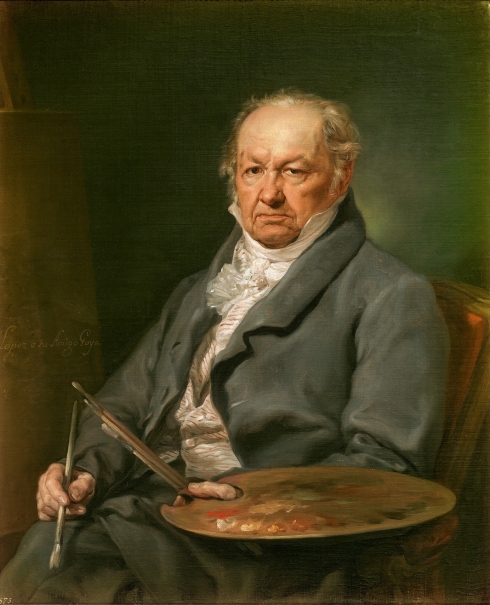
1826. Oil on canvas.Room 062A
In 1826, Francisco de Goya made a rapid visit to Madrid from his exile in Bordeaux to see to his pension as chamber painter. Valencian master Vicente López Portaña took advantage of that visit to paint his likeness, creating what is undoubtedly the most emblematic portrait of the Aragonese artist. The work was made for the Royal Museum as homage and recognition of Goya’s stature, insuring his lasting presence on the walls of the Museo del Prado. Goya posed for López sitting on an armchair with crossed legs. He wears a frock coat and greenish-gray trousers, a striped vest and a jabot. He is shown half-length, holding a palette in his left hand and a brush in his right. A canvas on an easel behind him bears the dedication. This portrait of Goya at the age of eighty is undoubtedly his most famous likeness -even more that his self portraits. Thus, it is also Vicente López’s most renowned, although this is due more to the sitter’s identity than to the canvas’s unquestionable excellence.
While it is unanimously considered López’s finest work, as well as the greatest 19th-century Spanish portrait, there is no reason to believe, or even consider the legend, that its stunning sense of aliveness is due to Goya’s own request that López leave it unfinished, eschewing the virtuosity he customarily brought to his commissioned portraits. What is both true and surprising is the vibrant and immediate freedom of the brushstrokes with which López resolves this portrait, a likeness that captures all of the energy, the complex personality and the resigned desperation of Goya as a tired old man. In fact, these elements are also present in other images of people close to Vicente López, especially artists, whom he always depicted with a totally frank pictorial language. Moreover, compared to those other portraits, the present one is among López’s most academic and conventional, due to its public function. This is visible in Goya’s rather hieratic and distant pose, his elegant clothing and the presence of his attributes as a painter.
Although the dedication might seem suggest that this portrait was a farewell present from Lopez to his friend, Goya, there is no indication that it ever belonged to the latter, as it comes from the Royal Collections and by 1828 it was already hanging in the museum’s Grand Gallery, which was then dedicated to semi-contemporary artists. As such, it must have entered the Museo del Prado immediately after it was painted. This suggests that both Goya’s pose and his clothing actually reflect López’s intention to perpetuate that artist’s image at the Museo del Prado from the very start. That, in turn, explains why he employed compositional and iconographic schemes particularly appropriate for such a special role: public contemplation among masterworks from the history of painting (Text drawn from Díez, J. L.: El Siglo XIX en el Prado, Museo Nacional del Prado, 2007, pp. 126-128).