The Triumph of Bacchus
1844. Oil on canvas.Room 061
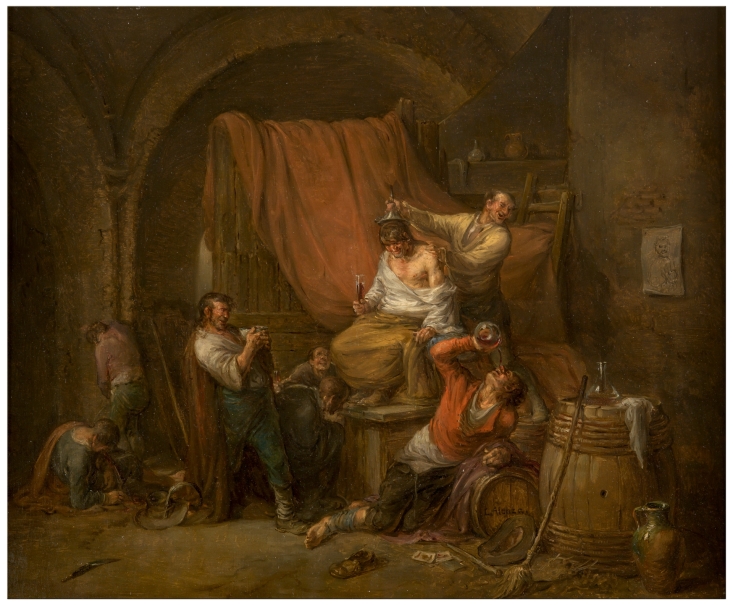
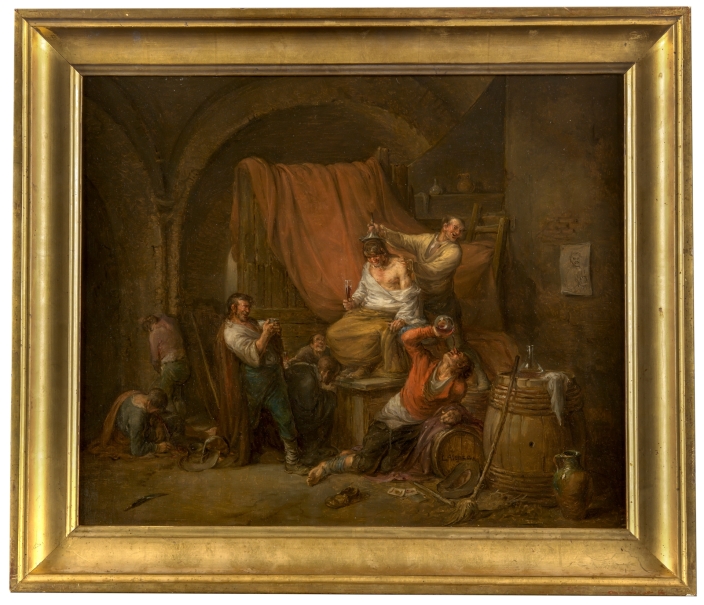
This is the companion piece for The Tooth-Puller (P007945) and was painted in the same year, 1844. It presents a clear relationship with Velázquez’s work of the same title, which Alenza had studied in the Museo del Prado. Regardless, both the extremes of inebriation and the mocking attitude of the character are much more pronounced in this painting. The painting reveals an openly popular and jocular sensibility. Eight drinking figures appear in different poses under the vaulted interior of a tavern, recalling 17th-century Flemish and Dutch genre paintings. A drinker – with his torso partially exposed in a parody of characters from classical antiquity – grotesquely crowns the central figure with a brass funnel. He is seated on a table, holding a glass of wine as a sceptre, before a large reddish cloth as if it were a canopy appropriated for his crude throne. Two kneeling men honour him as if he were the god of wine, while a standing third man holds against his chest a white crockery bowl with blue trim full of the red liquid. To his right, another man, barefoot and with loose trousers, is drinking wine from a pitcher. He lies recumbent on a barrel, the lid of which bears the artist’s signature. Akin to Goya’s expressiveness, the painter truthfully represents a drunk man urinating whilst leaning on the wall to the left and another drunk vomiting the wine he has consumed. They assume opposite positions, so that they form a kind of group that shows the consequences of intoxication.
As in other works by the same artist, there are several objects on the ground, namely an open knife, a shoe, some playing cards, and two hats. Their state of disarray stresses the impression of moral disorder in the scene. A broom – whose presence is related to its surrounding dirtiness, depicted leaning on a barrel as in Brouwer’s and Tenier’s scenes – and a large, partially enamelled clay jug in green can be found to the right of the composition. On the shelf in the background, there is a cloth, a glass demijohn, and a small jug. Those elements, along with the barrel with another jug on top of it, the wall that has lost its plastering and has visible bricks in some areas, the drawing pasted to the wall, and the own disorder of the objects placed in the ground are usual in interiors with drinkers in the aforementioned artists’ works. The light falls upon the crowned character as Bacchus, as well as upon the surrounding men’s faces, and leaves the background slightly dimly lit, like the wall, with a more diluted painting. The colour palette, comprised of ochre hues, accentuates the reds and dirty whites of the drunk’s shirts, on which we can see the shabby lines of the loose brushstrokes that highlight the vivaciousness of the scene.
Barón, Javier, 'Leonardo Alenza. The triumph of Bacchus'. The Nineteenth Century in the Prado, Madrid, Museo Nacional del Prado, 2007, p.138-142 nº.14