Twelve O’Clock
1892. Oil on canvas.Not on display
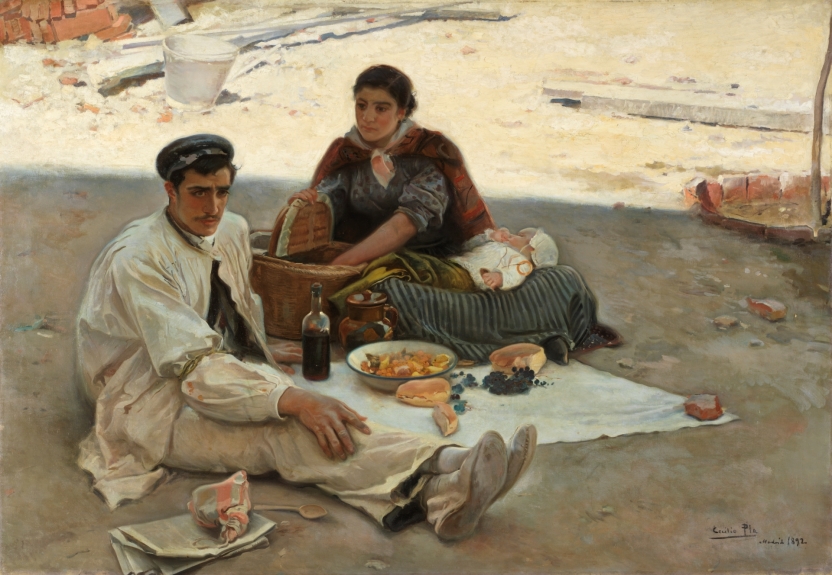
This canvas, which was awarded a second medal at the National Exhibition of Fine Arts in 1892, was Pla´s first public success in the genre of social Realism. It was in this genre which became fashionable in the last two decades of the century, that the Valencian master left some of his most significant works. However, any critical sense of his ideas always appears to be considerably filtered, and he inclines on the contrary, to the more amiable aspects in scenes of an essentially dramatic nature.
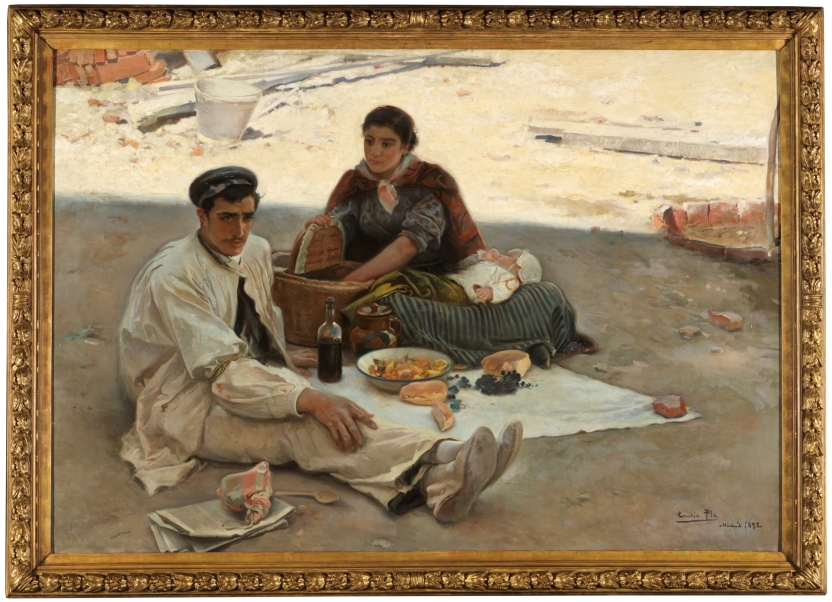
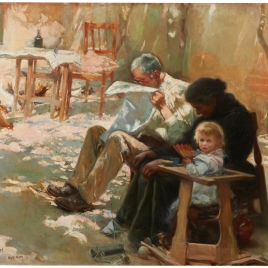
In this case, he depicts a construction worker having lunch during a midday break, as the title of the painting indicates. He is seated on the ground next to his wife, who has brought lunch to the building site. The groceries that his wife is taking out of her basket are placed on improvised tablecloth, held down with stones at the corners. Her little son, only a few months old, sleeps peacefully on her lap, one of the most beautiful fragments of the painting. They sit in the shade, sheltered from the strong midday sun, and various building materials can be seen in the background.
What in any other artist specialising in this genre would have served as a vehicle to denounce the miserable conditions of the working class, Pla transforms into a hymn to the nobility of the poorest, underlining the narrative of the scene with the inclusion of the baby. He depicts the protagonists of the lunch in humble but bright and clean clothes, only their expressions revealing any wretchedness in their condition. In these years, the painter has not yet neglected his rigorous drawing and attentive observation of nature, detailing all the elements of the composition. He attracted the viewer´s attention with details that he described in exquisite detail, such as the clay pot, the worker´s stitched espadrilles and the little boy´s teething ring.
Museo Nacional del Prado, Maestros de la pintura valenciana: del siglo XIX en el Museo, Madrid, Museo Nacional del Prado, 1997, p.178 nº35