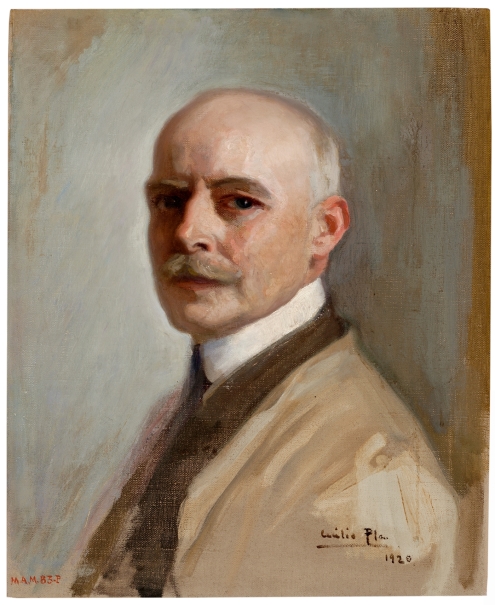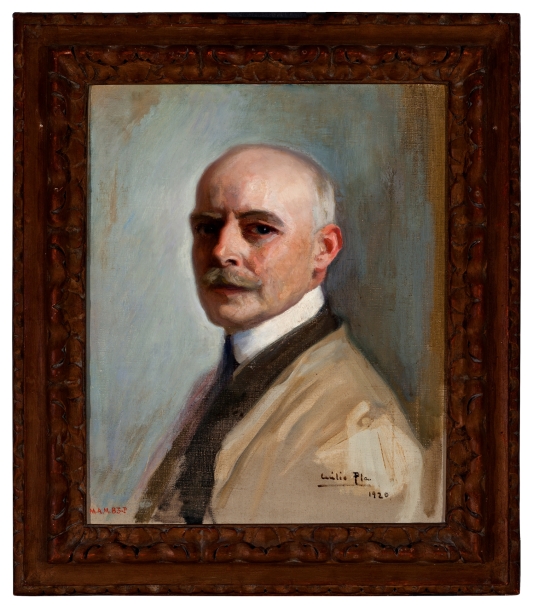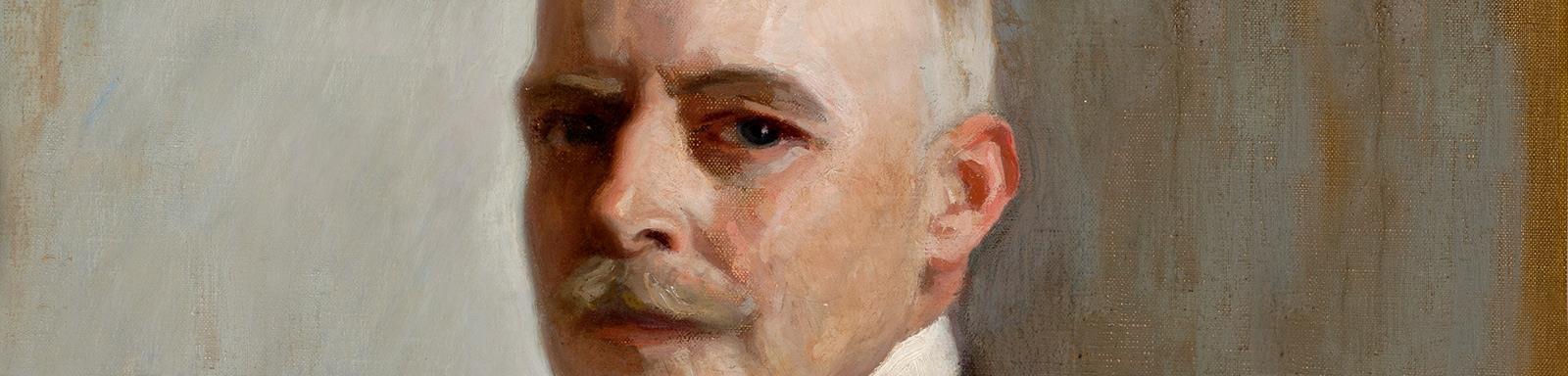
Self-portrait
1920. Oil on canvas.On display elsewhere
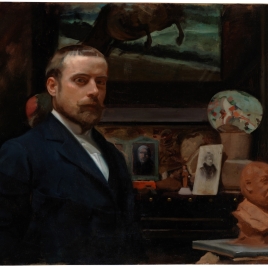
In this self-portrait, the Valencian master is depicted from the chest up, wearing a suit and the white coat he usually wore to work and to teach. The painting is executed with extraordinarily sober colours and technical frankness. His head stands out against a luminous background in violent chiaroscuro, which casts a shadow on half of his visage.
Born in Valencia on 22 November 1860, Cecilio Pla began his artistic training as a student at the Academia de San Carlos in Valencia and afterwards at the Academia de San Fernando in Madrid. He was also a disciple of Emilio Sala. Beginning in 1910, he taught Colour Aesthetics and pictorial proceedings at the Academia de San Fernando, thus replacing his master, Sala. In addition, many famous painters were among his students, including Juan Gris and José María López Mezquita. Although he was a painter with a rather expansive career, Cecilio Pla is especially considered to be the greatest exponent of modernist painting in Valencia. His elegant decorative taste always makes use of the bright, brilliant colours that characterise his school and the modernity of the settings of his compositions – which are broad and loose, with wide expanses of colour and great chromatic contrasts – make his work extraordinarily striking, even in his most conventional commissions.
Apart from this portrait, we know of another self-portrait in the Museo de Bellas Artes de San Fernando, signed in 1928. Both serve to illustrate the artist’s thoughts on the genre: ‘In portraits, we must go beyond the mere perusal of the outline (resemblance), in such a way that the portrait is endowed with something that reminds us of the character, the temperament of the sitter, that is to say, the soul: thus, the portrait will be complete, as it will have a spirit beyond the resemblance’.
Díez, J.L, Artistas pintados: retratos de pintores y escultores del siglo XIX en el Museo del Prado, Madrid, Ministerio de Educación y Cultura, Dirección General de Bellas Artes y Bienes Culturales, 1997, p.190-191 nº61