Vicente Palmaroli
1866 - 1867. Oil on canvas.Room 062A
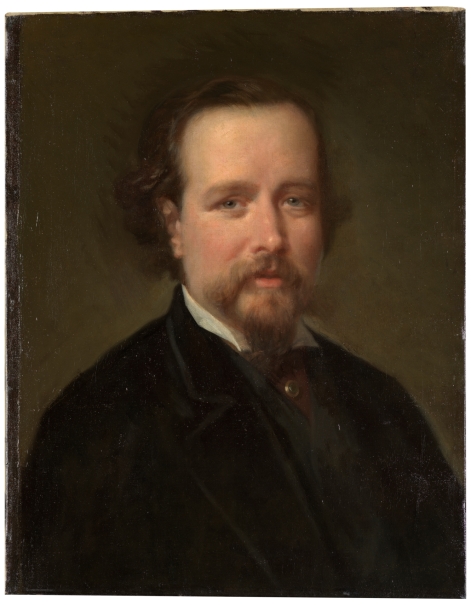
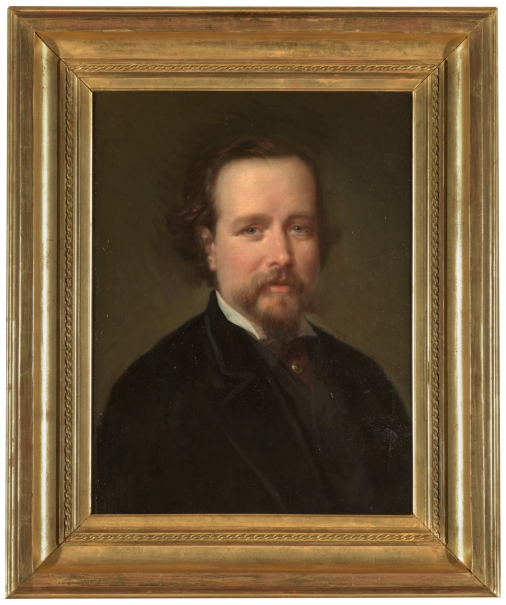
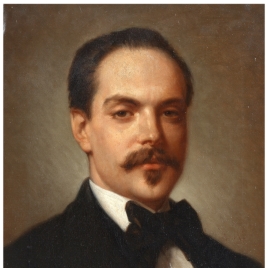
The artist depicted him in a bust portrait. His face has a large, high forehead, with eyes that convey a concealed air of jocularity, reinforced by its half-open mouth that seems about to smile. His long moustache and goatee aim to offset a certain rotundity to his of features. He also has short, wide hair on both sides of his head.
His affable face also appears in the portrait of him in the Círculo de Bellas Artes, painted in 1886 by Emilio Sala, who was a retired painter in Rome under his management.
Vicente Palmaroli (Zarzalejo, Madrid, 1934–Madrid, 1896) was a painter of both academic and professional renown. Producing a splendid and varied set of works, he held considerable status among the great figures of European academicism. He was awarded three medals from the National Exhibition of Fine Art. In 1862, he was awarded for Pascuccia and a second medal for The Five Saints, in 1867 for The Sermon in the Sistine Chapel and in 1871 for The Burials of the 3rd of May in the Moncloa Palace. They reflect the versatility of his art, depending on the genre of the plot or the type of clientele.
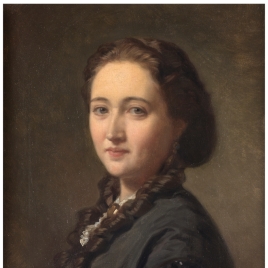
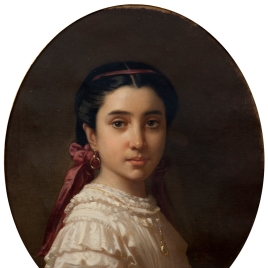
This portrait dates from 1866–1867, after his second stay in Italy and when he married Sofía Reboulet. Federico de Madrazo portrays her (P4460), with the same dimensions and also dated 1867, and dedicated it to her husband. Federico –of whom Palmaroli had been a pupil– was commissioned to paint the portrait of Sophia, while Luis de Madrazo was left to paint the portrait of the painter. This would prompt a resolution to the conflict of interests between Luis de Madrazo and Palmaroli at the National Exhibition of 1862. The jury took away the award that general opinion had rewarded Madrazo for his portraits and wanted to award Palmaroli a first medal in the portrait genre for Pascuccia.
Artistas pintados: retratos de pintores y escultores del siglo XIX en el Museo del Prado, Madrid, Ministerio de Educación y Cultura, Dirección Gener, 1997, p.114,115 nº25