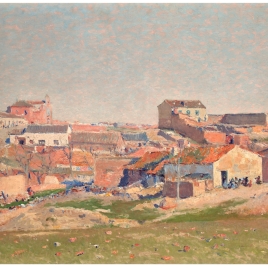
View of Madrid from the Meadow of San Isidro
1909. Oil on canvas.Not on display
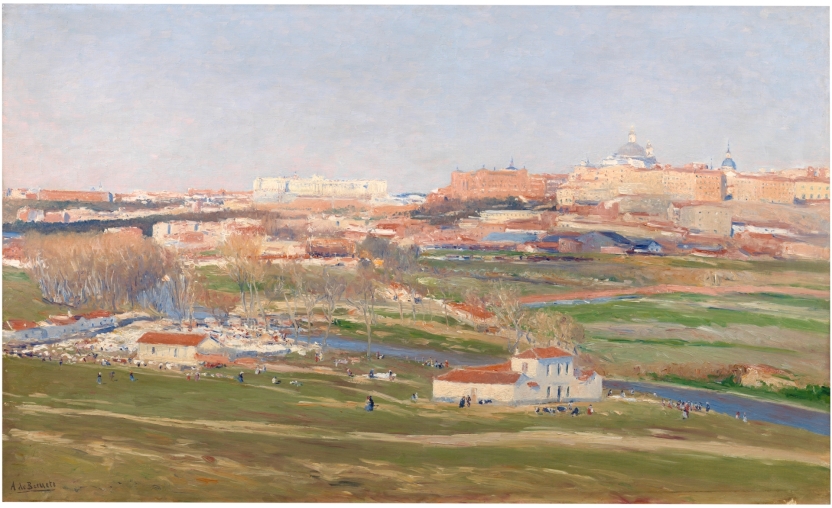
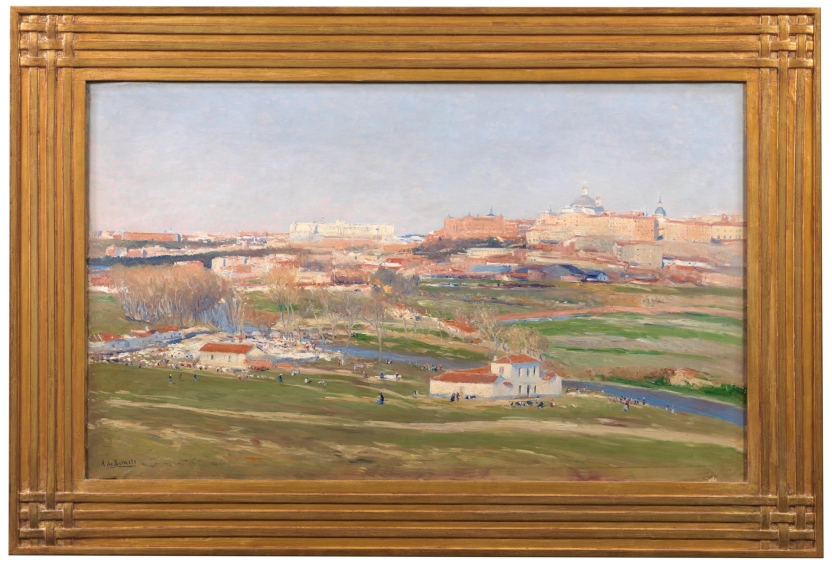
Beruete’s works often depict the outskirts of Madrid, where he habitually lived between November and June. Besides his views of the Guadarrama from el Plantío de los Infantes -the country estate belonging to his wife- he also frequently painted views of the city from the southeast, which he could easily reach from his house at number 15, calle Génova. Those settings were the most agreeable, as the Manzanares river fed a grove of poplar trees which was only dense in some places at that time. Here, it can be seen at the left of the composition. Moreover, the fact that the pilgrimage to Madrid’s patron saint was held there made it a well-known spot, and various artists had painted views of the city from there.
The meadows that run gently down to the river are resolved by the artist with broad, paint-laden brushstrokes that reflect that artist’s attention to the diversity of greens and ochers. The pilgrimage to Madrid’s patron saint was held at the meadow of Saint Isidore, in the foreground, and the area was filled with taverns and inns, as well as a few houses, which the painter depicted with total exactitude, as can be seen in contemporaneous photographs. The river was enlivened by washerwomen who worked for certain families from Madrid as well as for the Royal Palace. Their clothes, hung out to dry under the sun, appear at the left of the composition. This subject had already been explored by romantic landscape painter Genaro Pérez Villaamil and was common among realist landscape painters. Beruete captured it on several occasions from different places, although always with small figures, as they were not the central focus for him. The same was true of the animals, including the cows that appear here on the right.
Buildings played a more important role in his compositions, often as the backgrounds in his views of cities from the countryside. Here, standing out on the horizon from left to right, are the Mountain Barracks at Principe Pío, the white mass of the Royal Palace and the domes of the churches of San Francisco el Grande and San Andrés, whose depiction with accurate and precise patches of color totally integrates them into the city’s buildings. In broad landscapes like this one, the artist usually connects fore, middle and backgrounds uninterruptedly, configuring the composition in such a way that their leading features are presented at a lightly oblique angle. They are delimited only by color, with ocher on the road in the foreground, violet in the river and red in the city’s main buildings. Faithful to impressionist views and to his own sense of local color, Beruete uses brushstrokes of different shades to capture the precise light of each element in the landscape at the moment he paints it. Thus, for example, between the intense whiteness of the walls on the inn in the foreground and those of the base of the dome of San Francisco el Grande, in the background, there is an area of houses in violet and mauve shadows. In his mature years, as here, Beruete rendered the sky with spotted brushstrokes that alternate pink and blue. Below, however, he emphasizes the manner in which the pure whites and reds contrast with the green.
Like Sorolla, Beruete eschews regular strokes of the sort more frequently found among the French impressionists. His tend to be long, like those of Velázquez, whose technique he had studied in depth. In fact, Beruete actually wrote an important monographic work on that earlier artist. In his own work, Beruete obliged himself to paint alla prima, with the greatest economy of time and a precise, very summary and accurate resolution, which many Spanish critics of the period found overly fragmented. In fact, the fluidity of his execution does not lead to the dissolution of his representations, as the composition is very consistent and the chosen viewpoint generally brings out the structural character of the landscape itself, often revealing previously unnoticed aspects (Text drawn from Barón, J.: El siglo XIX en el Prado, Museo Nacional del Prado, 2007, pp. 376-377).