
Loading...
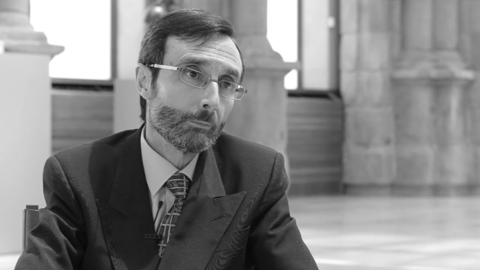
The 1960s. Hall watchmen
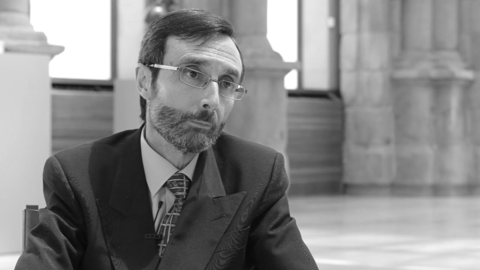
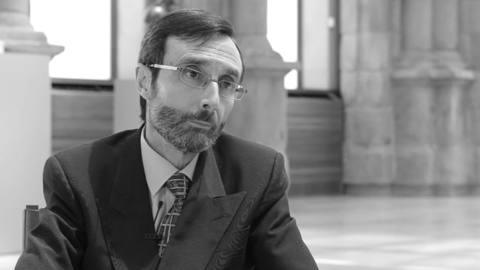
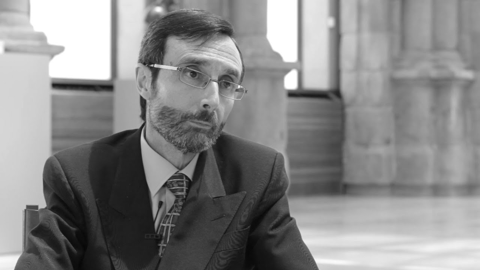
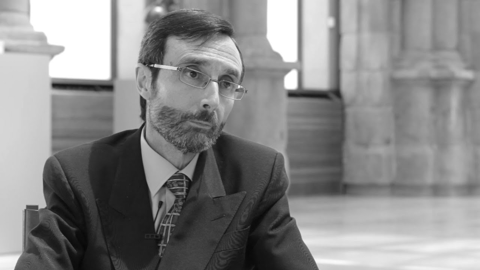
Francisco Martín Ortiz, Administrative Technician (copies), 1966-2015The 1960s. Hall watchmen
Francisco Martín Ortiz, Administrative Technician (copies), 1966-2015
Watchmen had to be in about 10 or 15 minutes before opening time, they had to be in the hall they worked in, and there were some feather dusters hidden from view that the watchmen used to dust the picture frames—not the canvas, naturally, just the frames. This dusting took place before the visitors came in. If you were in charge of three halls and there were fifty paintings, that meant you had to dust the fifty picture frames every day before the Museum opened to the public. Then, of course, the feather dusters were tucked away out of sight.
The watchmen used to wear a frock coat with buttons and some clasps up here, it was even a bit uncomfortable, and a hat. That hat, if the director came by and you were seated, you had to stand up and salute, take your hat off and salute. It wasn't a military salute, but you did have to remove your hat and greet him. On a certain occasion, I was by the lift near the Velázquez door and director Sánchez Cantón came by. I didn't realize that he was walking by and he came up to me and scolded me, telling me that when he walked by I was meant to remove my hat and salute. I apologized, I didn't notice it was him who was walking by. He was an older man and he wasn't happy about it, maybe he thought I didn't want to greet him and so he told me off.
The problem was that hall watchmen were subject to a sort of military discipline, they couldn't talk, they couldn't read, they were supposed to stand most of the time. If you were caught talking to a colleague or reading you could be penalized with extra guard duty. That meant you had to arrive at the Museum two or three hours before it opened, or you had to stay on two or three more hours in the evening. There were two shifts: the morning shift and the afternoon-evening shift. So of course watchmen didn't want to be at the Prado. Not because they didn't like the Museum: they loved it, but not the fact that they weren't allowed to read or really do anything, so they would end up leaving. They would ask for leave of absence or they managed to be transferred a Ministry… So they had to create a special corps of junior officers who would only work at the Prado Museum. That means that if you came to work at the Prado Museum there was no longer a way out, you had to stay and work here. Otherwise they would leave, they were better off working at a Ministry, where they could work as porters or messengers handing out papers, without working on Saturdays or Sundays... Here at the Prado we worked on Sundays. The Museum opened on Sundays from 10 a.m.to 2 p.m., so we only had Sunday afternoons to ourselves. There was a time when the Museum was also closed on Mondays …, but when you worked at a Ministry you knew that you wouldn't have to work on Saturdays, Sundays or bank holidays. So there was a pattern of people leaving, and they always had shortages in terms of surveillance staff, so they said, "All right, we'll create a special junior corps and that way whoever comes to work at the Museum won't be able to move anywhere else, they'll have to stay here."
In those days there were only men, no women. The only women were the director's secretary, I think there were two, three women at the sales offices belonging to the Museum, and then the cleaning ladies, who were all older. The rest of the staff were all men. In those days you could have your hair cut free of charge. The barber shop was located in a mezzanine between the upper floor and the main floor, where we changed and kept our uniforms. But then shortly after I came in, approximately in 1968, we were moved down to the main floor and we had a new changing room. There, in the new changing room, right by the sinks and in the middle was the barber's shop.
The ground floor had the lower Goya door, and of course the Velázquez door, which of course was always open … Those two doors, and then the Murillo door, which was closed because that's where the cafeteria of the Prado Museum was located… the stairwell going down to the Treasure of the Dauphin, well that was flat then and we had the cafeteria there. Where the dressing room is now is where the cafeteria bar was. The Museum employees and the copyists used to eat there, at the cafeteria bar, and the rest was for tourists.
He began to work at the Museum as an elevator operator, subsequently moving to the Copy Department as part of the administrative staff.
Interview recorded on May 21, 2015
Interview index
4 / 11-
I joined the Museum in May 1966 -
The 1960s. The Museum as a family -
The night watch and taking care of the Museum in the 1960s -
The 1960s. Hall watchmen -
Service to tourists in the 1970s -
Las Meninas opposite the mirror in Hall XV -
Goya's Majas -
Titian, Ribera, Velázquez -
The evolution of the copy service -
From 1989 to 1994 copying The Garden of Earthly Delights triptych -
Summing up 50 years
- Collective
- Gallery surveillance
- RDF
- RDF
Collective
Gallery surveillance
Conchi Montero Velasco
General Services Assistant, 1970-2014
María Teresa González Escolar
General Services Assistant, 1990-2013
Francisco Manso Guerrero
Gallery attendant and Clerical Support, 1966-1991
María Merino Cabrera
Clerical Support, 1977-2004
Theme
--
Voces del Prado