
Loading...
The evolution of the copy service
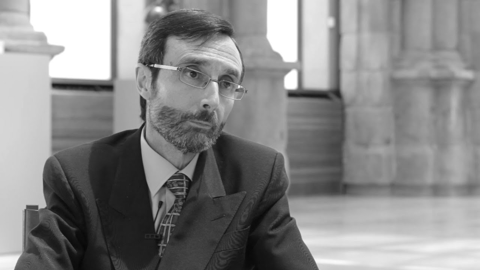
Francisco Martín Ortiz, Administrative Technician (copies), 1966-2015The evolution of the copy service
Francisco Martín Ortiz, Administrative Technician (copies), 1966-2015
If you speak to any copyist they'll tell you that they do it to learn and it's true, they learn a lot, you can learn a lot by painting. Some painters say that they're not only here to sell their copy, but I remember a young girl who told me, "Paco, I want to live from my painting, whether I sell a copy or paint something original, what I want to be able to do is sell it and make a living." She was right there, I absolutely agree. But today it's difficult to learn what you call realist, classical painting, because there aren't too many places where you can learn that.
What the Museum has done is provide those coming to paint a copy with an easel, allowing them time to paint a given copy.
In those days there was no information office, it didn't exist as such. We gave out information at the copy office. The first photocopy machine was at the copy office. In order to give out information in greater detail, we used to go through each hall, noting down all the pictures there, with their catalogue number, so that whenever somebody asked about any given picture, we knew where it was located.
The Museum used to be closed on Mondays and it was very convenient, because that way I could organize the easels and wooden frames in every hall where copyists were painting. I had a colleague who handled the easels and between the two of us we'd set them up at the places where each copyist was working, leaving it all set up so that they could start painting first thing on Tuesday morning. Not all the halls or all the paintings are available for copyists. For instance, Las Meninas cannot be copied. The same goes for the Majas. They are emblematic paintings that everybody who comes to the Prado wants to see, so of course … There were periods when there were over a hundred easels set up. Over a thousand copies were made each year. I'm talking about the early 20th century, those days … When I got here they used to make around two hundred copies a year. Now it's down to about seventy or eighty copies a year. Right now in order to make a copy you have to pay one hundred euros. Students pay less than someone who just comes by to make a copy. A self-trained painter, for instance, would have to pay a hundred euros, although it used to be fifty or sixty euros… The price has gone up because the cost of living has gone up too, so today you have to think things over a bit more. In the past a copyist could come here and make four copies a year, but now it's usually a couple or just one.
He began to work at the Museum as an elevator operator, subsequently moving to the Copy Department as part of the administrative staff.
Interview recorded on May 21, 2015
Interview index
9 / 11-
I joined the Museum in May 1966 -
The 1960s. The Museum as a family -
The night watch and taking care of the Museum in the 1960s -
The 1960s. Hall watchmen -
Service to tourists in the 1970s -
Las Meninas opposite the mirror in Hall XV -
Goya's Majas -
Titian, Ribera, Velázquez -
The evolution of the copy service -
From 1989 to 1994 copying The Garden of Earthly Delights triptych -
Summing up 50 years
- Included in themes
- The trade of copyist
- Collective
- Gallery surveillance
- RDF
- RDF
Collective
Gallery surveillance
Conchi Montero Velasco
General Services Assistant, 1970-2014
María Teresa González Escolar
General Services Assistant, 1990-2013
María Merino Cabrera
Clerical Support, 1977-2004
Francisco Manso Guerrero
Gallery attendant and Clerical Support, 1966-1991
Theme
--
Voces del Prado