Loading...
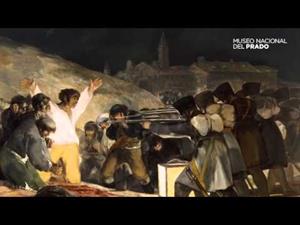
This one‑hour itinerary includes a selection of 15 masterpieces from the Prado’s Collection, spanning different historical and artistic periods. The visit begins with The Crucifixion by Juan de Flandes, an example of early sixteenth‑century Flemish spirituality. It continues with The Nobleman with his Hand on his Chest, one of El Greco’s most celebrated portraits. The route then moves on to one of the Museum’s absolute icons: Las Meninas, where Velázquez devoted exceptional effort to creating a composition that is both complex and convincing. After this, works such as Jusepe de Ribera lo Spagnoletto’s Jacob’s Dream and Goya’s The 3rd of May 1808 in Madrid bring dramatic intensity and historical depth. The itinerary also highlights key pieces from the Renaissance and the Baroque, including Fra Angelico’s The Annunciation, Raphael’s The Cardinal, and Titian’s Emperor Charles V at Mühlberg. Equally notable are works of great symbolic power, such as Tiepolo’s The Immaculate Conception and the The Garden of Earthly Delights Triptych, Bosch’s most intricate and enigmatic creation. This brief itinerary offers an in‑depth look at some of the most significant works in the Museum’s permanent collection.
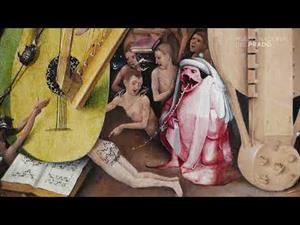
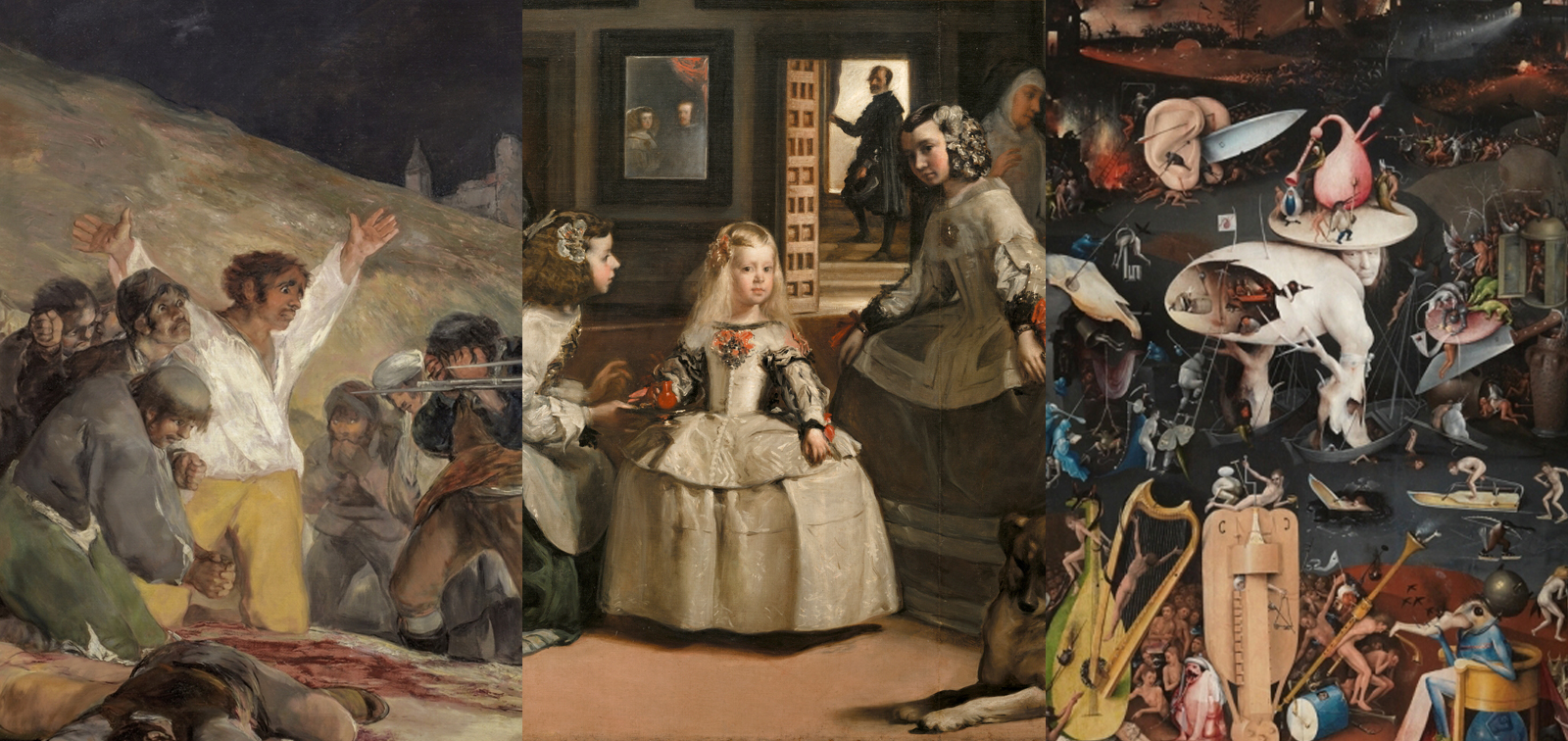
Composition featuring details from Goya’s The 3rd of May 1808 in Madrid, Velázquez’s Las Meninas, and the Hell panel of Bosch’s The Garden of Earthly Delights Triptych.
Collection
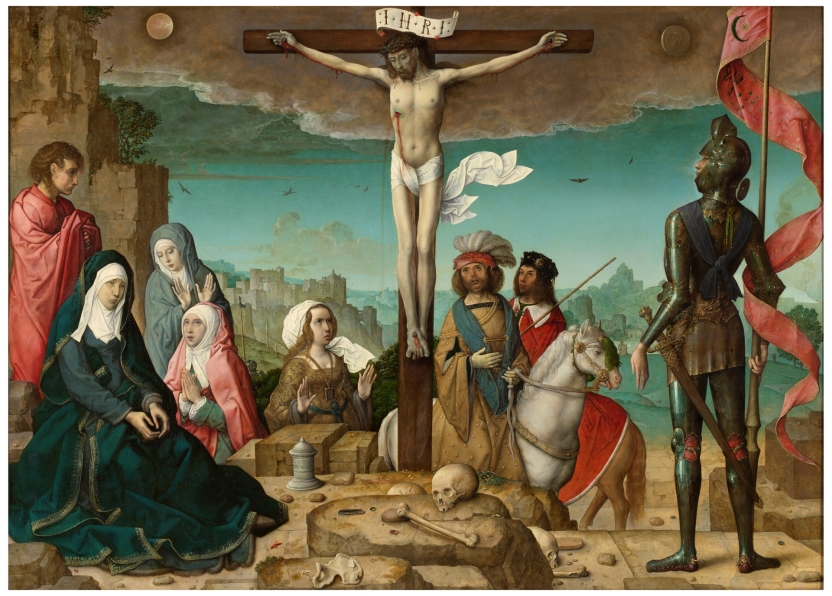

Documents at Palencia Cathedral cast light on this Crucifixion’s original location -the central row of the main altarpiece at that cathedral- and its author: Juan de Flandes (doc. 1496-1519). They also offer information about this panel between 1509, when that Flemish painter was commissioned to paint it, and 1944, when the Cathedral management sold it. Those same documents indicate that Palencia Cathedral’s current main altarpiece, which bears carvings and paintings, was commissioned by Bishop Diego de Deza (1443-1524) for what was then the main chapel and is now the Tabernacle chapel. At that time, it was not supposed to have any paintings, but instead, carvings by sculptor Felipe Bigarny (doc. 1498-1524) and architectural elements by Pedro de Guadalupe.
Room C
Collection
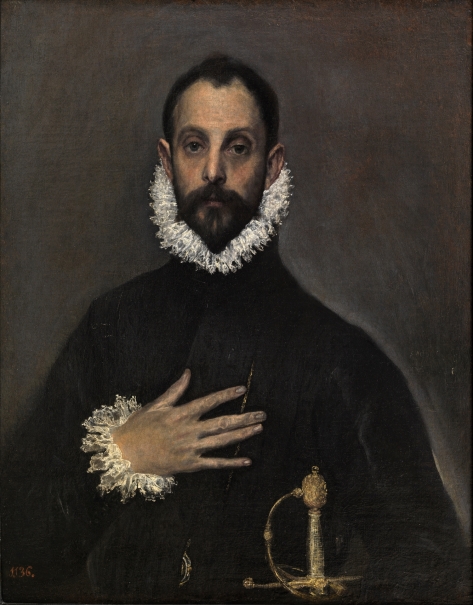

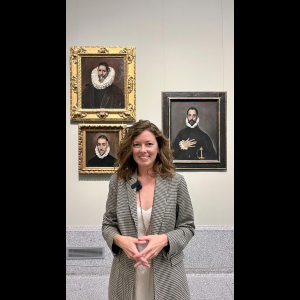
This bust-length portrait entered the royal collections as a donation by the widow of the Duke of Arco, gentlemanin- waiting, Equerry and Master of the Horse to Philip V. In his recreational estate at El Pardo, De Arco possessed a group of six portraits of gentlemen by El Greco whose provenance is now unknown.This group would come to constitute the principal holdings of portraits by the artist now in the Museo del Prado.The present canvas is one of the earliest works by El Greco painted in Spain, and the most distinctive of the six.
Room 008B
Collection
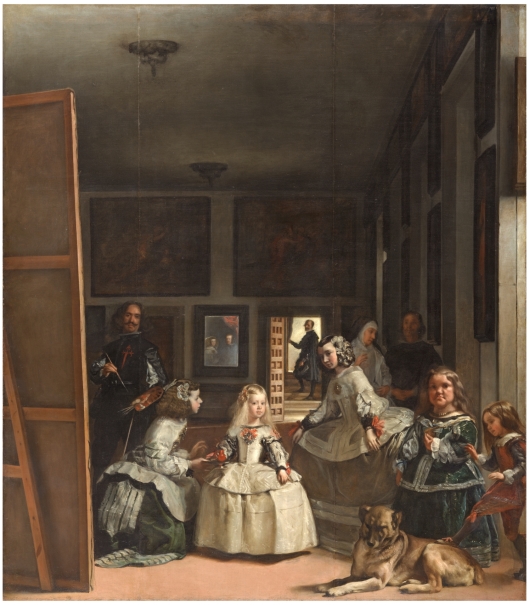

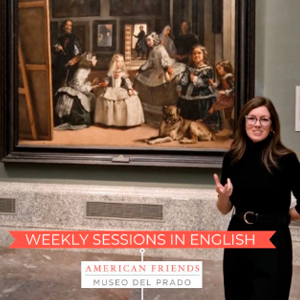
This is one of Velázquez`s largest paintings and among those in which he made most effort to create a complex and credible composition that would convey a sense of life and reality while enclosing a dense network of meanings. The artist achieved his intentions and Las Meninas became the only work to which the writer on art Antonio Palomino devoted a separate section in his history of Spanish painters of 1724, entitling it In which the most illustrious work by Don Diego Velázquez is described. Since then the painting has never lost its status as a masterpiece.
Room 012
Collection
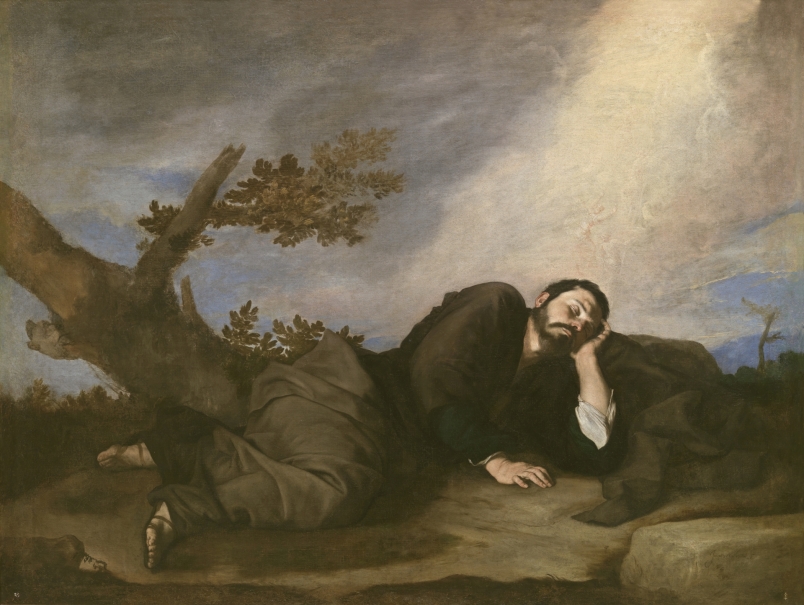

This painting tells of Jacob the Patriarch´s mysterious dream, as told in Genesis. He appears asleep, lying on his left shoulder with a tree behind him. On the other side is the ladder of light, by which the angels ascend and descend. This subject demonstrates Ribera´s skill at constructing metaphoric discourse. He uses the image of a shepherd resting in the countryside to describe one of the best-known Bible stories. The foreground view of the solidly constructed figure and the scene´s realistic features bring realism to the miraculous dream described in a ray of light under a blue and gray sky.
Room 009
Collection
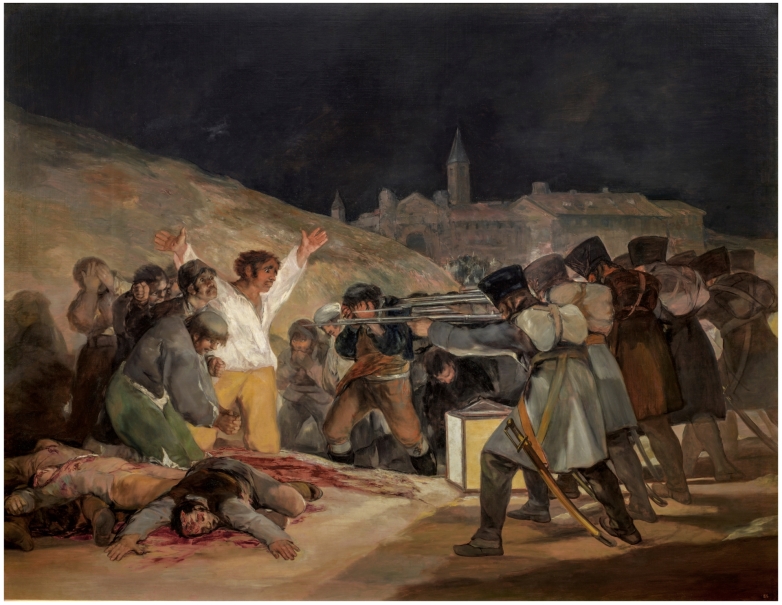

In the December of 1813, King Ferdinand VII’s return to Spain and his entry into Madrid were announced in by the Treaty of Valençay, which that year ended the Peninsular War Fernando who had been a prisoner of Napoleon in France since his own abdication in 1808, the absent king commenced his return to Spain in February of 1814, his pledge to the 1812 Constitution being the condition of his restoration to the throne. His arrival in Madrid would coincide with the first commemoration of the uprising of the people of the city against the occupying French on the 2nd of May 1808.
Room 064
Collection
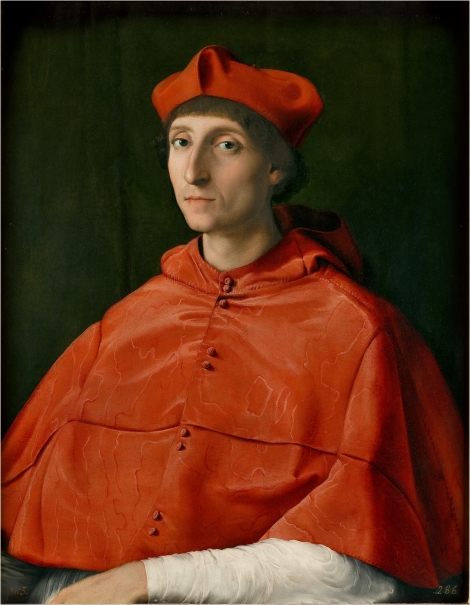

Since the moment when it was decided that the present work is by Raphael but that the sitter is not Antonio Granvela, art historians have expended considerable efforts on identifying the sitter.The most credible candidates would seem to be Cardinal Bendinello Suardi (painted by Del Piombo,Washington, National Gallery of Art), and even more probably Cardinal Giovanni Alidosi (depicted on a medal and also in the Disputa in the Stanza della Segnatura), due to the latter’s clear resemblance to the present sitter. However, neither can be clearly identified with the features of this cardinal. Aside from the high quality of the execution, the most striking aspect of this portrait is Raphael’s astonishing natural perceptiveness which results in the definitive and universal image of a Renaissance cardinal.
Room 049
Collection
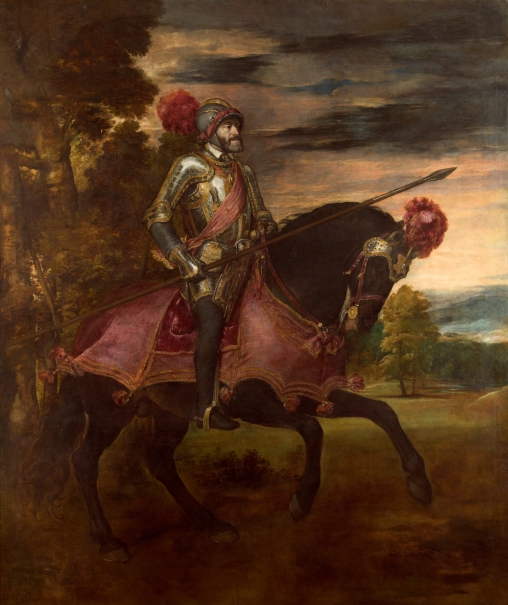

This portrait commemorates Charles V’s victory over the Schmalkaldic League at Mühlberg on 24 April 1547. The Emperor is equipped in the manner of the light cavalry with a half pike and wheel-lock pistol. His suit of armour was made around 1545 by Desiderius Helmschmid and has an image of the Virgin and Child on the breastplate, as was customary with Charles’ armour from 1531. Panofsky pointed to the combination of two non-exclusive concepts to be found in this image, which depicts Charles as the heir to the Roman tradition and also as the incarnation of the miles christianus, as he was described by Erasmus in the Enchiridion (1503).
Room 027
Collection
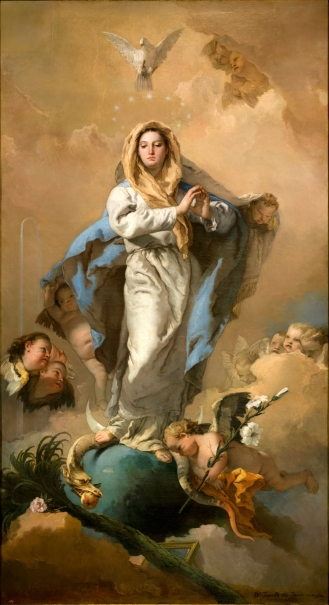

This majestic image was part of a cycle of seven altarpieces commissioned in 1767 for the new royal church of San Pascual Bailón at Aranjuez, founded by Charles III in the same year. The altarpieces comprised the entire pictorial decoration of this Alcantarine Franciscan church, which was built in an austere classical style. The subjects of the altarpieces reflected some of the most important devotional practices of the Franciscan Order: devotion to the Eucharist, to the Christ Child and to the purity of the Virgin Mary.
Room 023
Collection
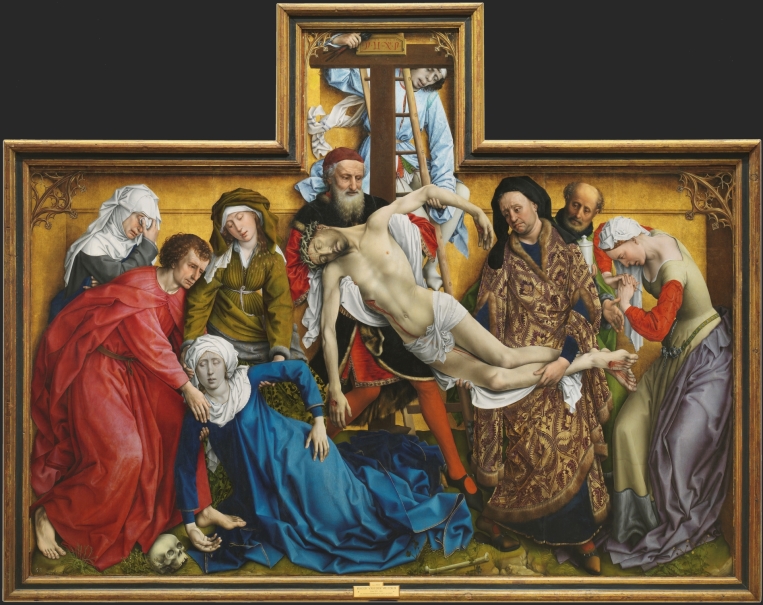

The painting represents an altarpiece of carved polychrome figures with the iconography of the deposition of Christ from the cross. The shape of the support with its projecting upper part and figures set inside a box with a gold background and sides, as well as the painted tracery in the corners, make it a depiction of a characteristic fifteenth-century sculpted altarpiece shrine.
There are accounts of Christ’s descent from the cross in the gospels. According to these texts, after Jesus died on the cross – in the exact spot where tradition had it that Adam was buried, as indicated by the skull and thighbone in the foreground – his body was lowered by his followers and interred in the tomb that a rich Jewish merchant, Joseph of Arimathea, had reserved for himself.
Room 058
Collection
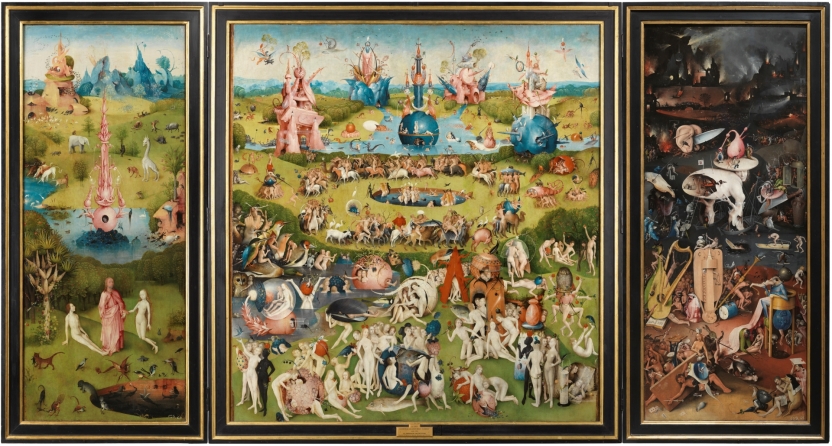

The Garden of Earthly Delights is Bosch’s most complex and enigmatic creation. For Falkenburg the overall theme of The Garden of Earthly Delights is the fate of humanity, as in The Haywain (P02052), although Bosch visualizes this concept very differently and in a much more explicit manner in the centre panel of that triptych than in The Garden of Earthly Delights. In order to analyse the work’s meaning the content of each panel must be identified. On the outer faces of the triptych Bosch depicted in grisaille the Third Day of the Creation of the World, when the waters were separated from the earth and the earthly Paradise (Eden) created.
Room 056A
Collection
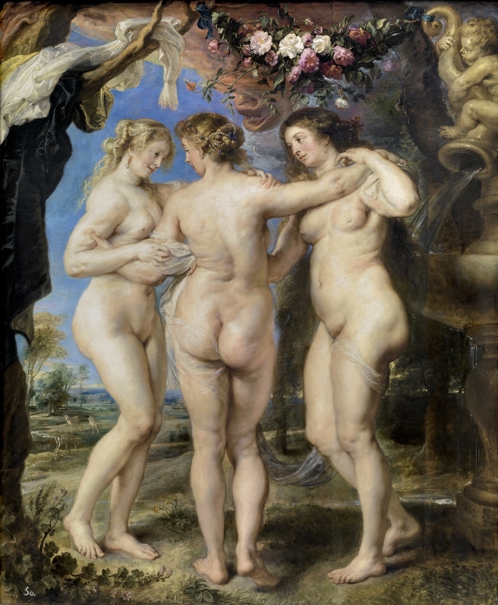

The Graces were minor deities but in this splendid work Peter Paul Rubens devotes his best effort to them. The three goddesses embrace each other forming a circle. The positioning of their feet suggests movement; they seem to dance gently. The setting is as luscious as the nude bodies of the goddesses. A field illuminated by sunlight filtered through dense trees stretches to a distant blue. The shadows cast by the figures show that they are lit from a source placed opposite the sun; Rubens is not a realist, he strives for effect. All is watered by a fountain crowned by a child with a cornucopia, the horn of abundance.
Room 029
Collection
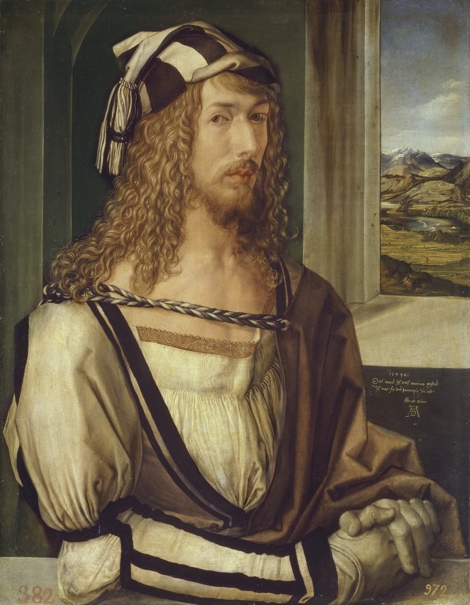

In the same year that he published the Apocalipsis cum figuris, Dürer painted himself as a gentleman, dressed in light toned clothes and looking his best. He wears an open black and white doublet with a striped cap in the same colours, an undershirt trimmed with gold and a silk cord of blue and white threads holding up a grey-brown cloak that falls over his right shoulder. Dürer has sheathed the hands that he uses to paint in grey kidskin gloves indicative of high rank with the aim of elevating his social status from that of craftsman to artist and of locating painting among the liberal arts, as in Italy.The artist chose a half-length, three-quarter format with two focuses of attention: the face and hands.
Room 055B
Collection
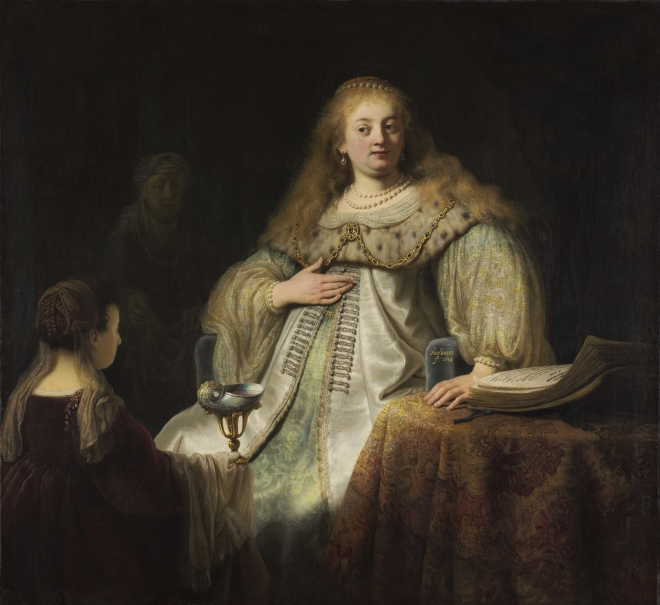

In the past various authors have expressed their scepticism about the attribution of the painting to Rembrandt. However, the Rembrandt Research Project includes it in the Corpus of 1986 as an original work, and this is supported by the technical study conducted at the Museo del Prado that year. As for the signature, the unsteadiness of the stroke and, above all, the yellow colour make it dubious. Nevertheless, the signature Rembrant without the d is found in various paintings dated 1633, in some engravings from 1632-33, and in the earliest documents signed by the painter.
Room 076
Collection
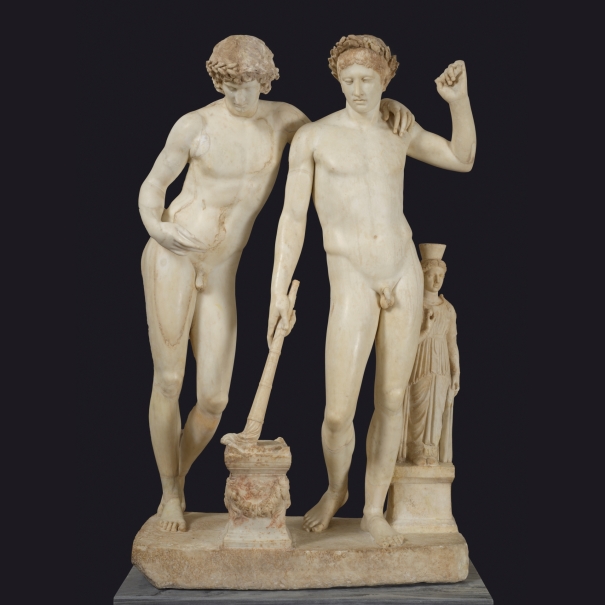

The work known as San Ildefonso Group–after San Ildefonso, Segovia, Spain, where, in the palace of La Granja, the work was kept during the 18th century– has been subject to many interpretations. Most researchers have not had access to precise knowledge of the modern restorative additions, there were also no known replicas, and the work includes only a few iconographic references and attributes with which to draw upon. Modern observers attracted by the embrace of the two ephebe (young men undergoing military training), unusual in ancient sculpture, interpreted it as a representation of friendship and brotherly love.
Room 071
Collection


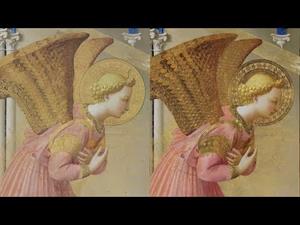
This altarpiece was painted for the monastery of Santo Domenico in Fiesole, near Florence. The central panel shows the Archangel Gabriel’s Annunciation to Mary under a portico. On the left, Adam and Eve are being expelled from Paradise. The damnation and salvation of Humanity. The predella has scenes from the life of the Virgin; Mary’s Birth, Her Wedding with Saint Joseph, Mary’s Visit to her cousin Saint Elisabeth, the Birth of the Christ Child, the Presentation of Jesus in the Temple and the Dormition of the Virgin with Christ receiving her soul. Fra Angelico, also known as Blessed Angelico, dedicated his work exclusively to religious subjects as he understood art to be an aspect of religious devotion.
Room 056B
Collection
Artworks (15)
The Crucifixion
Oil on panel.
1509 - 1519. Room C
1509 - 1519. Room C
The Nobleman with his Hand on his Chest
Oil on canvas.
Ca. 1580. Room 008B
Ca. 1580. Room 008B
Las Meninas
Oil on canvas.
1656. Room 012
1656. Room 012
Jacob’s Dream
Oil on canvas.
1639. Room 009
1639. Room 009
The 3rd of May 1808 in Madrid, or “The Executions”
Oil on canvas.
1814. Room 064
1814. Room 064
The Cardinal
Oil on panel.
1510 - 1511. Room 049
1510 - 1511. Room 049
Emperor Charles V at Mühlberg
Oil on canvas.
1548. Room 027
1548. Room 027
The Immaculate Conception
Oil on canvas.
1767 - 1769. Room 023
1767 - 1769. Room 023
The Descent from the Cross
Oil on panel.
Before 1443. Room 058
Before 1443. Room 058
The Garden of Earthly Delights Triptych
Grisaille, Oil on oak panel.
1490 - 1500. Room 056A
1490 - 1500. Room 056A
The Three Graces
Oil on oak panel.
1630 - 1635. Room 029
1630 - 1635. Room 029
Self-portrait
Oil on panel.
1498. Room 055B
1498. Room 055B
Judith at the Banquet of Holofernes
Oil on canvas.
1634. Room 076
1634. Room 076
Orestes and Pylades or The San Ildefonso Group
Sculpted.
Ca. 10 a.C.. Room 071
Ca. 10 a.C.. Room 071
The Annunciation
Tempera on poplar panel.
1425 - 1426. Room 056B
1425 - 1426. Room 056B
Floor 0 and -1
Floor 1
Floor 2
Related content