formularioRDF
The itinerary <em>TITULORECORRIDO</em> has been successfully created. Now you can add in works from the Collection browser
<em>TITULOOBRA</em> added to <em>TITULORECORRIDO</em> itinerary

Close Continuar a ficha de la obra Continuar a ficha de la obra
20-05-2026
Roman workshop

Ancient Rome (Italy)

See author's file

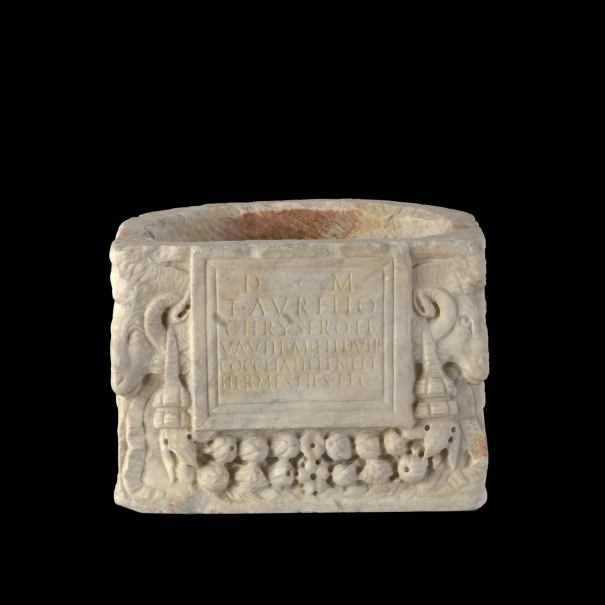
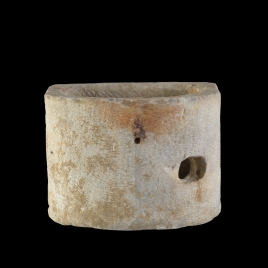
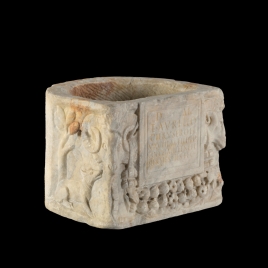
Cinerary urn

140 - 150. White marble.
Galería Jónica Planta Principal Norte

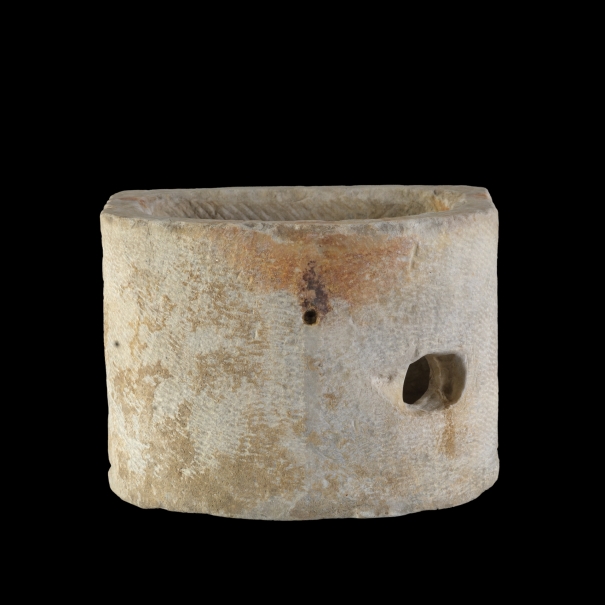
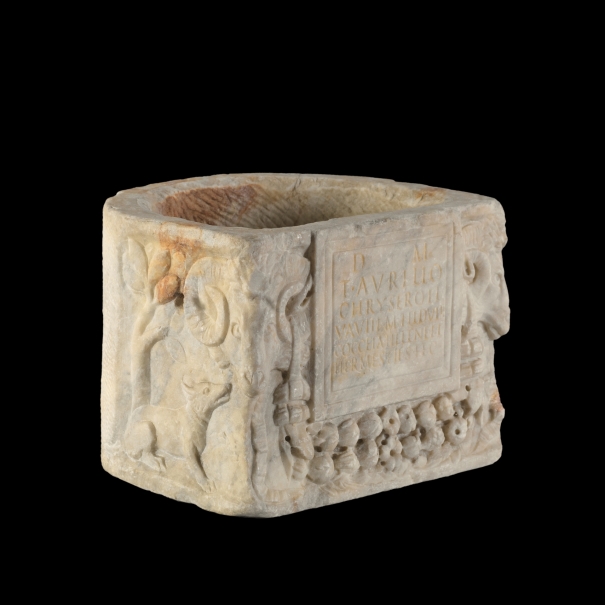
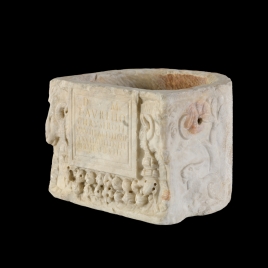
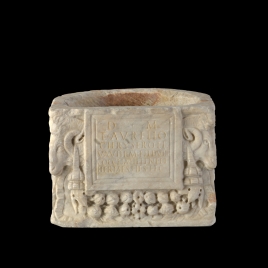
This urn served as a recipient for the bones and ashes generated by a public incineration ceremony. The round shape at the back of the urn allowed it to be stored in a semicircular niche in the funerary buildings whose rows of such small hollows led them to be called columbari (dovecotes) in modern times. A beautiful detail of its rich relief ornamentation are the two animals on opposite sides of the urn. Under a tree at the right, a dog with a collar raises his leg while, on the left, we see a hare with long ears, a short tail and a thickly furred neck. All that separates the hunting dog from his prey is the relief on the front of the urn. The names inscribed on this vessel indicate that the parents of the deceased child were of Greek origin and therefore from the east or south of the Roman Empire. The father was named Hermes and was probably a surf, while the mother, Helen, was somewhat more important, socially. Her family name indicates that she was a slave freed from the family of Emperor M. Cocceius Nerva (approx. 30 – 98 A.D.) Her son bears all three names: his praenomen and his family name, along with those of Titus Aurelius Boionius Arrius Antoninus (86-161 A.D.), the future emperor Antonius Pius, from whose family he had been freed, and his cognomen is Greek. The urn’s inscription dates it from the late Hadrian or Anthonian period.
Multimedia

Technical data

Imagen del carrusel
Imagen del carrusel
Imagen del carrusel
Imagen del carrusel
Inventory number
E000427
Author
Roman workshop
Title
Cinerary urn
Date
140 - 150
Technique
Sculpted
Medium
White marble
Dimension
Height: 21 cm; Depth: 24 cm; Weight: 17.999998 Kg; Width: 29 cm
Series
Colección Felipe V
Colección marqués del Carpio
Provenance
Collection of 7th Marquis of El Carpio, Rome, 1676-1682; Royal Collection (Felipe V's Collection, Royal Palace of La Granja de San Ildefonso, Segovia)

Bibliography +

Hübner, Emil, Die Antiken Bildwerke in Madrid, Druck Und Verlag Von Georg Reimer, Berlín, 1862, pp. 154.

Ricard, Robert, Marbres Antiques du Musée du Prado à Madrid, Féret & Fils, Burdeos, 1923, pp. 105.

Blanco Freijeiro, Antonio, Catálogo de la escultura. Museo del Prado, Museo Nacional del Prado, Madrid, 1957.

Nash, Ernest, Bildlexikon zur Topographie des antiken Rom., II, Tübingen, Wasmuth, Verlag, 1962, pp. 48, fig. 731.

Toynbee, J. M. C., Death and Burial in the Roman World, Thames and Hudson, London, 1971, pp. 48 ss.

Weaver, P. R. C., Familia Caesaris. A Social Study of the Emperor's Freedmen and Slaves, Cambridge University Press, 1972, pp. 82 ss.

Blanco, Antonio; Lorente, Manuel, Catálogo de la escultura. Museo del Prado (2ª ed.), Patronato Nacional de Museos, Madrid, 1981.

Solin, Heikki, Die griechischen Personennamen in Rom: ein Namenbuch, III, Walter de Gruyter, Berlin, 1982, pp. 172.

Sinn, Friederike, Stadtrömische Marmorurnen, Philipp von Zabern, -mainz am Rhein, 1987, pp. 42, 44, 218, n.º 525, lám. 79a.

Angelicoussis, Elizabeth, The Woburn Abbey Collection of classical antiquities, von Zabern, Mainz am Rhein, 1992, pp. 99, n.º 76, figs. 349, 350.

Schröder, S. F., Hispania Antiqua: Denkmäler der Römerzeit / editado por Trillmich, W.; Hauschild, Th., Von Zabern, Mainz, 1993, pp. 354, lám. 136 b, c.

Cacciotti, Beatrice, La collezione del VII Marchese del Carpio tra Roma e Madrid, Bollettino d'Arte, 86-87 VII-X, 1994, pp. 160, fig. 64.

Elvira Barba, Miguel Ángel, Bajo el signo de Fortuna: esculturas clásicas del Museo del Prado, Museo Nacional del Prado, Madrid, 1999, pp. 110 nº35.

Elvira Barba, M.A. Schröder, S. F, Las criaturas de Prometeo: esculturas clásicas del Museo del Prado, Fundación Marcelino Botín, Santander, 2000, pp. 132 nº38.

Schröder, Stephan F., Catálogo de la escultura clásica: Museo del Prado II, Museo Nacional del Prado, Madrid, 2004, pp. 482-484.

Azcue Brea, Leticia; Arias Martínez, Manuel, 'Galería Jónica de Escultura', En: Memoria de Actividades 2022, 2023, pp. 258-259,456.

Corpus Inscriptionum Latinarum, VI, pp. n.º 13051.

Other inventories +

Inv. Testamentaría Carlos III, La Granja, 1794. Núm. s. n..
Escultura / S.n Yldefonso [...] Galeria de Ydolos [...] {2905} Tres sepulcros pequeños de marmol blanco de figura esferica con sus epitafios: en ... 720

Museo Real de Pinturas a la muerte de Fernando VII, 1834. Núm. fol. 26.
Otras dos id. id. [urnas cinerarias de mármol blanco] sin tapa, e inscripciones en su frente ... 1200

Inv. Real Museo, 1857. Núm. 344.
344. Una urna cineraria de marmol de carrara sin tapa y con una inscripcion en su frente sobre un pedestal de escayola. Alto 9 pulg; largo 1 pie; alto del pedestal 2 pies.

Inscriptions +

D(iis) M(anibus) / T(ito) AURELIO / CHRYSEROTI / V(ixit) A(nnis) VIII. M(ensibus) III. D(iebus) VIII / COCCEIA HELENE ET / HERMES FIL(io) S(uo) FEC(erunt). [(Consagrado) a los Manes. Cocceya Helena y Hermes pusieron (esta urna) para su hijo Tito Aurelio Crisero, que vivió ocho años, tres meses y oc
Incised. On the front


Cross of Burgundy or Cross of Saint Andrew, collection’s mark belonged to King Felipe V. On the back

Exhibitions +

Las criaturas de Prometeo. Bajo el signo de la Fortuna. Esculturas antiguas del Museo del Prado
Santander
17.03.2000 - 23.04.2000

Bajo el signo de la fortuna. Esculturas antiguas del Museo del Prado
Salamanca
26.04.1999 - 23.05.1999

Location +

Galería Jónica Planta Principal Norte (On Display)

Update date: 20-05-2026 | Registry created on 28-04-2015

Visor 360

Drag with the cursor to rotate the piece

Other works by Roman workshop

Print on demand

Print artworks available in our catalogue in high quality and your preferred size and finish.

Image archive

Request artworks available in our catalogue in digital format.

Up