formularioRDF
The itinerary <em>TITULORECORRIDO</em> has been successfully created. Now you can add in works from the Collection browser
<em>TITULOOBRA</em> added to <em>TITULORECORRIDO</em> itinerary

Close Continuar a ficha de la obra Continuar a ficha de la obra
20-05-2026
Roman workshop

Ancient Rome (Italy)

See author's file

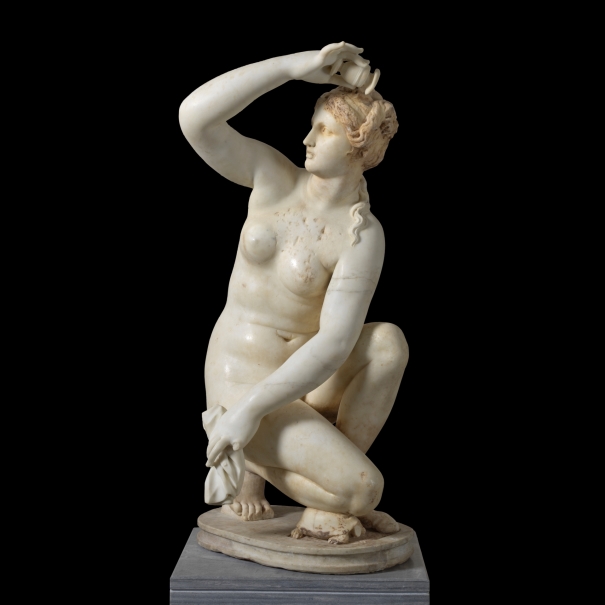
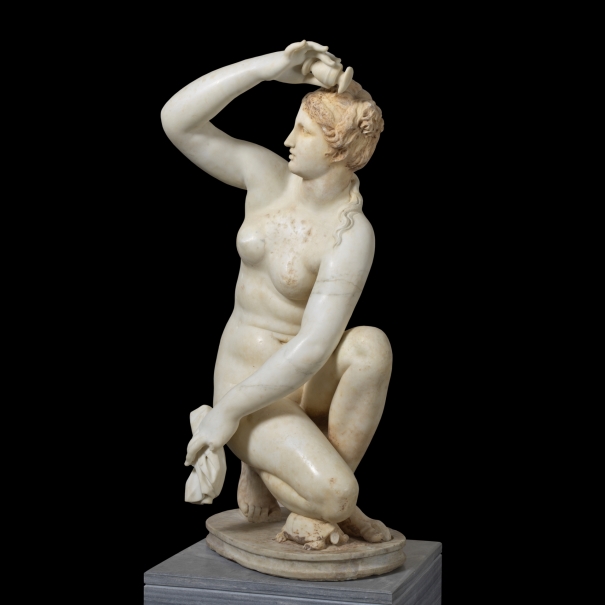
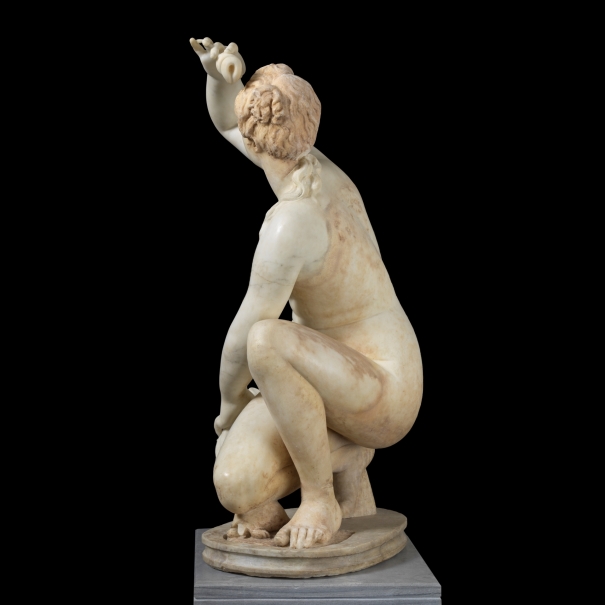
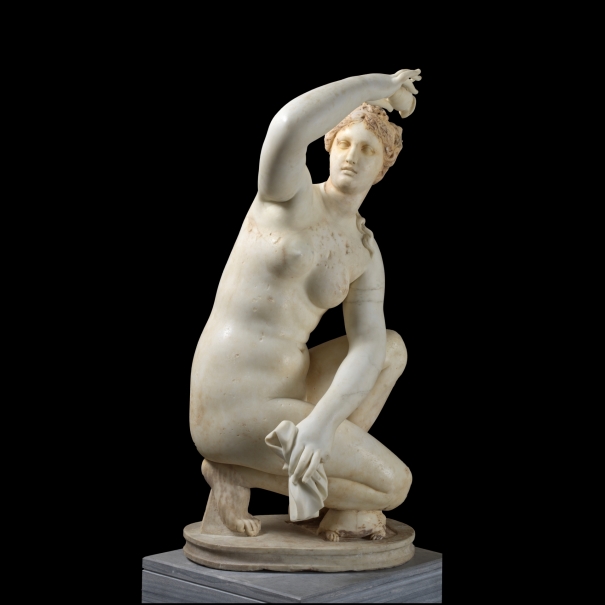
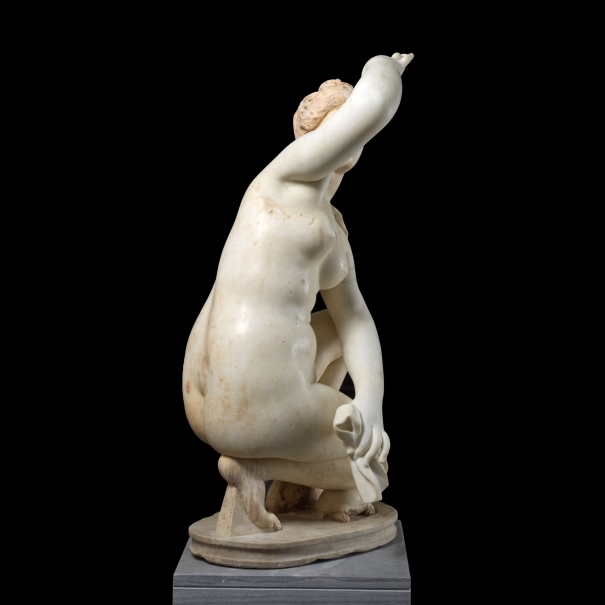
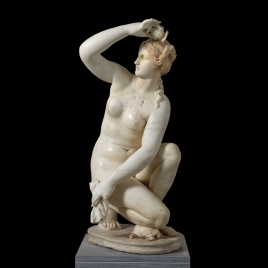
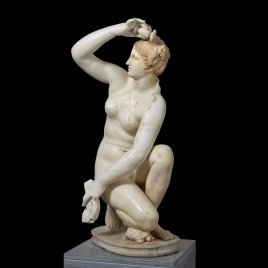
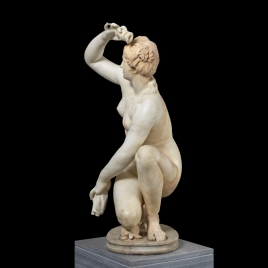
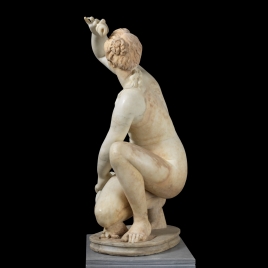
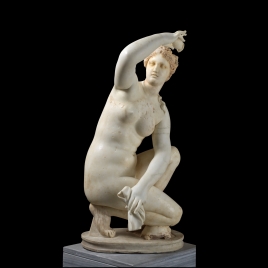
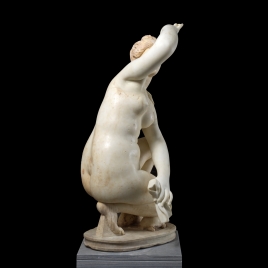
Crouching Aphrodite

Mid-IIcentury. White marble.
Room 072

In the fertile history of western art forms, a number of models gradually achieved canonical status; repeated over time, their endurance defied the passing centuries and fleeting fashions. We are not referring, here, to the standardisation of specific iconographical schemes as a means of conveying a given message, but rather to the lasting success of certain forms, certain gestural archetypes, certain compositions conveying an idea readily intelligible to the viewer, which – sanctioned by their use in classical antiquity – came to enjoy unchallenged primacy.

One such composition is the figure of the goddess Aphrodite crouching as she bathes; it is one of those clichés, endlessly reiterated since it was first introduced in the third century BC, to be found decorating gardens, villas, and public baths, or adorning collectors’ galleries. Albeit with certain variations, the piece at the Museo del Prado is based on a sculpture first mentioned in Pliny’s Natural History, where it is attributed to Doidalsas of Bithynia (act. around 250 BC), but with borrowings from the Rhodes Venus Anadyomene, in which the goddess is depicted in a similar posture, though drying her hair as she emerges from the sea.

This sculpture, first recorded in the holdings of Cardinal Camillo Massimo (1620–1677), passed through the collections of Queen Christina of Sweden (1626–1689) and Duke Livio Odescalchi (1652–1713) in the seventeenth century before it was purchased in 1724 by King Philip V and moved to Spain. Interestingly, the earliest references to it date from the start of the sixteenth century, before the upper part of the sculpture was restored. A drawing of the fragment, made around 1514 and now attributed to Andrea Solario (c. 1465–1524), is preserved at the Galleria dell’Accademia in Venice. Aphrodite’s right knee rests on a tortoise, an unusual feature enabling the composition to be unmistakeably identified, even in a bronze recreation made for the Gonzaga family by Pier Jacopo Alari Bonacolsi, known as Antico (c. 1455–1528) around 1520.

In representations of Aphrodite Urania, the image of heavenly or spiritual love, the goddess was shown standing, dressed, resting one foot on a tortoise; however, this animal symbol was not commonly used with the crouching Aphrodite. Its exceptional presence here may hint at an additional reading: for Plutarch, this detail in Phidias’ Aphrodite Urania signified that a woman should look after her home – since the tortoise carries its house on its shoulders – and should preserve a decorous silence, tortoises then being thought to lack tongues; these features were taken up in later emblematic literature.

The Prado Aphrodite offers a fascinating iconographic reinterpretation following restoration work carried out in the seventeenth century, which modified the original position of the right arm; now raised over her head, the right hand holds a perfume bottle, thus enhancing the bathing motif. The arm is similarly positioned in several other sculptures, including the Crouching Aphrodite at the Palazzo Altemps in Rome, which came from the Cesi–Ludovisi collection; it was restored a posteriori and later grouped with the Boy with a Goose to form an artificial Leda.

The Leonardesque drawing of the incomplete sculpture, mentioned earlier, suggests that it had by then joined the select group of classical pieces regarded as suitable for study by budding sculptors; and this gives us an idea of its true importance. Some years ago, reflecting on the success of this model, Selma Holo highlighted the marked influence of the Prado sculpture among Renaissance artists, noting that versions were to be found in frescoes painted by Francesco Salviati (1510–1563) for the Palazzo Vecchio in Florence and by Perino del Vaga (1501–1547) for the Palazzo Massimo alle Colonne in Rome. The incomplete statue, the mutilated archaeological fragment – including such key pieces as the Belvedere Torso – held a particular appeal for artists; these precious relics provided a conceptually solid basis on which they could construct their own imaginative recreation.

Arias Martínez, Manuel, 'Anónimo. Afrodita agachada'. En: Guido Reni, Madrid, Museo Nacional del Prado, 2023, p.308-310 nº 59
Multimedia

Technical data

Imagen del carrusel
Imagen del carrusel
Imagen del carrusel
Imagen del carrusel
Imagen del carrusel
Imagen del carrusel
Inventory number
E000033
Author
Roman workshop
Title
Crouching Aphrodite
Date
Mid-II century; XVII century
Technique
Sculpted
Medium
White marble
Dimension
Height: 128 cm; Weight: 190.40001 Kg; Width: 56 cm; Depth: 54 cm
Series
Colección Cristina de Suecia
Colección Isabel de Farnesio
Provenance
Collection of Cardinal Camillo Massimo/Massimi, Rome, until 1677; Collection of Queen Christina of Sweden, Rome, until 1689; Cardinal Azzolino; collection of Livio Odescalchi, Duke of Bracciano, Rome, until 1713; Royal Collection (purchased by Isabella Farnese, 1724; Royal Palace of La Granja de San Ildefonso, Segovia, pieza tercera, 1794, s.n.)

Bibliography +

Hübner, Emil, Die Antiken Bildwerke in Madrid, Druck Und Verlag Von Georg Reimer, Berlín, 1862, pp. 49.

Bernoulli, J. J, Aphrodite, 1873, pp. 318, n.º 28.

Klein, Wilhelm, Praxiteles, Veit & Comp., 1898, pp. 271, n.º C 1.

Barrón, Eduardo, Catálogo de la escultura. Museo Nacional de Pintura y Escultura, Imprenta y fototipia J. Lacoste, Madrid, 1908, pp. 47, lám. XIX, n.33.

Arndt, P.; Amelung, W, Photographische Einzelaufnahmen antiker Skulpturen, Múnich, 1912, pp. 1539-1541.

Klein, Wilhelm, Vom antiken Rokoko, Hölzel & Co., Wien, 1921, pp. 32.

Ricard, Robert, Marbres Antiques du Musée du Prado à Madrid, Féret & Fils, Burdeos, 1923, pp. 50.

Reinach, S., Deux nouvelles statues d'Aphrodite, Monuments et mémoires. Fondation E. Piot, 27, 1924, pp. 122 s., fig. 1.

Spano, G, Le reppresentanze di Artemis e Aktaim e l' Aphrodite di Doidalses, Atti della Real Accademia di Napoli, 10, 1928, pp. 1-82 [63 ss fg.11].

Battaglia, Gabriela, L' Afrodite di Deodalsas, Bolletino d' arte, 10, 1931, pp. 406-416 [409 s. nº4].

Tormo y Monzó, Elías, Museo del Prado. Catálogo de las esculturas I. La Sala de las Musas, Hauser y Menet, Madrid, 1949, pp. 67.

Lippold, G, Griechische Plastik, III (1), C.H.Becks'Sche Verlags Buchnandlung, Munich, 1950, pp. 346, nota 10.

Adriani, A, Contributo allo Studio dell’Afrodite di Deodalsas, Bulletin. Société archéologique d'Alexandrie, 39, 1951, pp. 147, nota 3.

Garcia y Bellido, Antonio, La escultura clásica del "Legado Zayas", en el Museo del Prado, Archivo Español de Arqueología, 25, 1952, pp. 98 s., fig. 15.

Lullies, Reinhard, Die kauernde Aphrodite, Filser, 1954, pp. 85, nota 436.

Bieber, Margarete, The Sculpture of the Hellenistic Age, Hacker Art Books, Nueva York, 1955, pp. 83, figs. 294, 295.

Blanco Freijeiro, Antonio, Catálogo de la escultura. Museo del Prado, Museo Nacional del Prado, Madrid, 1957, pp. 36.

Lullies, Reinhard, Griechische plastik von den anfängen bis zum ausgang des hellenismus, II, Hirmer Verlag, München, 1960, pp. lám. 273.

Adriani, Achille, Repertorio d'arte dell'Egitto greco-romano, II, Fondazione "Ignacio Mormino", Sicilia, 1961, pp. 27 ss., n.º 106-111, láms. 60, 61.

Bulst, W. A., Die Antiken-Sammlungen der Königin Christina von Schweden, Ruperto Carola. Zeitschrift der Studentenschaft der Universität Heidelberg, 19, 1967, pp. 129, nota 108.

Arslan, Ermanno A., Un disegno rinascimentale della Venere inginocchiata sulla tartaruga al Museo del Prado, Arte Lombarda, XIII 2, 1968.

Linfert, Andreas, Der Meister der 'Kauernden Aphrodite', Mitteilungen des Deutschen Archäologischen Instituts, Athenische Abteilung, 84, 1969, pp. 158-164 [161 ss nt.16].

Vermeule, Cornelius Clarkson; Neuerburg, Norman, Catalogue of the ancient art in the J. Paul Getty Museum, J. Paul Getty Museum, 1973, pp. 11 s., n.º 20.

Merker, Gloria S, The Hellenistic sculpture of Rhodes, Studies in Mediterranean archaeology, 40, Göteborg, 1973, pp. 25 s., n.º 2, láms. 1, 2.

Gualandi, L, Sculture di Rodi, Annuario della Scuola archeologica di Atene e delle Missioni italiane in Oriente, 54, 1976, pp. 115 s., n.º 66, figs. 97-98.

Holo, S., A Note on the Afterlife of the Crouching Aphrodite in the Renaissance, The J. Paul Getty Museum Journal, 6/7, 1978/1979, pp. 28, fig. 7.

Cogliati Arano, L, Leonardo, Disegni dell'Academia, Venecia, 1980, pp. 100 s., n.º 50.

Stähler, Klaus Peter, Heroen und Götter der Griechen, Universität Münster. Archäologisches Museum, Münster, 1980, pp. 53 s., n.º 37.

Blanco, Antonio; Lorente, Manuel, Catálogo de la escultura. Museo del Prado (2ª ed.), Patronato Nacional de Museos, Madrid, 1981, pp. 28-29.

Neumer-Pfau, Wiltrud, Studien zur ikonographie und gesellschaftlichen funktion hellenistischer aphrodite-statuen, Dr. Rudolf Habelt, Bonn, 1982, pp. 413, nota 525.

Palma, B, Museo Nazionale Romano, Le sculture / editado por A. Giuliano, I (5), De Luca Editore, Roma, 1983, pp. 72, n.º 29.

Delivorrias, Angelos, Lexicon Iconographicum Mythologiae Classicae, II, 1984, pp. 105, n.º 1026, s. v. Aphrodite.

Kell, Klaus, Formuntersuchungen zu spät- und nachhellenistischen Gruppen, Saarbrücker Druckerei und Verlag edition, 1988, pp. 57 ss., figs. 12, 13.

Ridgway, B. S, Hellenistic Sculpture, I, The University of Wisconsin Press, Madison, Wisconsin, 1990, pp. 231, lám. 113.

Constantini, A, La Collezione Boncompagni Ludovisi: Algardi, Bernini e la fortuna dell'antico / editado por A. Giuliano, Marsilio, Venezia, 1992, pp. 108 ss., n.º 8a.

Walker, Stefanie, The sculpture Gallery of Prince Livio Odescalchi, Journal of the history of collections, VI, 1994, pp. 205, n.º 62.

Moreno, Paolo, Scultura ellenistica, II, Istituto poligrafico e Zecca dello Stato, Libreria dello Stato, Roma, 1994, pp. 716, con nota 1124, fig. 881.

Salomonson, J. W., Furtwänglers Anadyomene. Bekanntes und Unbekanntes zu einer Marmorstatuette aus ehemaligem Münchener Privatbesitz, Bulletin Antieke Beschaving te’s-Gravenhage, 70, 1995, pp. 12, figs. 22, 26.

Cacciotti, Beatrice, Collezionista di Antichitá / editado por Camillo Massimo, En: Xenia Antiqua, Monographie, 1997, pp. 222.

Elvira Barba, Miguel Angel, Cristina de Suecia en el Museo del Prado, Museo del Prado, Madrid, 1997.

Elvira Barba, Miguel Angel - Schröder, Stephan, Escultura clásica. Guía. Museo Nacional del Prado, Fundación Marcelino Botín - Museo del Prado, Santander, 1999, pp. 104.

Cacciotti, Beatrice, L'idea del Bello. Viaggio per Roma nel Seicento con Giovan Pietro Bellori, Roma, 2000, pp. 420 s., n.º 17.

Borea, Evelina; Gasparri, Carlo, L'idea del bello: viaggio per Roma nel seicento con Giovan Pietro Bellori, Edizioni de Luca, Roma, 2000, pp. 420-421 nº 17.

Checa Cremades, Fernando, Cortes del Barroco: De Bernini y Velazquez a Luca Giordano, Seacex Patrimonio Nacional, Madrid, 2003, pp. 250.

Schröder, Stephan F, Catálogo de la escultura clásica: Museo del Prado II, Museo Nacional del Prado, Madrid, 2004, pp. 267-270.

Schröder,S. Elvira Barba,M.A, Eutichio Ajello (1711-1793) y su descripción de la célebre Real Galería de San Idelfonso, Boletín del Museo del Prado, XXIV, 2006, pp. 40-88.

Hübner, Emil, Las colecciones de arte antiguo en Madrid descritas por Emil Hubner, con un apéndice sobre otras colecciones existentes en España y Portugal [1862], Institutum Archaeologicum Germanicum,, Madrid, 2008, pp. 52-53 nº 28.

Warren, J, ' Antico' s nude of the tortoise, Nuovi studi, XV, 2010, pp. 26-31, L 49.

Elvira Barba, Miguel Angel, Las esculturas de Cristina de Suecia: un tesoro de la Corona de España, Real Academia de Historia, Madrid, 2011, pp. 55,77 / 179.

Gasparotto, D., 'Crouching Venus' En:, Serial Classic. Portable Classic : The Greek Canon and its m..., Fondazione Prada, Milan, 2015, pp. 240 n.41.

Trans: Diversidad de identidades y roles de género, Ministerio de Educación, Cultura y Deporte, Madrid, 2017, pp. 229 f.2.

Arias Martínez, Manuel, 'Anónimo. Afrodita agachada', En: Guido Reni, Museo Nacional del Prado, Madrid, 2023, pp. 308-310 nº 59.

Arias Martínez, Manuel, 'Anonymous. Crouching Aphrodite', In: Guido Reni, Museo Nacional del Prado, Madrid, 2023, pp. 308-310 nº 59.

García Pérez, Noelia, The female perspective III. Queen Isabella Farnese (1692-1766), Museo Nacional del Prado, Madrid, 2025, pp. 122-131; 142 n.43.

García Pérez, Noelia, El Prado en femenino III. La reina Isabel de Farnesio (1692-1766), Museo Nacional del Prado, Madrid, 2025, pp. 122-131; 142 n.43.

Other inventories +

Inv. Testamentaría Carlos III, La Granja, 1794. Núm. s. n..
Escultura / S.n Yldefonso [...] Pieza tercera [...] {2803} Otra Venus antigua, que esta en ademan de salir del Vaño, y tiene hincada la rodilla derecha sobre un galápago, bien restaurados los brazos: su altura es como la del natural: en ... 45.000

Museo Real de Pinturas a la muerte de Fernando VII, 1834. Núm. fol. 27v.
Otra id. [estatua] de Marmol de Carrara, tamaño natural que representa una Venus en el vaño, restaurada ... 12.000

Inv. Real Museo, Sección Escultura, 1857. Núm. 365.
365. Una estatua de marmol de Carrara sobre un terrazo demadera que representa a Venus puesta encuclillas saliendo del baño. / Alto 4 pies, 6 pulgs. incluso el terrazo.

Inscriptions +


Fleur-de-lys , used as a collection’s mark belonged to Queen Isabella Farnese. Plinth

Exhibitions +

The Female Perspective III. Queen Isabella Farnese (1692–1766) and the Museo del Prado
Madrid
01.12.2025 - 24.05.2026

Guido Reni
Madrid
28.03.2023 - 09.07.2023

Portable Classics: Ancient Greece to Modern Europe
Venecia
09.05.2015 - 13.09.2015

Bernini, Velázquez, Luca Giordano. Le Corti del Barocco - Cortes del Barroco
Madrid
15.10.2003 - 15.01.2004

Roma Antica e Moderna. Il Seicento de Bellori
Roma
28.03.2000 - 26.06.2000

Location +

Room 072 (On Display)

Expuesto
Update date: 20-05-2026 | Registry created on 28-04-2015

Visor 360

Drag with the cursor to rotate the piece

Other works by Roman workshop

Print on demand

Print artworks available in our catalogue in high quality and your preferred size and finish.

Image archive

Request artworks available in our catalogue in digital format.

Up