The Human Beast
1897. Oil on canvas.Room 061A
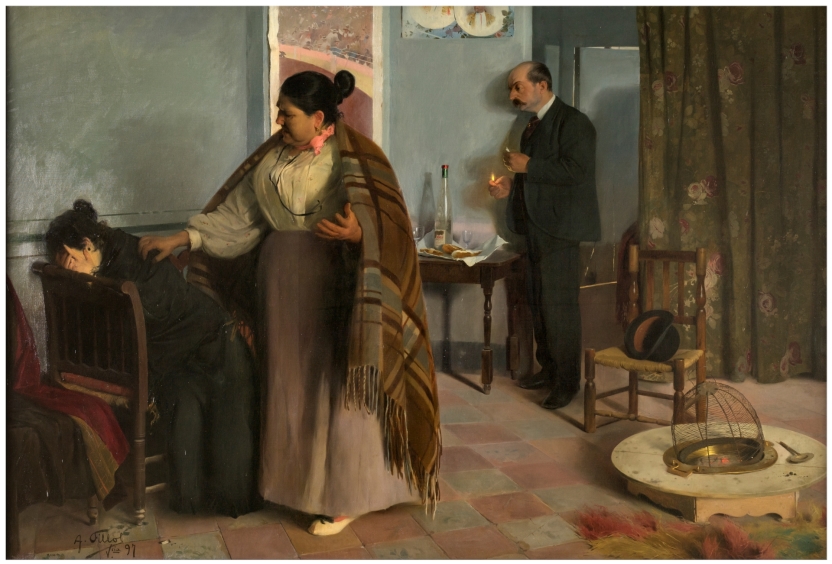
Without concealment, Fillol presents an image of female prostitution that denounces human exploitation and the personal degradation of the victim. Although critics acknowledged the painting for its boldness and naturalist stance, the academic recognition it received—a Second-Class Medal at the Exposición Nacional de Bellas Artes in 1897—was not accompanied by any monetary award, and in fact, the painting was not acquired until 1910.
Earlier naturalist paintings that addressed the subject of prostitution had generally done so obliquely, either suggesting the situation or presenting it through a lens of pity, with the title being essential to identifying the true theme. Fillol’s painting, by contrast, adopts a far more direct and stark approach, beginning with its Zolaesque title. It reflects the artist’s commitment to exposing the exploitation and degradation inherent in prostitution, and marks a shift in painting from a neutral field of representation to a weapon of social critique and denunciation in Fillol’s hands.
To submit a painting on the subject of prostitution to an official exhibition would have been unthinkable just a few decades earlier. And though society and public consciousness were undergoing marked changes, such a choice remained bold and risky, as it touched on taboo aspects of human behavior that were rarely unveiled through critical lenses. Yet the social injustices and contradictions of a time in flux could no longer be ignored—not even by the Church, which had already called for solutions to exploitation and inequality in the 1891 encyclical Rerum Novarum.
Sorolla had been the first Spanish painter to take on the subject of prostitution with “White Slave Trade”, painted in 1895 and exhibited alongside Fillol’s work at the Exposición Nacional of 1897. Sorolla, however, presented the theme in a more veiled and socially acceptable manner, with the title supplying the key to its interpretation—thus avoiding controversy or scandal. Fillol’s work, on the other hand, had the opposite effect: although it was awarded on technical grounds for its plastic and realistic quality, it was morally sanctioned, and Fillol was denied the financial reward that would have accompanied his medal.
To fully understand the jury´s response and Fillol’s critical intent, it is necessary to draw continuous parallels with Sorolla’s painting. Whereas Sorolla depicts a transitional moment, in which the fate of the women remains unknown, Fillol focuses on a moment of decision in a specific setting, with characters who do not belong to a marginal or bohemian class. There is no nudity nor improper behavior, yet the young woman on the verge of entering prostitution could be the daughter or widow of a respectable middle-class family. The client could easily be one of the jury members themselves—a seemingly respectable man, not from the lower classes.
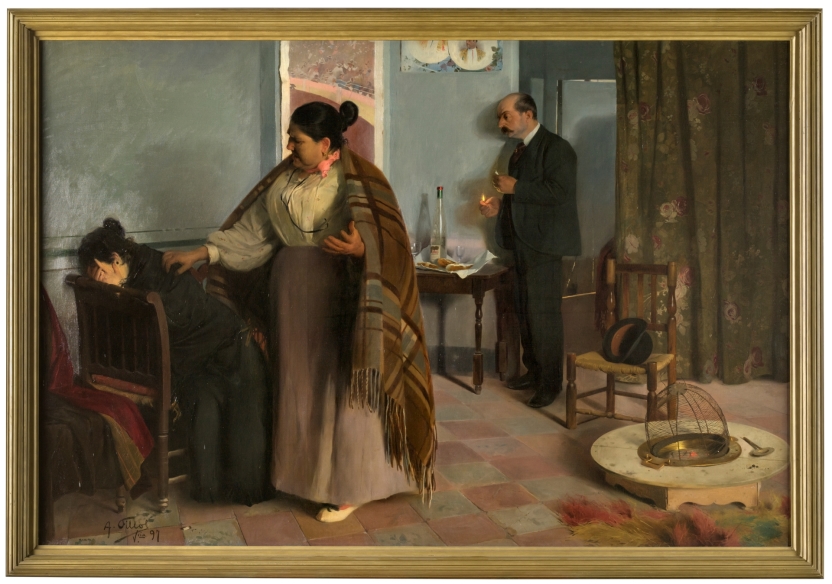
The setting is stark and cold: a nearly empty house with minimal furnishings, devoid of life. The brazier is unlit, its cover crooked; a straw chair bears the visitor’s hat; the table holds a bottle of liquor and pastries, presumably brought by the man. The floor tiles are worn, and the heavy curtain is the only colorful element. Each object is rendered as a still life in its own right. On a canapé, the young woman weeps with her face buried in her hands, ashamed of the path she has taken—or been offered—as a desperate solution. She is not a peasant girl from the countryside, but a well-dressed young woman of the urban middle class. Dressed in fashionable black, she appears as either a widow or an orphan—abandoned, without resources, and lacking the courage to confront her condition.
The procuress is crude and unscrupulous. One hand urges the girl to stop crying and fulfill the agreement, while the other is raised in a gesture of irritation and disbelief. The man is dull and expressionless, worn and disenchanted, thin and sickly in appearance—a bourgeois figure who remains unmoved by the situation he has provoked.
In terms of both composition and narrative, the painting is masterfully constructed. It stands as one of the finest achievements of 19th-century Spanish naturalist painting. As expected, a painting on such a subject did not go unnoticed by the art world. Much of the criticism recognized Fillol’s courage in denouncing corruption and abuse. The Valencian press promptly echoed the debates surrounding the work, and Fillol’s then friend Vicente Blasco Ibáñez was among its earliest defenders.
Fillol’s talent and the technical excellence of the painting were acknowledged even by critics who raised moral objections. An important takeaway from the critical reception is the evolution of art criticism itself, revealing an increasing openness to works that presented a more radical engagement with contemporary reality. The controversial painting was later selected as one of the works representing Spanish art at the 1900 Paris Exposition.
G. Navarro, Carlos, Invitadas. Fragmentos sobre mujeres, ideología y artes plásticas en España (1833-1931), Madrid, Museo Nacional del Prado, 2020, p.163 nº 17