Red-tailed oriole
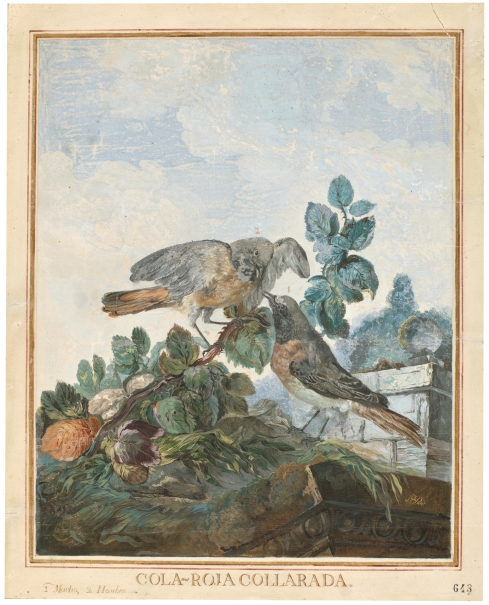
1774 - 1775. Gouache / tempera, Brush, Black chalk on laid paper.Not on display
Luis Paret’s obituary published in 1799 by the Academia de San Fernando mentions that he worked in the service of the infante Don Luis de Borbón for 11 years, during which time he painted – among other works – a ‘a collection of birds in tempera’ to which these four drawings belong (D005530, D003531 and two in the collection of Juan Várez). Since that date, and until the exhibition devoted to 18th- and 19th-century drawings organized by Félix Boix in 1922, there has been no news of these gouaches. Three of them were exhibited back then, belonging to the Third Count of las Almenas, and were subsequently exhibited in 1946, when they were under the ownership of his granddaughter, the Fifth Countess. After that time, they appeared in selected exhibitions, articles and auctions, always partially, which prevented a complete viewing of the group. In 1958, Gaya Nuño had the chance to see a cover signed by Luis Paret under the title ‘Collection of the Birds contained in the Natural History Cabinet of the Infante don Luis’. Probably catering to the owner’s request to remain anonymous, the historian did not reveal the name of the collection in which it was found, and instead it appears as ‘Collection X…’. In 1991, José Milicua rigorously gathered everything known until then in a study that has yet to be surpassed. In his elegant prose and using his breadth of expertise, he analysed the drawings he was able to see and determined that they used to belong to an album made up of at least 20 drawings.
Despite the efforts put forth by Milicua in 1991 and Martínez in 2018, it has been impossible to study the birds of this album together. As a matter of fact, many of them remain in private collections to which there has been no access or of which their whereabouts are unknown. To make their study even more complicated, there is a group of drawings that are clearly by a different hand than Paret’s and of lower quality. In some cases, they are copies of his preserved originals, namely the Oriole in the Prado (D005530), and in other cases, even though the original is unknown, the logical thing to believe is that it once did exist, since its composition scheme and its style undoubtedly bear his stamp. On the other hand, as not all the extant drawings have Paret’s signature – which is usual in his works – their labelling becomes dubious. There is a possible explanation for this fact: the artist left the series unfinished when he left for Puerto Rico, and another artist continued it.
A good example of the gaps regarding the study of these drawings concerns the first of those in the Museo del Prado, Red-tailed oriole (D003531), which entered on an undetermined date. It has not been found in the 19th-century Museum inventories (1857 and 1877), so its provenance from the Royal Collection or the funds of the Museo de la Trinidad would be dismissed. There is also no record of any documents in the Archive indicating a purchase or donation in the 20th century. In fact, it is not mentioned until Pérez Sánchez’s 1977 catalogue of drawings. The only clue is a pithy remark by Gaya Nuño in his 1958 article, in which he points out that an album sheet ‘was offered for sale to the Museo del Prado around 1942’. Conceivably, this was the one that was kept unknowingly in the museum without leaving any documentary traces, thus being registered after 1963 along with other Paret’s drawings for the Viana chapel.
These four drawings exemplify the characteristics of this series. First of all, the drawn frame that delineates the composition – rendered meticulously and enhanced by a golden moulding – was already used by Paret in other works, such as Zebra (D005534) and La Celestina y los enamorados (D009400). Occasionally, as in Oriole, the tail of one of the birds protrudes from the frame as a trompe-l’oeil. Below, also in golden lettering outlined in dark red, he states the bird’s name. In some cases, he identifies the male and the female by inserting numbers in the composition.
Finally, the signature – traced in golden ink with a brush – is not always the same: sometimes, his initials are intertwined; in other instances, he signs with his first initial, then his surname; and, in one case, with the Latin word indicating his status as a painter (‘pinx.t’). The essential quality of these drawings is variety. Although they follow the models established in 16th-century prints for depicting birds, Paret inserts elements that introduce diversity and richness: in addition to the branches upon which the birds are perched – also a nod to the way in which they were kept stuffed in the prince’s cabinet – he places them in different settings, which imparts a pleasant quality to the drawing: landscapes with architecture, especially with classical and monumental elements, but also purely rustic or simply natural ones, such as rocks and plants. Paret also played with the positions of the birds, moving away from monotonous repetition, sometimes showing them in movement and other times simply perched.
Technically, these washes are a good example of Paret’s virtuosity with the brush. In some of them, the black pencil with which he outlined the profile is perceptible, despite the use of dull colours that make it difficult to observe what is below. In the Blue-Spotted Tanager (Juan Várez collection) he subsequently added reinforcement lines in pencil. Furthermore, he outlined the architecture with black pigment lines, some of which were traced with the help of a ruler. Afterwards, he meticulously overlapped brushstrokes of different thicknesses (first thick and then thin), sometimes to outline the profile and other times to build the bird’s delicate plumage. Finally, he reinforced the blue cloudscapes with intense washes, applying different hues with which he recreated clouds. At first glance, they cause the same effect as the stuffed birds by which he was inspired: a combination of nature and artifice that, even though they try to realistically convey the animals’ appearance, their pictorial materiality is otherwise unconcealed by leaving the brushstrokes that constitute them in plain sight.
When examined under magnifying glasses or digital media, these drawings are an excellent testimony of Paret’s accurateness, rather close to a miniaturist’s, which is also one of the stylistic features of his painting.
Matilla, José Manuel, 'Luis Paret y Alcázar. Cola-roja collarada' En:. Paret, Madrid, Museo Nacional del Prado, 2022, p.11-117 nº 18