formularioRDF
The itinerary <em>TITULORECORRIDO</em> has been successfully created. Now you can add in works from the Collection browser
<em>TITULOOBRA</em> added to <em>TITULORECORRIDO</em> itinerary

Close Continuar a ficha de la obra Continuar a ficha de la obra
02-06-2026
Luis Paret y Alcázar

Madrid (Spain), 1746 - Madrid (Spain), 1799

Luis Paret y Alcázar See author's file

Royal Couples

1770. Oil on canvas.
Room 039

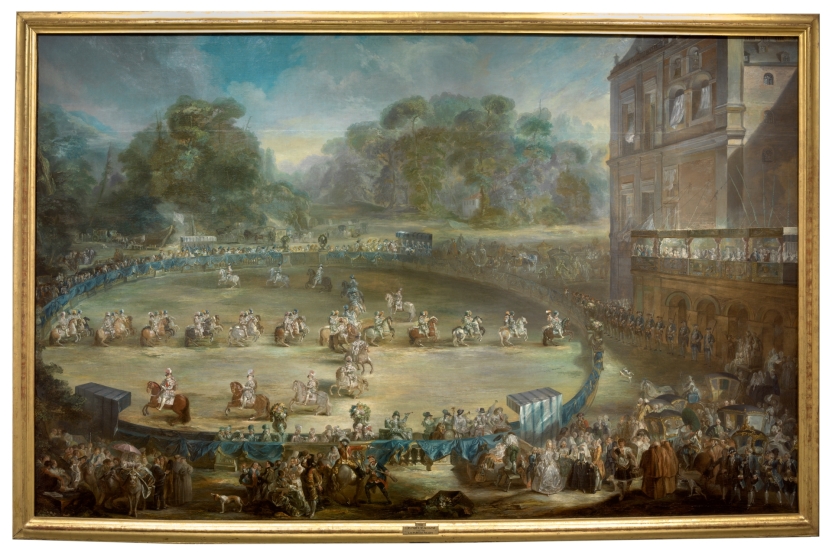
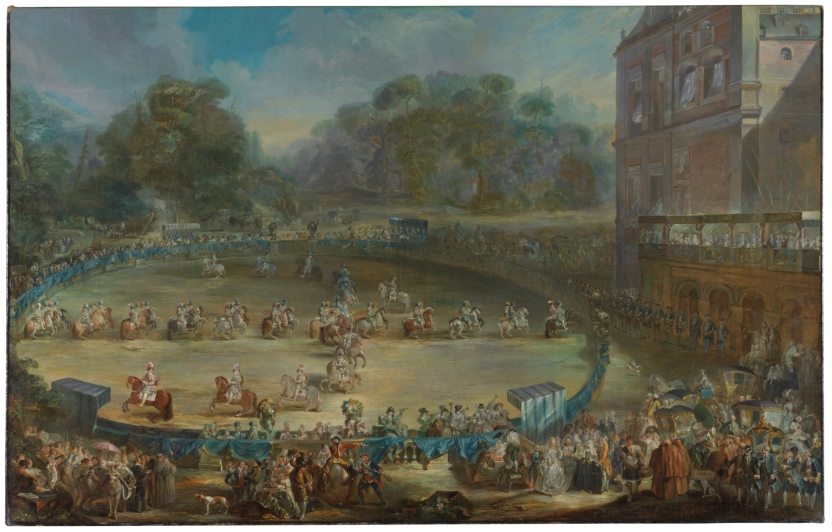
This is Paret’s first large-format painting. The painting demonstrates how he had mastered composition in perspective with numerous figures from very early in his career. It also shows that he had already developed his characteristic painting style, affected and tending towards a cold range of chromaticism pearly in appearance. He painted it at the request of his protector, the Infante Don Luis. The event the canvas portrays is a partner dance that took place in the surroundings of the Palace of Aranjuez on 6 June 1770.

This courtly celebration is defined by different country dances performed on horseback to the rhythm of the music. According to the account of Juan Antonio Álvarez de Quindós, more than 70 steeds and around 200 people took part in the performance, although the most important participants were the 48 knights. Those knights were lavishly dressed in the old style and made up the four quadrilles that the figures carried out. On this occasion, they were led by Prince Charles himself, who was dressed like his quadrille in white and red and who is depicted in the canvas at the forefront of the group that has turned to his right. In the background on the opposite side is the Infante Don Gabriel in blue and white. The quadrille of the Infante Don Luis, in green and white, and that of Duke of Medina Sidonia, in gold and white, are arranged in front of the royal box. In this space, which was created for that purpose over the palace gallery and covered with tapestries depicting mythological or genre themes in the style of Teniers and flower vases, Charles III, King of Spain, and Maria Luisa de Parma are clearly distinguishable, accompanied by Infantes Antonio Pascual and Francisco Javier and by Infanta María Josefa. Not only are they faithfully depicted despite their size, but the area in which they are portrayed is more illuminated than the adjacent areas, where other sophisticatedly dressed courtly figures are grouped.

The ‘elegant spectacle’, as described by the English traveller Joseph Townsend – who saw it in 1787 – constituted the most crowded day of the royal site of the court at the time, drawing several thousand people from all social classes. Paret reflects this by integrating a representation of members of the other social strata along with the aforementioned distinguished entourage. These other social classes range from the military, through the Walloon Guards; the ecclesiastical, through the figures of various friars and abbots; and finally the common people, in which refined dandies and dandizettes dressed in the traditional black overskirt and modern white mantillas, majos with Andalusian monteras or hairnets and still wrapped in their capes, and villagers can be identified. All of them are accurately captured, thus displaying a complete range of expressions and attitudes. They are depicted with extraordinary meticulousness, which is visible even in the smallest details, such as the diverse hairstyles or the jewellery and accessories worn by the different figures.

The artist reserves the foreground of the composition for these common people and depicts them as protagonists in several scenes outside the festivities that give the work greater variety and liveliness. Thus, the lower left corner groups together a motley of characters, amongst whom some village women can be distinguished riding their donkeys whilst protecting themselves from the sun with parasols. A young man with his guitar can also be seen, as well as some sheets yet to be identified but which, judging by their drawings and inscription, could be related to the popular romance ‘The virtues of the night’, of which different versions exist from at least the mid-17th century, with the common element of the list of events and situations that take place at that time of day. In a version that circulated around the time this painting was made, the main emphasis is charity events, which, beyond portraying a royal scene, could be interpreted as an allegory of the reign of Charles III, King of Spain, who brought prosperity and safety to his people.

In order to achieve this generalised happiness, activities and events such as the one depicted in this painting were favoured. All social classes could enjoy these events. However, they did not mix with each other, as is shown in the central part of the canvas where, despite the fact that no altercation can be seen, given that a young woman drinks and continues to breastfeed her child undisturbed, two armed soldiers violently burst in. They are probably trying to prevent the group from approaching the other side, which seems to have been intended for the arrival of people of higher social standing, as evidenced by their rich attire and the elegant carriages arranged in this area. Even so, several majos and a couple of villagers on a donkey have succeeded in making their way through. In the background of the composition, behind the musicians and almost blending into the leafy landscape, there are people and floats of various kinds, stalls of vendors and even a boat; a reminder of the river entertainments that also took place at the Royal Site of Aranjuez.

Thus, considering that the Collection of attire from Spain by Juan de la Cruz (1777–88) had not yet been published, nor had the tapestry cartoons intended for the royal residencies included the representation of the contemporary people, Paret can be considered the first to make them protagonists.

Three preparatory drawings have been linked to this composition, revealing a meticuous creative process in which the possible influence of works such as Philip IV hunting Wild Boar by Velázquez (1632–37; National Gallery in London) or View of Zaragoza by Juan Bautista Martínez del Mazo (1647; Museo del Prado) cannot be overlooked, especially since at the time said paintings were hung in the corridor to infante Don Luis’ room in the Royal Palace in Madrid.

As Delgado records in a letter to the Board of the Real Academia de Bellas Artes de San Fernando dated 16 June 1771, the marquess of Santa Cruz commented that ‘in Aranjuez was Luis Paret, who had painted the couples of the previous year with great accuracy’. Significant evidence of the painting’s success occurred when the Infante Don Gabriel commissioned the artist to make a copy of it.

Albarrán, Virginia, 'Luis Paret y Alcázar. Las parejas reales' En:. Paret, Madrid, Museo Nacional del Prado, 2022, p.100-104 nº 15
Multimedia

Technical data

Imagen del carrusel
Imagen del carrusel
Inventory number
P001044
Author
Luis Paret y Alcázar
Title
Royal Couples
Date
1770
Technique
Oil
Support
Canvas
Dimension
Height: 236.99998 cm; Width: 370 cm
Provenance
Royal Collection (Palacio de Aranjuez, Madrid, galería de la Real Capilla, 1818, s. n.).

Bibliography +

Real Academia de Bellas Artes de San Fernando., Distribucion de los premios concedidos por el rey Nuestro Señor a los discípulos de las tres nobles artes hecho por la Real Academia de San Fernando en la junta pública de 13 de julio de 1799, en la imprenta de la Viuda de Ibarra,, 1799, pp. 39.

Inventario: Real Palacio de Aranjuez, Madrid, 1818.

Eusebi, Luis, Catálogo de los cuadros de escuela española que existen en el Real Museo del Prado, Imprenta Real, Madrid, 1819, pp. 20 n.2.

Inventario de las Pinturas del Museo Hecho a la Muerte del R, Inventarios Reales en 12 volúmenes y un índice (fotcopias), [s.n, Madrid, 1834, pp. 71.

Sánchez Cantón, Francisco Javier, Pintores de los Borbones, Boletin de la Sociedad Española de Excursiones, 24, 1916, pp. 143.

Paris, Pierre, La peinture espagnole depuis les origines jusqu'au debut, Les Éditions G. Van Oest, París, 1928, pp. lám.55.

Lozoya, Juan de Contreras y López de Ayala, Marqués de, Historia del arte hispánico, IV, Salvat, Barcelona-Buenos Aires, 1945, pp. 517.

Aguilera, Emiliano M., Pintores españoles del siglo XVIII, Iberia Joaquin Gil, Barcelona, 1946, pp. 18.

Sánchez Cantón, Francisco Javier; Pita Andrade, José Manuel, Los retratos de los Reyes de España, Omega, Barcelona, 1948, pp. 168/ lám.12.

Caturla, Maria Luisa, 'Paret, de Goya coetáneo y dispar' En: Goya (cinco estudios), Institución Fernando el Católico, Zaragoza, 1949, pp. 27-41 [34].

Gaya Nuño, Juan Antonio, Luis Paret y Alcázar, Boletín Sociedad Española de Excursiones, LVI, 1952, pp. 87-153 [102-103,140, nº10].

Lafuente Ferrari, Enrique, Breve historia de la pintura española, Tecnos, Madrid, 1953, pp. 396.

Delgado, O., Paret y Alcázar, Universidad de Puerto Rico. Instituto Diego Velázquez, C.S.I.C., 1957, pp. 113-119, 241 nº 12.

Ceán Bermúdez, Juan Agustín, Diccionario histórico de los más ilustres profesores de las de las Bellas Artes en España, IV, Reales Academias de Bellas Artes de San Fernando y de la Historia, Madrid, 1965, pp. 56.

Ars hispaniae: historia universal del arte hispánico, Plus Ultra, Madrid, 1965, pp. 232.

Sánchez Cantón, Francisco Javier, Museo del Prado. Catálogo de las pinturas, Museo del Prado, Madrid, 1972.

Pardo Canalís, Enrique, Luis Paret, pintor de Madrid, Instituto de Estudios Madrileños (CSIC), Madrid, 1978, pp. 11.

Museo Nacional del Prado, Catálogo de las pinturas, Museo del Prado, Madrid, 1985, pp. 490.

Symmons, Sarah, 'El galgo y la liebre Francisco de Goya y Luis Paret'. En: Goya nuevas visiones. Homenaje a Enrique Lafuente Ferrari, Amigos del Museo del Prado,, Madrid, 1987, pp. 396-412 [398-404].

Goya: nuevas visiones : homenaje a Enrique Lafuente Ferrari, Amigos del Museo del Prado, Madrid, 1987, pp. 398,400,403.

El Real Sitio de Aranjuez y el arte cortesano del siglo XVII, Patrimonio Nacional, Madrid, 1987, pp. 418.

Symmons, Sarah, Goya. In Pursuit of Patronage, Gordon Fraser, Londres, 1988, pp. 83.

Iglesias, Maria del Carmen, Carlos III y la ilustración: 1788-1988, Ministerio de Cultura, Madrid, 1988.

Museo Nacional del Prado, Museo del Prado. Inventario general de pinturas (I) La Colección Real, Museo del Prado, Espasa Calpe, Madrid, 1990.

Buendía, José Rogelio, El Prado. Colecciones de Pintura, Lunwerg Editores, Madrid, 1994, pp. 168.

Morales y Marín, José Luis, Pintura en España: 1750-1808, Cátedra, Madrid, 1994, pp. 210/ lám.120.

Benito Olmos, Aurora, Arte y Musica en el Museo del Prado, Fundacion ArgentariaVisor, Madrid, 1997, pp. 208.

Morales y Marín, José Luis, Luis Paret, vida y obra, Aneto Publicaciones, Zaragoza, 1997, pp. 113-114 nº11.

Díaz Gallegos, Carmen, Dibujos preparatorios para 'Las parejas reales' de Luis Paret en la Biblioteca del Palacio Real de Madrid, Reales Sitios, XXXIV, 1997, pp. 70.

Museo Nacional del Prado, Goya y la pintura española del siglo XVIII: guía, Museo del Prado, Aldeasa, Madrid, 2000, pp. 136.

Portús Pérez, Javier, La colección de pintura española en el Museo del Prado, Edilupa, Madrid, 2003, pp. 100.

Molina, Alvaro, Vestir la identidad, construir la apariencia: la cuestión del traje en la España del Siglo XVIII, Ayuntamiento de Madrid, Madrid, 2004, pp. 207-208.

Mena Marqués, M.B, 'Las clases sociales. La armonía del pueblo' En:, Mena Marques,Manuela B. Goya en Madrid : cartones para tapices 1775-1794, Museo Nacional del Prado, Madrid, 2014, pp. 132-139 [138 f.3.9].

Castillo Álvarez, Silvia, Marcos, muebles y maderas: obras de carpintería, ebasnistería y enmarcado en el Museo del Prado (1818-38), Boletín del Museo del Prado, XXXIII (51), 2015, pp. 100-111 [105].

Martínez Pérez, Alejandro, Dibujos de Luis Paret y Alcázar (1746-1799). Catálogo razonado., Centro de Estudios Europa Hispánica, Madrid, 2018, pp. 102-103.

Martínez Plaza, Pedro J., El gabinete de descanso de sus majestades, Museo Nacional del Prado, Madrid, 2019, pp. 9,11,16-17,49.

ALba, L. García Maíquez, J. Gayo, M.D, Jover de Celis, M. Merino Gorospe, J.L, 'Aportaciones al estudio técnico de las obras de Paret', Paret, Museo Nacional del Prado, Madrid, 2022, pp. 47-63 [47-48,51-52,54,56-57].

Albarrán, Virginia, 'Luis Paret y Alcázar. Las parejas reales' En:, Paret, Museo Nacional del Prado, Madrid, 2022, pp. 100-104 nº 15.

Maurer, Gudrun, 'Paret, pintor de singular ingenio', Paret, Museo Nacional del Prado, Madrid, 2022, pp. 15-45 [22,27].

Other inventories +

Inv. Fernando VII, Aranjuez, 1814-1818. Núm. s. n..
Galería de la Real Capilla [...] {20994} Las parejas que se executaban delante del Palacio de Aranjuez cuatro varas y media ancho tres alto = Paret

Museo Real de Pinturas a la muerte de Fernando VII, 1834. Núm. 54.
GABINETE DE DESCANSO DE SS. MM. / Cincuenta y cuatro. Función de parejas por el Rey D. Carlos 4º, siendo Príncipe ejecutadas en el Real Sitio de Aranjuez / Luis Paret / Lº / 25.400

Inv. Real Museo, 1857. Núm. 2003.
Paret / 2003. Un torneo en el sitio de Aranjuez. (firmado) / Alto 8 pies, 5 pulg; ancho 13 pies.

Catálogo Museo del Prado, 1872-1907. Núm. 838.

Catálogo Museo del Prado, 1910. Núm. 1044.

Catálogo Museo del Prado, 1985. Núm. 1044.

Inscriptions +

2003
Inscribed in orange. Front, lower left corner

Ludovicus Parèt / & Alcazar / pinxit / a. MDCCLXX
Inscribed in orange. Front, lower central area

LAS VIRTUD[Es] [inscrito en unos pliegos, en color gris]
Painted. Front, lower left corner

Exhibitions +

Paret
Madrid
24.05.2022 - 21.08.2022

Their Majesties’ Retiring Room
Madrid
09.04.2019 - 12.10.2021

Goya in Madrid
Madrid
28.11.2014 - 03.05.2015

Carlos III y la Ilustración
Barcelona
27.02.1989 - 16.04.1989

Carlos III y la Ilustración
Madrid
09.11.1988 - 22.01.1989

Location +

Room 039 (On Display)

Expuesto

Displayed objects +

Dance: Junto a la tribuna más próxima al espectador se distingue un grupo de músicos: un timbalero y cinco clarineros montados a caballo. Frente a ellos, otro grupo de seis jinetes seguramente siguen la misma formación. Según los documentos del Archivo del Palacio Real relativos a estos festejos, asistían a los mismos dos “orquestas” y los caballos danzaban una contradanza. La fiesta de Parejas es un tipo de ballet ecuestre en el que destaca la doma de los caballos, que debían ir al unísono por parejas, formando figuras geométricas al son de una música de ritmo marcado (Marchas, Gigas, Contradanzas y otras similares). Es una diversión cortesana que se difundió en las cortes europeas desde la de Florencia donde se practicaba en el s. XVII. En España hay constancia desde la década de 1720, durante el reinado de Felipe V, y se hacían asiduamente con Carlos IV, siendo príncipe. Están documentados los gastos de estas fiestas en el Archivo General del Palacio Real entre 1773 y 1788 (Bordas, 2009).

Clarion / Bugle: En parte inferior central-derecha de la composición hay un grupo de cinco instrumentistas de viento con trompetas - clarines, montados a caballo. Tres están tocando, mientras un cuarto sujeta el instrumento y el del extremo de la derecha está de espaldas y no se ve la acción. Los instrumentos están descritos vagamente, aunque lo suficiente para ver el tubo de metal dorado, con una vuelta, que se abre en campana. Portan estandartes como es habitual. El registro agudo de la trompeta se conoce como clarín, dándosele este mismo nombre al instrumento en el que se hace. La trompeta es un aerófono de metal con embocadura de boquilla y tubo cilíndrico en su mayor parte, que se abre en campana. La longitud el tubo determina su tonalidad base, a partir de la cual suenan los armónicos naturales. Los sonidos son modificados por la vibración de los labios del tañedor (Proyecto Iconografía Musical, UCM).
Se usó en casi todos los pueblos de la Antigüedad y más tarde en Oriente, antes de generalizarse en el mundo cristiano aproximadamente a partir del s. XIII. En general es un instrumento heráldico y militar que se usa para hacer señales o toques. En este caso se usa en conjunto para hacer melodías sencillas y aumentar la sonoridad en un ejercicio al aire libre.

Recorder: A la izquierda del cuadro, un niño toca una flauta recta o un pito. Lo sostiene con ambas manos, en actitud de imitar a los clarineros. Apenas descrito visualmente, parece de tamaño pequeño y color dorado. Probablemente es una flauta dulce, ya que la toca con ambas manos y eso parece indicar que tiene más de tres agujeros (Proyecto Iconografía Musical, UCM).

Drum, Kettle: A la izquierda del grupo que toca los clarines, un timbalero toca los dos timbales que cuelgan en los costados del caballo. Los timbales están cubiertos con estandartes del mismo color azul claro que los clarines. El músico bate ambos brazos con las baquetas en las manos en actitud de estar golpeando sucesivamente los parches. No se aprecia la forma de la caja del instrumento. Los timbales (atabales en el mundo árabe y medieval) son instrumentos unimembranófonos con caja metálica semiesférica (Proyecto Iconografía Musical, UCM).
Acompañan generalmente a los clarines en la música heráldica y militar. Se tocan en pares colocados en los flancos del caballo. Cada parte tiene una altura sonora diferente con un intervalo variable (modernamente de quinta). En el siglo XVIII empiezan a utilizarse en los conjuntos instrumentales, de donde pasan a la orquesta moderna.

Update date: 02-06-2026 | Registry created on 28-04-2015

Visor 360

Drag with the cursor to rotate the piece

Other works by Luis Paret y Alcázar

Prado Shop

Print on demand

Print artworks available in our catalogue in high quality and your preferred size and finish.

Image archive

Request artworks available in our catalogue in digital format.

Up