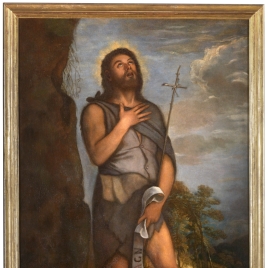
Saint John the Baptist
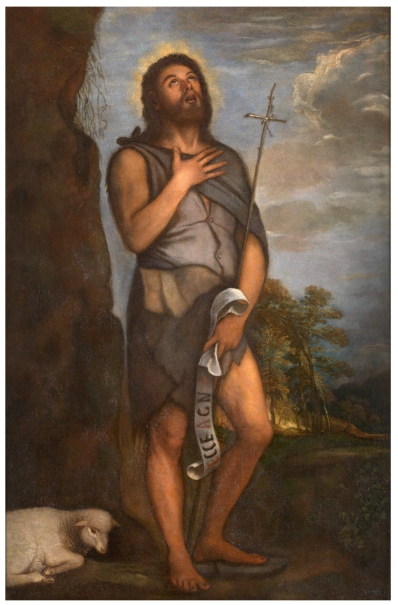
1550 - 1555. Oil on canvas.Not on display
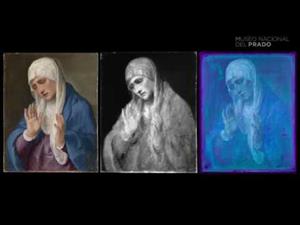
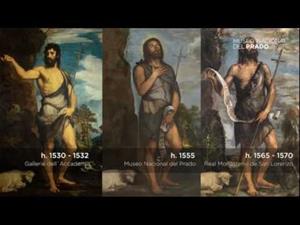
This work joins the two known compositions on this subject by the artist, one in the Galleria dell’Accademia in Venice (ca. 1530-1532) and the other in El Escorial (1565-1570). When he produced a painting Titian would generally execute a copy of it to be kept in his studio as a reference point for subsequent commission. This copy was created by tracing, but once the original image had been transferred Titian introduced small changes (to the gestures, landscape and colour) that resulted in a new original. This explains why there are never two identical works by the artist. Titian`s method is clearly evident on the X-radiographs as the images of the replicas always reveal the composition that was their starting point. Thus, the X-radiograph of the latest of the three Baptists (El Escorial) has the composition of the previous one (Museo del Prado) beneath the paint surface, while the Prado version reveals the Accademia composition underneath.
Stylistically, the Prado’s Saint John the Baptist is closer to the Accademia version than to the one in El Escorial. Both the landscape (the best preserved area along with the sky) and the unusual preparation of lead white with added calcium carbonate are found in works by Titian dating between 1550 and 1555. The Prado painting maintains the powerful body of the Baptist seen in the Accademia canvas, which in turn looks to classical and contemporary sculpture, while colour is still subordinate to disegno. Although Titian used a looser brushstroke in the landscape it is not comparable to the very sketchy handling in the El Escorial version. The three paintings constitute three different interpretations of the figure of John the Baptist. The Accademia version shows him as the impassioned preacher who urges the masses to be baptized and convert, by means of gestures inspired by classical rhetoric. In contrast, the Prado’s painting focuses on the previous moment when John ecstatically receives Christ`s call and accepts his will, placing his right hand on his breast. The Escorial canvas is comparable in this sense and emphasises the saint’s spiritual nature by showing him with the gaunt and wasted body of a hermit.
The canvas is recorded in Spain since the sixteenth century and was probably commissioned by Martín de Gurrea y Aragón, 5th Duke of Villahermosa. The canvas is documented between the late 17th and early 19th centuries in the convent of San Pascual Bailón, a religious house founded by the Admiral of Castile. Its influence on Spanish painting was considerable, as numerous surviving copies indicate (Text drawn from the exhibition brochure: Titian. Saint John the Baptist, Museo Nacional del Prado, 2012).