formularioRDF
The itinerary <em>TITULORECORRIDO</em> has been successfully created. Now you can add in works from the Collection browser
<em>TITULOOBRA</em> added to <em>TITULORECORRIDO</em> itinerary

Close Continuar a ficha de la obra Continuar a ficha de la obra
02-06-2026
Peter Paul Rubens

Siegen, Westphalia (Germany), 1577 - Antwerp (Belgium), 1640

Peter Paul Rubens See author's file

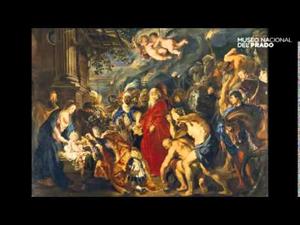
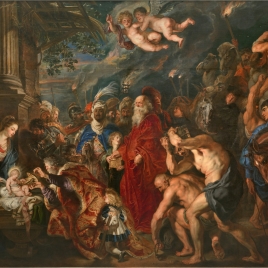
The Adoration of the Magi

1609. Oil on canvas.
Room 028

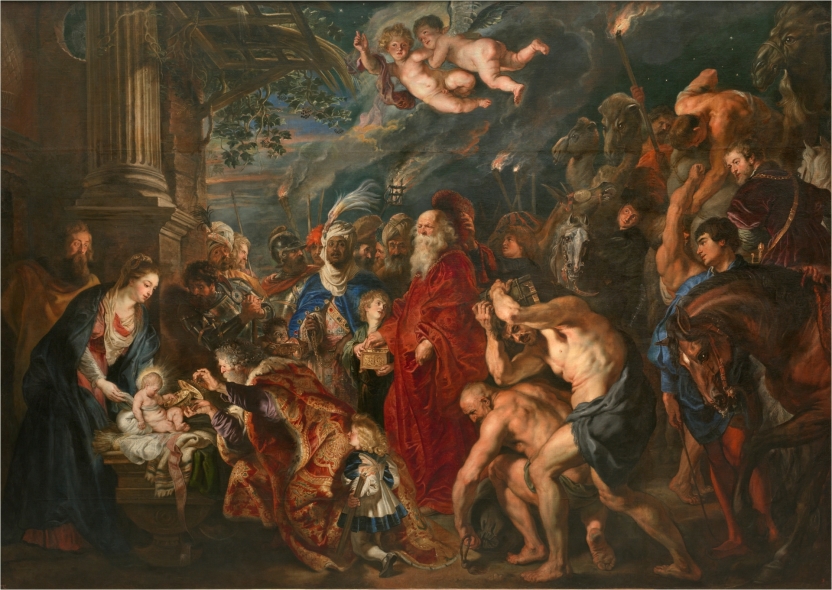
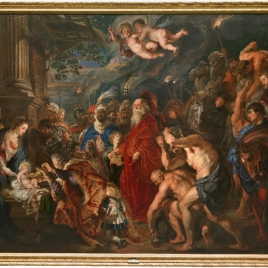
The Adoration of the Magi is one of the most important works within the Rubens collection in the Museo del Prado, not only because it is the largest but also because of its historical and technical importance. Iconographically, it depicts the moment when the three kings, accompanied by a large entourage, present their gifts to the infant Jesus. The child, in his mother´s arms, seems to be playing with the incense presented to him by Gaspar, who is kneeling before him. The scene is set outside, with a reference to the manger on the left, transformed into classical architecture. The richly coloured and richly embroidered robes of the kings, such as Balthazar’s adornments of precious-stones and jewels, and the number of companions, evince the luxury of this procession.

The scene takes place at night, as can be seen in the sky in the background. However, the luminosity is clear and the focus is on the figure of the child Jesus, who radiates the light that falls on the rest of the figures. The grandeur of the work arises in the multitude of figures. Their position allows to trace a diagonal from the upper right corner that converges on the figure of the child, the central point of the piece. This composition is full of movement and dynamism, where each of the characters is studied both individually and as part of the whole, revealing different postures and plains.

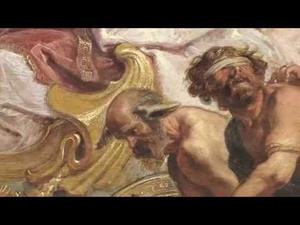
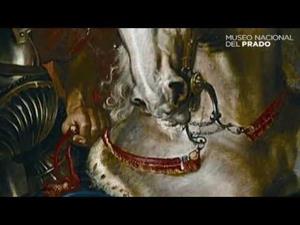
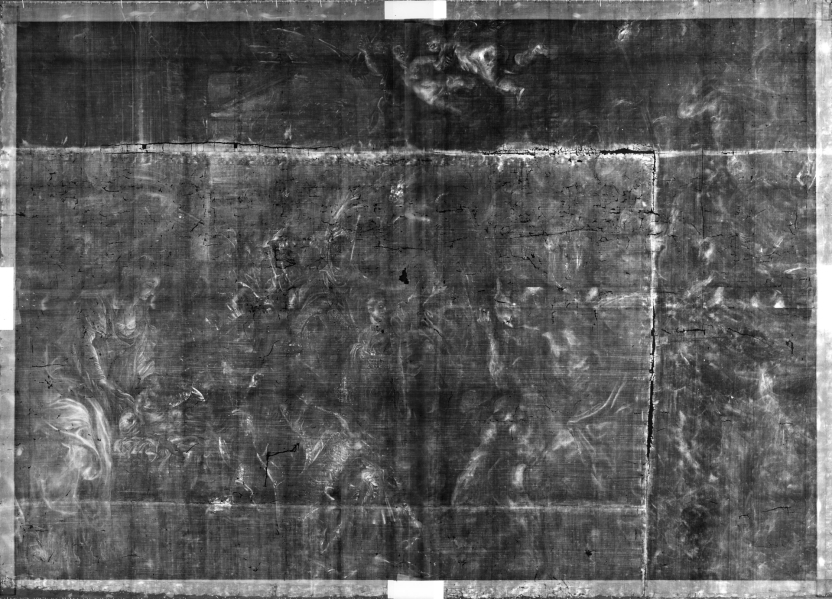
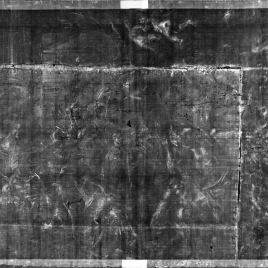
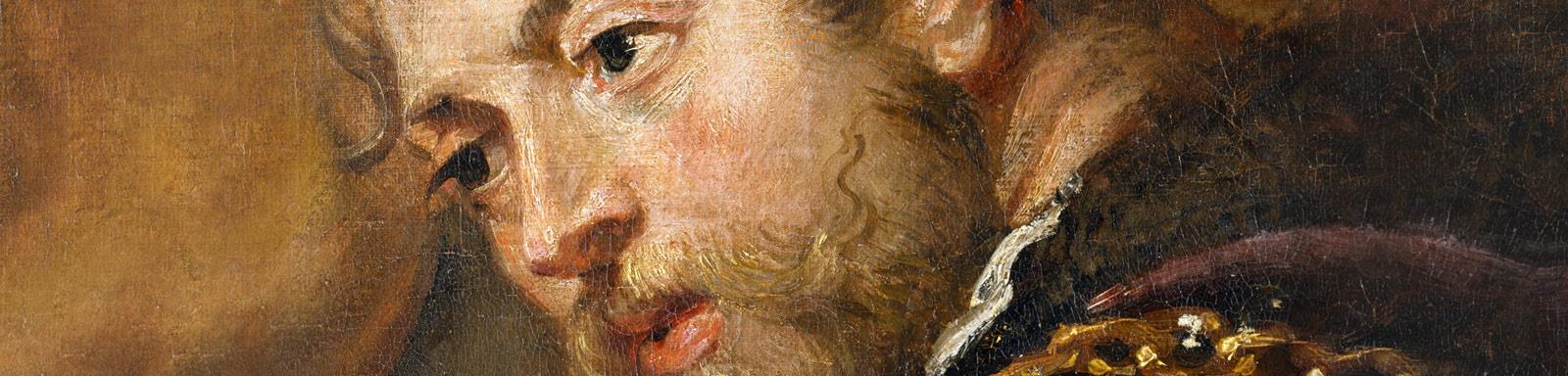
The work was executed in two stages: the first carried out around 1608–1609, then twenty years later the painting was enlarged by the artist himself. The first version is known thanks to a sketch kept in the Groninger Museum in Groningen, making it possible to work out Rubens´ first idea; a more horizontal composition that recalls the narrative friezes of classical antiquity. It reveals traces of his apprenticeship during his trip to Italy, immediately prior to the present work. The influence can be seen in the bearers in the foreground, which recall the vigorous, strong figures of Michelangelo and Caravaggio, with the detail of the dirty soles of the feet that one of them displays to the viewer. The additions are focused on the right and upper part of the composition, where the artist used the opportunity to paint his self-portrait as the man in the purple coat behind the horse. Another reference to Italian tradition is present with the two servants trying to hold each other, inspired by The Fire in the Borgo in the Vatican rooms painted by Raphael. In addition to enlarging the composition, Rubens also made some changes to his work and retouched some of the parts already painted, using a much looser technique.

The work was commissioned by the city of Antwerp around 1608 to decorate the Salon des États of the City Hall, which was to host the signing of a peace treaty between Spain and the United Provinces known as the Twelve Years´ Truce. The symbolic importance of the work was linked to the decorative programme of the room, where Scaldis and Antwerpia, an allegory of the river Scheldt and the city of Antwerp by A. Janssen, were also hung, and are now extant in the Royal Museum of Fine Arts in Antwerp. Both works were an attempt to express the desire for peace and the diplomatic achievements that would result from the signing of the treaty. Thus in the Adoration of the Magi, as J. Vander Auwera argues in his article for the catalogue of the Prado Museum exhibition in 2004, Jesus embodies a symbolic representation of the archdukes as keepers of peace in these territories, and the large retinue accompanying the magi would be the dignitaries who come to pay their respects to them.

The work came to Spain from Rodrigo Calderón, a Flemish politician and diplomat under the service of Philip III, whom Rubens had painted in an equestrian portrait similar to the one he had painted for the Duke of Lerma. In fact, Calderón was the Duke´s favourite and he may have given the city of Antwerp to him as a present in order to gain the favour of both Lerma and the King himself. The canvas arrived in Spain around 1613. With the diplomat´s fall from grace in 1621, the work passed into the hands of Philip IV two years later, who placed it in the lower room of the Alcázar in Madrid. Rubens saw it there when he returned to Spain between 1628–1629 and decided to retouch it.
Multimedia

Technical data

Imagen del carrusel
Imagen del carrusel
Imagen del carrusel

Related artworks

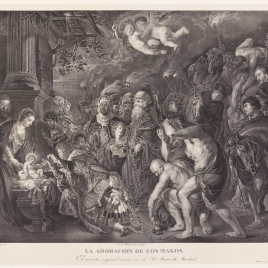
The Adoration of the Magi
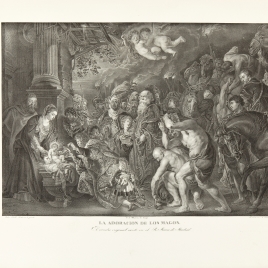
Lithographic aquatint on wove paper, 1829 - 1832
Florentino Decraene - Lithographer - (Author of the original work - Peter Paul Rubens)
José de Madrazo y Agudo - Director
Real Establecimiento Litográfico de Madrid - Printer
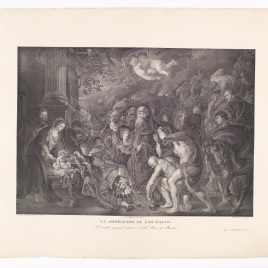
The Adoration of the Magi
Crayon lithography on wove paper, 1829 - 1832
José de Madrazo y Agudo - Director
Real Establecimiento Litográfico de Madrid - Printer
Florentino Decraene - Lithographer - (Author of the original work - Peter Paul Rubens)
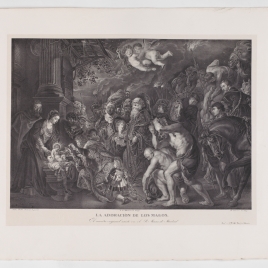
The Adoration of the Magi
Lithographic aquatint on wove paper, 1829 - 1832
Florentino Decraene - Lithographer - (Author of the original work - Peter Paul Rubens)
José de Madrazo y Agudo - Director
Real Establecimiento Litográfico de Madrid - Printer
The Adoration of the Magi
Lithographic aquatint on wove paper, 1829 - 1832
Florentino Decraene - Lithographer - (Author of the original work - Peter Paul Rubens)
José de Madrazo y Agudo - Director
Real Establecimiento Litográfico de Madrid - Printer
Inventory number
P001638
Author
Peter Paul Rubens
Title
The Adoration of the Magi
Date
1628 - 1629; 1609
Technique
Oil
Support
Canvas
Dimension
Height: 349 cm; Width: 488 cm
Provenance
Royal Collection (Real Alcázar, Madrid, Pieza en que su magd. come en el quarto bajo, 1636, s.n.; Real Alcázar, Pieza inmediata de la Aurora, 1666, nº 133; Real Alcázar, Pieza inmediata de la Aurora, 1686, s.n.; Real Aclázar, Pieza inmediata de la Aurora, 1700-1703, nº258; Real Alcázar, Pinturas que se hallaron en las Bobedas de Palacio, 1734, nº630; Palacio Nuevo, Madrid, Antesala de la Furriera, 1747, nº3; Palacio Nuevo, Antecámara de la princesa, 1772, nº3 [dupl.]; Palacio Nuevo, Madrid, Pieza de vestir [2ª], 1794, nº3; Palacio Nuevo, Dormitorio del príncipe, 1814-1818, nº3; Museo Real de Pinturas a la muerte de Fernando VII, Madrid, Salón 2º Escuela Flamenca, 1834, nº 333)

Bibliography +

Sánchez Cantón, Francisco Javier y Beroqui, Pedro, Inventarios Reales en 12 Volúmenes (Fotocopias), 1923.

Bottineau, Yves, L'Alcazar de Madrid et l'inventaire de 1686 (procedencia/provenance), Bulletin Hispanique, 1956-1958.

Norris, Christopher, Nederlands kunsthistorisch jaarboek = Netherlands yearbook f.."Rubens´Adoration of the Kings of 1609", Nederlands kunsthistorisch jaarboek, XIV, 1963, pp. 129-136.

Moreno Garbayo, Justa, El Nacimiento de Cristo en los grabados de la Biblioteca de Palacio, Reales Sitios, 18, 1968, pp. 44.

Fernández Bayton, Gloria, Inventarios reales: testamentaria del Rey Carlos II: 1701-1703 (procedencia/provenance), Museo del Prado: Patronato Nacional de Museos, Madrid, 1975.

Díaz Padrón, Matías, Museo del Prado: catálogo de pinturas: escuela flamenca, Museo del Prado Patronato Nacional de Museos, Madrid, 1975, pp. 227-228.

Crawford Volk, Mary, Rubens in Madrid and the Decoration of the Salón Nuevo in the Palace, The Burlington magazine, CXXII, 1980, pp. 168-180 fg.33.

Crawford Volk, Mary, Rubens in Madrid and the decoration of the King's summer Apartments, The Burlington magazine, CXXIII, 1981, pp. 513-529 fg.22.

Díaz Padrón, Matías, El siglo de Rubens en el Museo del Prado : catálogo razonado, Prensa Iberica, Barcelona, 1995, pp. 864.

Anes, Gonzalo, Las colecciones reales y la fundación del Museo del Prado, Amigos del Museo del Prado, Madrid, 1996, pp. 187.

Vergara, Alejandro, The Presence of Rubens in Spain, I-II, A Bell & Howell Company, Ann Arbor, 1999, pp. 11-18.

Vergara, Alejandro, Rubens and his spanish patrons, Cambridge University Press, Cambridge, 1999, pp. 19,80.

Aterido Fernández, A.; Martínez Cuesta, J.; Pérez Preciado, J. J., Colecciones de pinturas de Felipe V e Isabel Farnesio: inventarios reales, Fundación de Apoyo de la Historia del Arte Hispánico, Madrid, 2004.

Vergara, Alejandro, Rubens. La Adoracion de los Magos, Museo Nacional del Prado, Madrid, 2004.

Wetzel, Barbara, Rubens' aubetung der Könige 1608 und 1628/29: die Gestallung für verschiedene Patrone ; in Sponsors of the Past. Flemish Art and Patronage 1550-1700, Brepols, Brussels, 2005, pp. 230-231.
V.V.A.A., In sapientia libertas: escritos en homenaje al profesor Alfo..., Museo Nacional del Prado. Fundación Focus-Abengoa, Madrid, 2007, pp. 287.

Marcaida, José Ramón, Rubens and the bird of paradise. Painting natural knowledge in the early seventeenh century, Renaissance studies, 28 n.1, 2014, pp. 112-127 [112-119 fg 1,2].

Devisscher, H. y Vlieghe, H., The Life of Christ before the Passion., The Centrum Rubenianum. Harvey Miller publishers, Amberes, 2014, pp. Vol I: p110-123 n.23; Vol II fg.70-73.

Barbeitio, J. M., De arte y arquitectura. El Salón de los Espejos en el Alcázar de Madrid, Boletín del Museo del Prado, XXXIII (51), 2015, pp. 24-43 [30].

Martínez Leiva, Gloria; Rodríguez Rebollo, Ángel, El inventario del Alcázar de Madrid de 1666. Felipe IV y su colección artística, Consejo Superior de Investigaciones Científicas, Madrid, 2015, pp. 256 nº 140.

van Beneden, Ben (ed.), Rubens in private. The Master Portrays his Family, Rubens in private. The master portrays his family, Thames & Hudson Ltd., Amberes, 2015, pp. 39-53 fg.14-15.

Vergara, Alejandro, 'P. P. Rubens, Cabeza de joven (Blanton Museum of Art, Texas)', En: Rubens pintor de bocetos, Museo Nacional del Prado, Madrid, 2018, pp. 56-57 f.33.

Vergara, Alejandro, 'P. P. Rubens, El Descendimiento (The Courtauld Gallery)', En: Rubens pintor de bocetos, Museo Nacional del Prado, Madrid, 2018, pp. 88 [o.r.].

Vergara, Alejandro, 'P. P. Rubens, El Prendimiento de Sansón (Art Institute Chicago)', En: Rubens pintor de bocetos, Museo Nacional del Prado, Madrid, 2018, pp. 68-69 [p 68 f.34].

Vergara, Alejandro, 'P. P. Rubens, La adoración de los Magos (Groeninge Museum)', En: Rubens pintor de bocetos, Museo Nacional del Prado, Madrid, 2018, pp. 66-67.

Vézilier-Dussart, S., Gaspar de Crayer. L' adoration des Rois Mages avec l'autoportrait de Gaspar de Crayer, En: Gaspar de Crayer (1584-1669): Entre Rubens et Van Dyck, Musée de Flandre, Cassel, 2018, pp. 52-55 n. 1.5 [o.r].

Logan, Anne Marie; Lohse Belkin, Kristin, The drawings of Peter Paul Rubens: a critical catalogue. Volume II 1609-1620. T.1 Text.T.2 Plates, Brepols, Turnhout, 2021, pp. T.I: 19-24 nº215, nº216, nº217; [o.r. 143-144 nº278]; T.II: fg.271, 271a, 272a, 273..

Cruz Yábar, Juan Maria, Las pinturas del Salon Nuevo del Alcázar de Madrid que vió Cassiano dal Pozzo (1626), Anales del Instituto de Estudios Madrileños., LXIII, 2023, pp. 199-263 [243-245 fg.20].

Marx, Lizzie, 'Dressed up. A thousand fine concoctions: costumed heads', En: Turning Heads: Rubens, Rembrandt and Vermeer., Hannibal ; KMSKA,, 2023, pp. 91-99 [96 fg.59 (o.r fg.72)].

Other inventories +

Inv. Felipe IV, Alcázar de Madrid, 1636. Núm. s.n..
Pieça en que su magd. come en el quarto bajo [...] {2754} Vn lienço, con moldura dorada y negra, de la adoracion de los Reyes, de amno de Rubenes que se trajo de la almoneda de D. Rodrigo Calderón que tiene de largo diez y nueve pies poco mas o menos.

Inv. Felipe IV, Alcázar de Madrid, 1666. Núm. s.n..
PIEÇA YNMEDIATA DE LA AURORA [...] {140} Un quadro de la adorazión de los Reyes, de zinco baras y media de largo y tres y media de ancho, con su marco dorado, de mano de Rubenes, tasada en seiscientos ducados de plata... 6.600.

Inv. Felipe IV, Alcázar de Madrid, 1686. Núm. s.n..
Pieza inmediata de la Aurora [...] {475} Un quadro de la Adoración de los Reyes de cinco varas y media de largo y tres y media de ancho original de mano de Rubenes con Marco Dorado.

Inv. Testamentaría Carlos II, Alcázar de Madrid, 1701-1703. Núm. 258.
Pieza ynmediata de la Aurora 258 / Un quadro de la adoraçion de los Reyes de Zinco Varas y media de largo y tres y media de ancho original de mano de Rubenes Con marco dorado tasado en dos mill Doblones ... 2000

Inv. Alcázar, Madrid, 1734. Núm. 630.
Pinturas que se hallaron en las Bóbedas de palacio [...] 630 / Otro sin bastidor de quatro varas de alto y mas de cinco de ancho de la Adoración de santos Reyes original de Rubenes

Inv. Felipe V, Palacio Nuevo, 1747. Núm. 3.
Pinturas existentes antiguas En la Antesala de este Ofo [oficio] 3 / Ottro de la Adoracion de los Santtos Reyes de seis varas de largo y quattro y media de cahida original de Rubens = Se tasó en en sesenta mil reales

Inv. Carlos III, Palacio Nuevo, 1772. Núm. 3 [dupl.].
Antecámara de la Princesa [...] 3 / Vn quadro que significa la adoracion de los Santos Reyes de seis varas de largo y quatro y media de caida original de Rubenes.

Inv. Testamentaría Carlos III, Palacio Nuevo, 1794. Núm. 3.
Pieza de bestir [...] 3 / Seis varas de largo y quatro y mª. de alto: La Adoración de los Santos Reyes Yd ... 60.000

Inv. Fernando VII, Palacio Nuevo, 1814-1818. Núm. 3.
Dormitorio del Principe [...] 3 / La adoracion de los Reyes = Rubens

Museo Real de Pinturas a la muerte de Fernando VII, 1834. Núm. 333.
Salon 2º Escuela Flamenca [...] Tres cientos treinta y tres. La Adoración de los Magos Rubens Lº 802.500

Inv. Real Museo, 1857. Núm. 1292.
Rubens. / 1292. La Adoración de los magos. / Bajo un pórtico en parte arruinado, que forma la entrada del establo de belen, presenta la virgen su divino hijo a los magos, que con gran sequito vienen a adorarle. este cuadro se pinto en Amberes, le añadió un trozo a la derecha del espectador, y entre otras figuras puso su propio retrato a caballo. (C.L.) / Alto 12 pies, 5 pulg; ancho 17 pies, 6 pulg.

Catálogo Museo del Prado, 1873-1907. Núm. 1559.
1559.-(1292-M.)-La adoracion de los Reyes.-Presenta María su divino Hijo á los tres magos, que acuden al establo de Bethlehem con sus dádivas y acompañados de una lujosa comitiva luciendo espléndidos trajes. (véase nuestro Catálogo extenso.)-Figuras de tamaño mayor que el natural. / Adquirido por Felipe IV en la almoneda de D.Rodrigo Calderon. R.Alcázar y Pal. de Madrid.-C.L. / Alto 3,46; ancho 4,88.-L.

Inscriptions +

3
Inscribed in orange. Front, lower right corner

1292.
Inscribed in white. Front, lower left corner

Exhibitions +

Reunited
Madrid
06.06.2020 - 25.07.2021

Rubens
Madrid
05.11.2010 - 23.01.2011

The Adoration of the Magi
Madrid
30.11.2004 - 27.02.2005

Location +

Room 028 (On Display)

Expuesto

Displayed objects +

Textile: Túnica que viste el Mago negro, confeccionada en damasco de seda blanco, espolinado en colores con motivos de rosetas y piñas El diseño de esta tela de damasco es característico de mediados del siglo XV en Florencia y tuvo tanto éxito que se tejieron variates durante siglos (Benito García, P."Textiles en La Adoración de los Magos de Rubes" en Escritos en Homenaje al profesor Alfonso E. Pérez Sánchez, 2007: 287-293)

Clothing / Dress: La túnica que porta el Mago anciano de pie está realizada en terciopelo a dos alturas. Estos se confeccionaba para las capas de los patricios veneciados respondiendo a los cánones estilísticos de los damascos del siglo XVI. Se utilizaronen el Norte de Italia y en Flandes. Se conserva en Museo del Tejido de Prato un ejemplar muy parecido al que a quíse representa (Rosalía Bonito Fanelli, Five Centuries of Italian Textiles:1300-1800. Prato, 1981, Pág.78-79) Pone de relieve el papel que el comercio de tejidos de lujo tenía para la ciudad de Amberes, en el que Venecia era uno de los principales artífices. Además, al representar estos mantos al poder civil, Rubens lo representa arrodillado, doblegado ante Dios (Benito García, P."Textiles en La Adoración de los Magos de Rubes" en Escritos en Homenaje al profesor Alfonso E. Pérez Sánchez, 2007: 287-293)

Dress / Courtly o Clothing/Courtly: Capa del Rey Mago arrodillado, con borde de armiño y el exterior de la capa decorado con motivos típicamente orientales, del gusto otomano. Son típicos de la corte otomana, aunque fueron utizados también en Europa, distribuidos desde Florencia. Estos tejidos son caraterísticos de la corte otomana, fabricados con hilos de oro o plata. Tuvieron escasa difusión y a Europa llegaron pricipalmente como botín de guerra. Lo lleva el único Mago arrodillado, simbolizando la victoria del cristianismo. El armiño tiene un uso regio, identifica a la majestad. Estos tejidos proceden del Imperio Otomano, fabricados en Bursa o Estambul en el s. XVI-XVII (Benito García, P."Textiles en La Adoración de los Magos de Rubes" en Escritos en Homenaje al profesor Alfonso E. Pérez Sánchez, 2007: 287-293)

Update date: 02-06-2026 | Registry created on 28-04-2015

Visor 360

Drag with the cursor to rotate the piece

Other works by Peter Paul Rubens

Prado Shop

Print on demand

Print artworks available in our catalogue in high quality and your preferred size and finish.

Image archive

Request artworks available in our catalogue in digital format.

Up