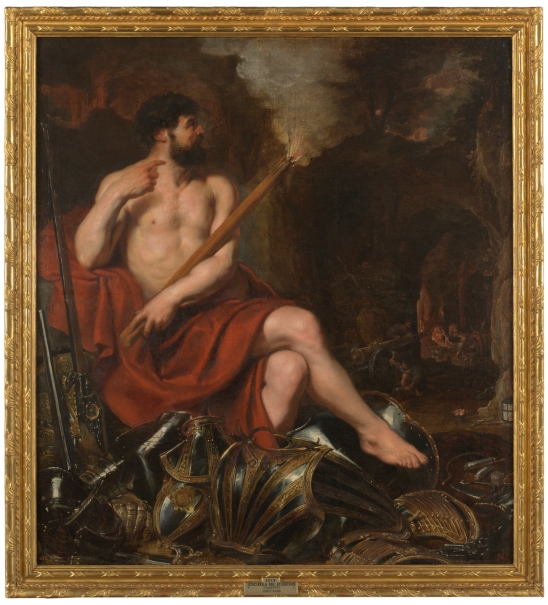
Vulcan and Fire
XVII century. Oil on canvas.On display elsewhere
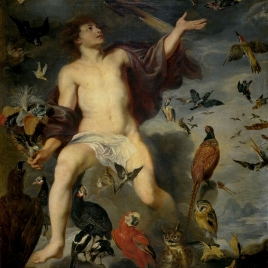
This work, together with Aeolus (P001716), is mentioned in the Zarzuela Palace (inventario de la Testamentaría de Carlos II [inventory of the Testament of Charles II], 1701–3) as ‘two frameless paintings, one and a half vara high, of the elements of fire and air’. Curiously, Ponz, in his Viage when recounting his experience in the Capuchin convent of El Pardo in Madrid near the Manzanares river, mentions that ‘in the style of the Rubens school, there are four paintings with figures from life that represent the four elements’. We do not know whether these are the same paintings and, if so, when and how they were moved between the Zarzuela inventory of 1747 and the next one that locates them in the Buen Retiro Palace in 1772. Nor do we know what happened to the other two works.
In the same passage, Ponz also mentions some paintings that used to belong to the Torre de la Parada, but it is not clear whether those depicting ‘the four elements’ also belonged there. Some studies, however, have used Ponz’s words to justify that they came from the aforementioned Torre.
Nevertheless, the origin and destination of these two paintings is unknown. The fact that the two paintings that have survived have been understood to be representations of fire and air has led some specialists to believe that they were part of a group of four (the four elements) of which the other two canvases have been lost. In the Corpus Rubenianum volume on the Torre de Parada, Svetlana Alpers refuted the thesis of Michael Jaffé, who speculated that this group might have been part of the Torre decoration. Alpers refuted this idea by arguing that a series of paintings alluding to the four elements would have no place in or connection with the subject matter of that space.
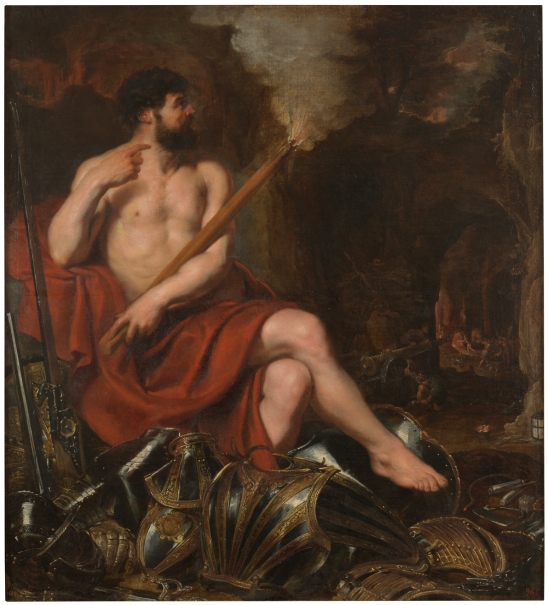
The attribution of these canvases fluctuated between ‘anonymous’, ‘Flemish school’ and ‘school of Rubens’. In the 1857 inventory of the Real Museo (Royal Museum), the painting is attributed to the ‘school of Rubens’ and in 1995 Matías Díaz Padrón included this painting together with Aeolus in the section on Erasmus Quellinus II (1607–1678). It has recently been suggested that the arms and armour surrounding Vulcan are by Cornelis de Vos (1584/5–1651), a theory that implicitly includes Rubens in the execution or design of the painting or part of it.
This painting, together with Aeolus, is attributed to a ‘follower of Rubens’ as it is not possible to establish the authorship of Rubens, Erasmus Quellinus II or Cornelis de Vos, nor that the paintings were supervised by Rubens himself in his studio.
The origin of the god Hephaestus (known as such to the Greeks; Vulcan to the Romans) varies according to the author: Hesiod recounts that he was conceived solely by Hera; other sources argue for Zeus as the progenitor. The sources also differ on the location of his forge: the Greeks place it on the island of Lemmos or on Olympus itself, as the Iliad attests; the Romans locate the forge under Mount Etna, in Sicily. The legends regarding this mythological figure converge in his appearance, which was not very graceful; in fact, he suffered from lameness. Despite his central importance in the mythological stories for his skill in forging weapons, armour and other works, he was treated with derision on Mount Olympus both for his appearance and for the many misfortunes he endured.
Nevertheless, the way in which the god has been depicted is unique. Vulcan does not show the ugliness alluded to in the sources, except in the abrupt design of his nose. In contrast to other images of the god of fire, he is not shown working or engaged in any action, but rather is seated on a rock, enjoying the creation of fire at the end of a piece of lumber.
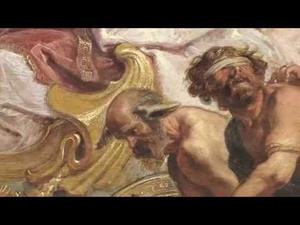
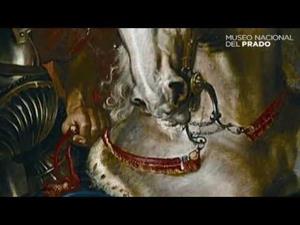
The setting chosen to represent Vulcan’s forge seems to be a volcanic site, probably a representation of the interior of Mount Etna. In addition to the god himself, other figures can be seen in the cavernous space forging military panoply which, as can be seen in the one surrounding Vulcan?, is contemporary to the time of production of the canvas.
Muñoz Baudot, Eduardo, 'Seguidor de Rubens. Vulcano y el fuego' En: El factor Prado: los depósitos del Museo Nacional del Prado., Museo de Bellas Artes de Asturias,, 2022, p.46-49 nº 7