Aeolus
Early XVII century. Oil on canvas.On display elsewhere
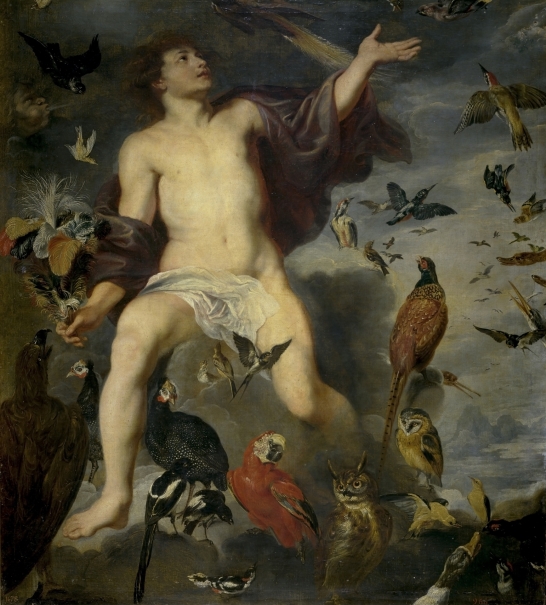
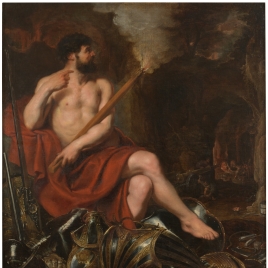
This work, together with Vulcan and Fire (P001717), has been considered part of a possible series of four paintings with the four elements as a guiding thread. In 1995, Matías Díaz Padrón attributed these two paintings to the hand of Erasmus Quellinus II (1607–1678). The birds depicted on the canvas have also been controversial: Alfred Weil suggested Frans Snyders (1579–1657), but Díaz Padrón stated that the artist who painted them was Paul de Vos (1595–1678).
The difference in the pictorial execution between that of this work and that of Vulcan and fire supports the idea that several hands were involved in this probable series of four paintings representing the four elements.
As with Vulcan and fire, this painting is attributed to a ‘follower of Rubens’ as it is not possible to establish the authorship of Erasmus Quellinus II or the supervision by Rubens in his workshop.
Not to be confused with the son of Helen and Orseis or the son of Poseidon and Melanippe, Aeolus was the son of Hippotes and king of the floating Aeolian Islands in the Tyrrhenian Sea. Despite being a mortal, Zeus granted him control of the winds as a result of a love affair they had. For this reason, Aeolus is frequently found in visual culture, epitomised as a naked young man with a short mane, as a representation of the wind or winter as well.
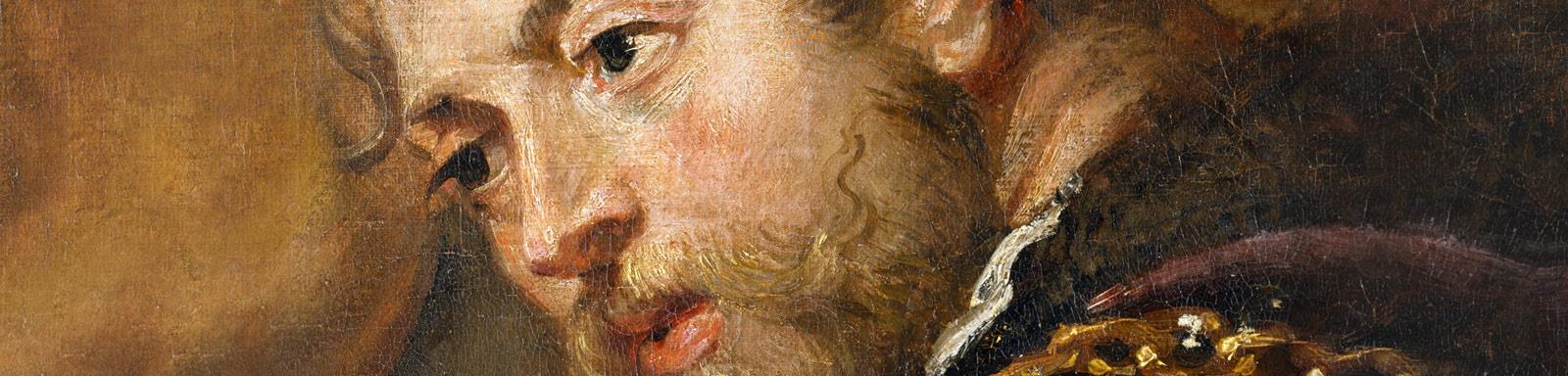
In this canvas, Aeolus is suspended in the air, covered by a white cloth around his private parts and wrapped in a violet-coloured cloth. His right hand holds several bird feathers, whereas his left hand interacts with the array of winged animals that surround him. On the overcast left side, a child’s face emerges from one of the clouds, making a great effort to blow.
This way of representing Aeolus resembles a painting by Martin de Vos (1532–1603), The air, in the Museo del Prado (P0003328).
Muñoz Baudot, Eduardo, 'Seguidor de Rubens. Eolo' En:El factor Prado: los depósitos del Museo Nacional del Prado., Museo de Bellas Artes de Asturias,, 2022, p.42-45 nº 6