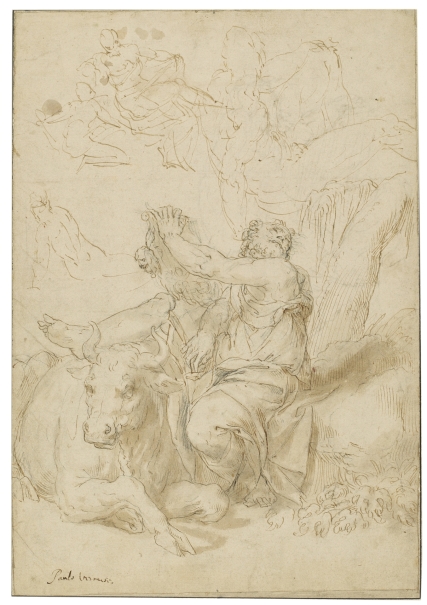
The Evangelist Saint Luke seated in a landscape and other studies
1580 - 1581. Wash, Grey-brown ink, White lead, Pencil ground, Pencil, Touches of chalk / pencil on dark yellow paper.Not on display
The pose of the Evangelist, seated on a mound in a landscape, with one leg astride the back of the ox, his attribute, recalls the painted figure of St. Luke in one of four irregularly shaped compartments of Evangelists at the corners of the ceiling of the destroyed church of S. Nicolo della Lattuga ai Frari, decorated by Paolo Veronese and his school in 1580-1581, and now in the Basilica of SS. Giovanni e Paolo (Pignatti, 1976, I, pp. 157-58, cat. no. 288; II, fig. 644); the ceiling´s central compartment, also now in SS. Giovanni e Paolo, is an Adoration of the Magi, likewise by Veronese and helpers. Since the destruction of S. Nicolo della Lattuga, the ceiling has had a somewhat chequered history: in 1826 it was transferred to the Palazzo Ducale and, in 1909, entered the Gallerie dell´Accademia. Only in 1929 was it accorded its present function as the presbytery ceiling of the Cappella del Rosario in SS. Giovanni e Paolo.
In fact, St. Luke in the Prado drawing conflates the poses of two of the Evangelists from the S. Nicolo della Lattuga and SS. Giovanni e Paolo compartments, borrowing also some elements from the figure of St. John (Pignatti, 1976, I, pp. 157-58, cat. no. 290; II, fig. 644). In the painted compartment, St. John turning his head back to the right, stretches his left arm forward to hold in his hand the top of a tall, elaborately shaped lectern, the base of which rests on his knees. The upper part of the figure of St. Luke in the Prado drawing echoes this position of the St. John. The fact that the St. Luke in the Prado drawing shows the Evangelist in a landscape setting suggests that it was done early on in the preparation of the artist´s designs, when the decision had not yet been taken to show the figures on clouds against the sky. Certainly the style of drawing employed indicates that it is a working study, the angular breadth of the pen work and the sparing, beautifully modulated areas of wash corresponding exactly in handling to that of Veronese´s other drawings of the type.
Turner, Nicholas, From Michelangelo to Annibale Carracci. A century of Italian drawings from the Prado, Chicago, Art Services International, 2008, p.112, 411