The Holy Family with Raphael, Tobias and Saint Jerome, or the Virgin with a Fish
1513 - 1514. Oil on panel transferred to canvas.On display elsewhere
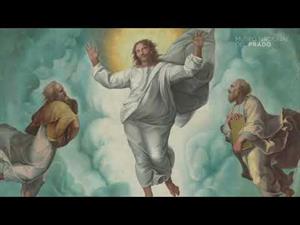
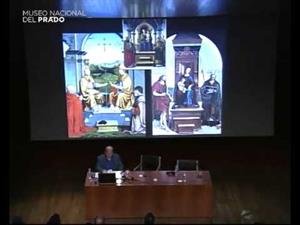
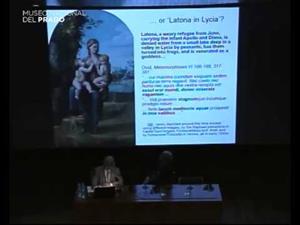
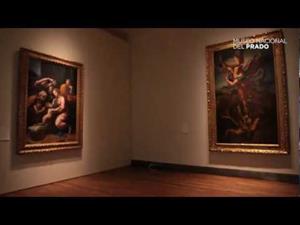
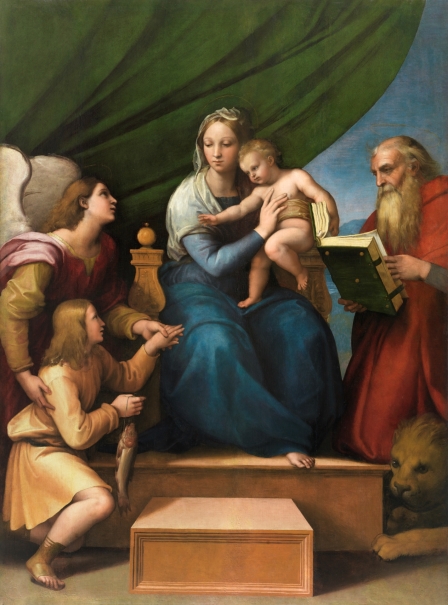
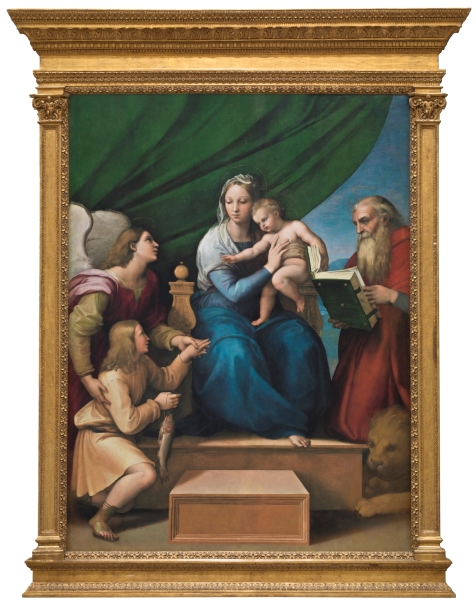
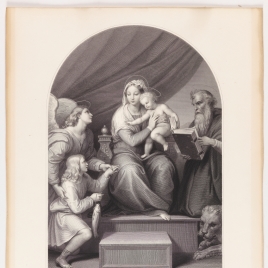
The Madonna del Pesce was painted for the chapel of Giovanni Battista del Duce in the church of San Domenico Maggiore in Naples, where the humanist Pietro Summonte saw it in situ in March 1524. It was brought to Spain from Naples in 1645 by Ramiro Núñez de Guzmán, duke of Medina de las Torres, together with Giovanni Penni and Giulio Romano’s copy of the Transfiguration (1520-1528?; Museo del Prado, P315). Seated on a throne, the Virgin holds the Christ Child in her lap. On the right, Saint Jerome dressed as a Cardinal reads the Vulgata (The Bible he, himself, translated into Latin). The Archangel Raphael, with the lion that symbolizes him, stands with Tobias, who holds the fish with which he will cure his father´s blindness.
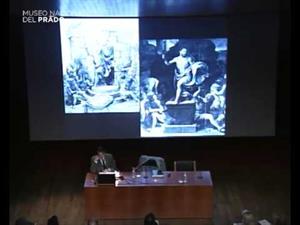
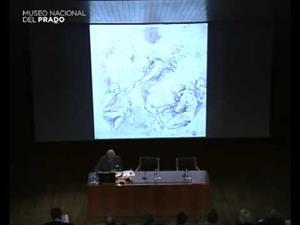
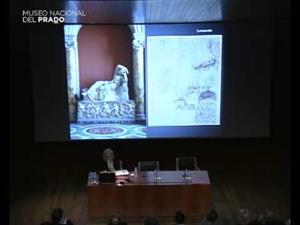
The altarpiece exemplifies the design method Raphael put into practice when he had only a short time to compose a large scene. He would reuse both his own existing models and those of other artists, assembling them and integrating them with new ideas. In this case, he took arrangements of the sacra conversazione and of the Madonna and Child that he had drawn and painted during his Florentine period and combined them with elements inspired by the marble statues of Muses at the Villa Madama in Rome and the ancient Roman Jupiter Ciampolini (Museo Archeologico Nazionale, Naples). He then posed his garzoni to visualize his idea of the scene that would bring these elements into harmony. The result was a red-chalk study, now in the Uffizi, Florence, in which the arrangement of the figures is very similar to that seen in the painting. This was followed by a more finished black chalk and wash study, heightened with white, which is now preserved at the National Galleries of Scotland in Edinburgh and displays many rectifications in the figure of Saint Jerome that reveal Raphael’s doubts over where best to position him. The Edinburgh drawing’s similarity to the underdrawing of the painting indicates that it would have immediately preceded the execution of the cartoon or cartoons used to transfer the composition.
The support, made up of five wooden panels, was replaced in Paris in 1816 by another consisting of four cloths. The original ground, still present in some areas, is of glue and gesso, and over it is a priming of lead white, powdered glass, and calcium carbonate. To ensure the adherence of the original strata to the new support, an enduit, or coat, was applied as a base for the transfer. Its high lead white content makes X-radiography difficult to interpret, so the scientific study of the work has been based on images provided by infrared analysis and X-ray fluorescence.
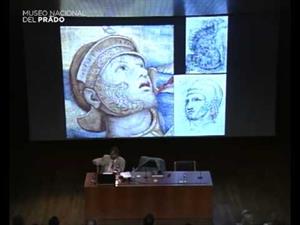
Recent examination of the painting with multispectral equipment generated an intensified response from the underdrawing, which was barely legible in earlier reflectograms. Its design reproduces the Edinburgh model quite closely, demonstrating that thanks to the arduous graphic process that preceded the execution of the painting, Raphael had very clear ideas when the moment came to take up his brushes, though this did not prevent him from making formal adjustments at various moments. A comparison of the Edinburgh model with the reflectogram and the painted surface demonstrates that Raphael adjusted the composition even when the work was at a very advanced stage.
The first phase of the underdrawing corresponds to the transfer of the scene by carbon tracing from one or several cartoons, which were positioned with reference to two perpendicular lines that divide the space for the composition into four sections. Raphael went over this first outline several times, drawing freehand in a dry medium that yields a very intense response in the reflectogram, and made a few corrections. Next he distributed the shadows, light, and halftones with a grayish diluted material that is visible on the paint surface in the darker parts of the flesh tones. On the mantles, the underlying shadows coincide with those cast in the Edinburgh model, corroborating the annotations made by François-Toussaint Hacquin during the removal of the support, which were published by William Buchanan in 1824 and describe a “thin transparent glazing” of “a warm hue” applied to the underdrawing.
The features modified during the painting process are drawn over the preparatory design as Raphael had situated them in the model. Among these elements are the bald pate of Saint Jerome, the length of the fish, the perspective of the arms of the throne, and the position of the spherical finial, which was varied at least twice before being corrected again after it was painted, this time by tracing with a compass. The most striking difference with respect to the drawings on paper is in the perspective of the step of the throne. The reflectogram does not appear to show that it was initially positioned as seen in the drawings, which suggests that the artist changed his mind and decided to make the perspective frontal before executing the cartoon. The folds of the Virgin’s mantle, originally drawn and painted after the model, were transformed in accordance with the adjustments made to the arms of the throne. All these variations were aimed at achieving greater clarity in the composition, although they led to a loss of the interrelationship between the figures and, consequently, a reduction of dynamism in the painting with respect to the drawings.
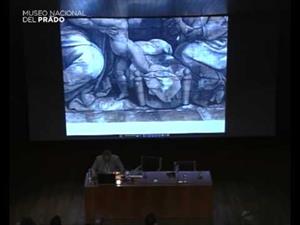
The way the Madonna del Pesce was painted was conditioned by the lighting in the place where it was to be displayed and the distance from which it would be viewed. Simulating a fresco, it is constructed with large and rapidly applied planes of saturated color, while more heavily laden brushstrokes add relief to the angel’s wings and Saint Jerome’s hair and beard. Standing in contrast to this elaboration are the subtle velaturas (glazes) that vivify the flesh tones of the figures and enrich the colors of the drapery. These glazes are difficult to find on the Christ Child and Tobias, the figures that were most heavily damaged when the original support was removed. The work was given the appearance of a mural painting by the synthetic manner in which it was worked. In the first place, simple flat color fields were laid over the underdrawing. These underpaintings provided Raphael with a basis for modeling the transitions of light and color on the figures and for adding the final touches. He did so by superimposing several layers with similar compositions, but different tones, on each area of color. For example, the brown color used for areas of flesh was left uncovered in order to define the halftones. These layers moreover contain particles of colorless glass, which may have been added to help them dry more quickly but also increase their transparency. The faces, which seem flat from a distance, are skillfully modulated. On their gray and brown base, Raphael created soft transitions by supplementing the basic lead white of the mix with lead-tin yellow in the lighter areas and vermilion in the halftones, and using iron- and manganese-rich pigments to heighten the shadows.
The study of the state of conservation of this painting carried out in 2015 revealed the damage suffered during the process of transferring the support, which would explain the doubts that have arisen over the authorship of the Christ Child and Tobias. Once the velaturas were worn away, the schematic intermediate phases of the painting process emerged onto the surface, and these figures acquired a flat and irregular appearance that has led in the past to their attribution to an assistant, an unlikely circumstance in a work with no secondary characters.
González Mozo, Ana, En: Raphael. Sublime Poetry, Nueva York, The Metropolitan Museum Of Art; Yale University Press, 2026, p.246