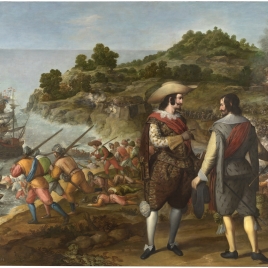
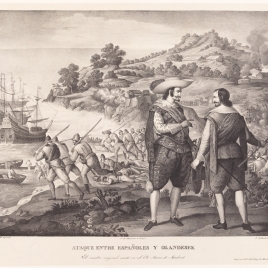
The Recapture of Saint Christopher
1634 - 1635. Oil on canvas.Not on display
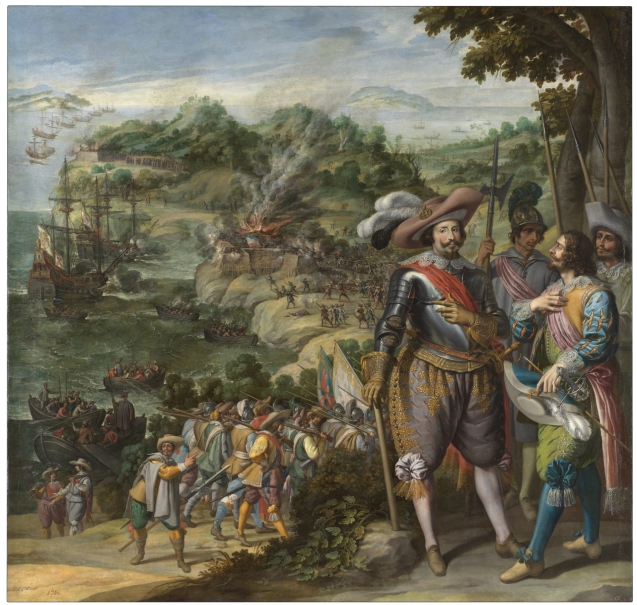
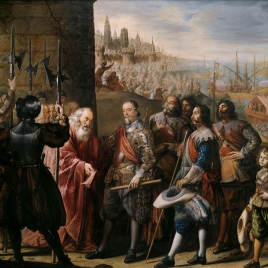
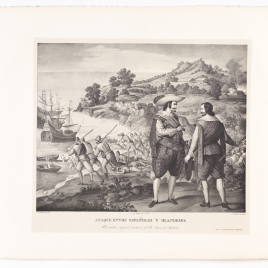
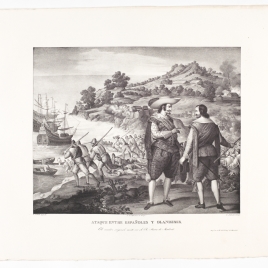
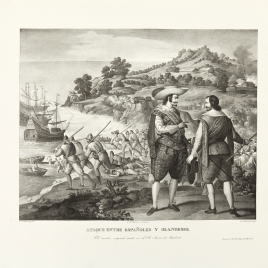
The island of Saint Christopher (modern-day Saint Kitts) in the Lesser Antilles was invaded by the English and French and recaptured by Spanish forces in 1629. The Spanish expedition was led by Fadrique de Toledo y Osorio, I Marquis of Villanueva de Valdueza and Captain General of the Ocean Fleet. He was accompanied by Fleet General Martín de Vallecilla and Admiral Antonio de Oquendo. After capturing various pirate ships on Nevis Island, the expedition debarked at Saint Kitts, where they rapidly captured two French forts and one English one with almost no losses. They took 2,300 prisoners and obtained 200 cannons. As with other battles depicted in the Hall of Realms, this was a fleeting victory. After burning the tobacco plantations, Fadrique left the island without leaving any garrison there. As he continued on to Portobello and Havana to take delivery of the customary treasure from the Indies, the French and English returned, occupying Saint Kitts again in August 1630. Fadrique de Toledo was the son of the V Marquis of Villafranca and had been appointed Capitan General of the Oceanic Sea in 1618 after his significant success in the Mediterranean and Brazil. Another of his achievements was The Recovery of Bahía de Todos los Santos (P885), which Maíno depicted in the Hall of Realm’s most symbolic painting. By the time those two paintings were commissioned, however, Fadrique had fallen from favor as a result of his dispute in 1633 with the Count-Duke of Olivares over a projected expedition to Brazil for which Fadrique sought a degree of funding that Olivares was unwilling to provide. Sent to prison and found guilty in November, 1633 by the Council of Castile, he was permanently banished, stripped of all his posts, and denied the income from his possessions. He died on December 10 of the following year. Castelo depicts him in the foreground, giving orders to one of his officers (possibly Pedro de Osorio, his Field Marshall), who has placed his hand on his chest. Behind this officer, we see a soldier, and another officer wearing a hat, whom Ceán and Madrazo supposed to be Juan de Orellana. As in the other paintings from the Hall of Realms, the battle is meticulously rendered in the background, with warships, barges and skiffs debarking troops. Other Spanish troops appear on land, where they are receiving fire from a burning stronghold and an enemy fort. Castelo was a relatively minor painter, with very little original work before 1633. His participation in the Hall of Realms’ decorative program (the King’s painter, Angelo Nardi was not even included in this project) can be explained by the fact that he was Vicente Carducho’s favorite disciple and seems to have been an important collaborator in previous years. This relationship is borne out by the similarity of the present work’s composition to Carducho’s although, as Angulo and Pérez Sánchez have observed, the landscape is richer and more kinetic. There is a preparatory drawing for this painting at the Cabinet of Drawings and Prints in the Uffizis.
Museo Nacional del Prado, El Palacio del Rey Planeta. El Palacio del Rey Planeta. Felipe IV y el Buen Retiro, Museo Nacional del Prado, 2005, p.146