Venus Discovering the Dead Adonis
1640 - 1645. Oil on canvas.Not on display
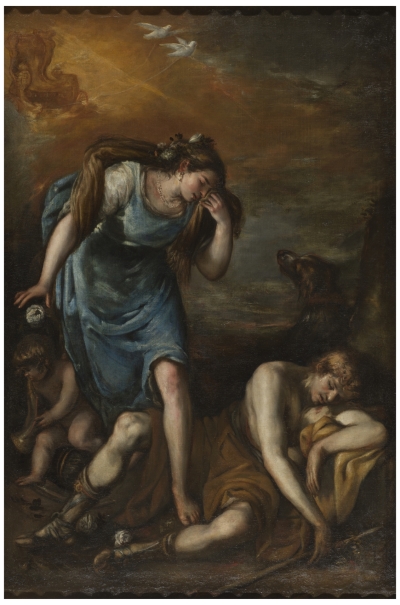
The work depicts Venus, down from the heavens, weeping the death of the young hunter, having found his moribund body in the forest, gored by a wild boar. Cupid, leaning on a quiver with arrows and a bow, carries a hunting horn. In the background, the outline of a dog stands out against an empty landscape.
Iconographically, it is worth highlighting the chaste portrayal of Venus, almost completely clothed, and Adonis’ wound, which is in his side rather than the groin, as narrated by Ovid in his Metamorphoses, the subject’s original source. These elements, along with the flowers the goddess scatters over her beloved, and the chariot being pulled by doves rather than swans, are shared with other painters from the time, and draw heavily on Bion of Smyrna’s Lament for Adonis, the Ovide Moralise and Adonis by Marino.
The loose and sketchy technique is typical of the late Titianesque style acquired by Polo during his training at El Escorial monastery. The dark setting, the powerful colouring of the figure of Venus, with one bare leg pushed forward, reminiscent of Titian’s versions of St. Margaret, bear witness to the profound impact the Venetian master’s work, which Polo studied in the royal collection, had on our artist. The features that so often set Diego Polo the Younger’s paintings apart, such as the wide-shouldered figures with large hands and tapered fingers, faces with almond-shaped eyes and sunken brows, are joined here by other devices that also appear in works from his artistic corpus.
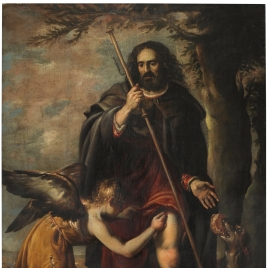
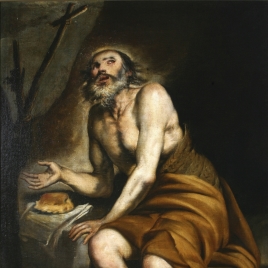
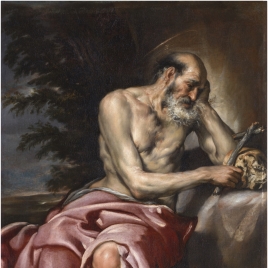
Adonis’ corpulent anatomy, lying back with his right arm crossing over his chest, reminds one of the St. Jerome chastised by the Angels from El Escorial. This model is also repeated in the Leipzig and Munich St. Jeromes and in the Prado’s St. Paul the Hermit, on loan in Huesca (P5164). The thick, mustard-coloured cloak is in line with Polo’s technical characteristics, using large-scale fabrics executed in a summary and uniform manner, in contrast to the nervous and scintillating brushstrokes one can appreciate in the blond hair or in Venus’ rich floral headdress. The intense red of Adonis’ blood, a pool of which may be seen next him in the foreground, is reminiscent of the blood-stained knife at the bottom of the Martyrdom of St. Bartholomew housed in the parish church of Barásoain (Navarre). The young victim’s sandals, modelled on those of antiquity, are typical of the artist, inviting close comparison with the Prado’s St. Roch (P3105) on loan in Burgos, and the executioner in the Martyrdom of St. Stephen, in Lille.
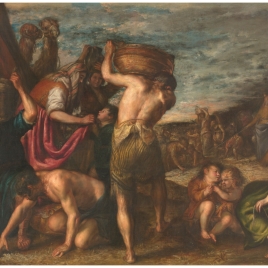
The figure of Cupid is reminiscent of the children that appear in the Prado’s Gathering of Manna (P6775), Polo’s masterpiece, commissioned by the city scribe Alonso Portero, who died in 1647. This iconographic element, and the similar way in which the carnations have been executed, invites one to date this new work to around the mid-1640s, when the painter had reached maturity. The considerable scale of the canvas indicates it was for a major client, intended to be displayed in a prominent palatial setting.
With this work joining Polo’s catalogue raisonné, it seems clear that the painter belonged to a circle of artists, collectors and intellectuals with a shared interest in classical antiquity. Within this context, it is worth noting that in October 1641 Polo received a commission, along with Antonio Puga, to make an evaluation of the unique collection belonging to Rodrigo de Herrera y Ribera, a poet and playwright who followed the school of Lope de Vega. The collection was largely made up of copies and versions of mythological paintings inspired by Titian, Michelangelo, Leonardo da Vinci and Luca Cambiaso, so Polo’s involvement in this assessment (the only documented example we have found to date) might have been due to the artist’s familiarity with mythological painting.
Cueto Martínez-Pontrémuli, José Luis, 'Venus descubre a Adonis muerto': una mitología de Diego Polo. Ars magazine: revista de arte y coleccionismo, 2022, p.142-143