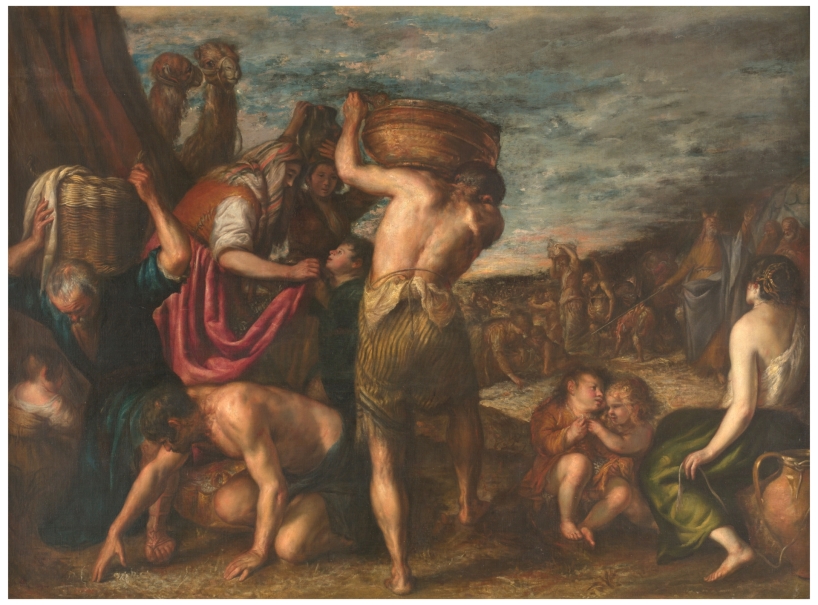
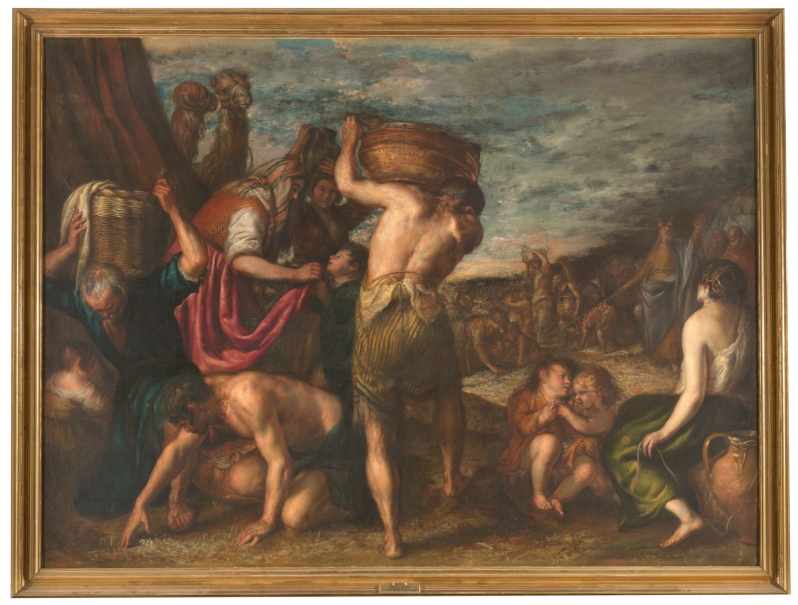
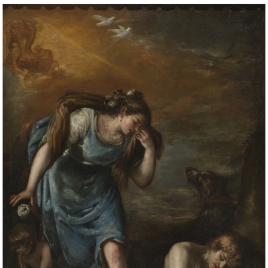
The gathering of manna
1640 - 1645. Oil on canvas.Not on display
This remarkable work shows an artist of outstanding quality, superior to the common Madrid painters of his time, a perfect connoisseur of the technique of Titian’s last period and with a personal way of interpreting the nude. The rich colouring is rendered with thick brushstrokes, creating a very dense effect, in the style of Carreño’s altar paintings. Certain elements recall the work of Velázquez: the female figure on the right and the child on the left evoke Venus in the Mirror. The work is also close to the style of Alonso Cano in The Miracle of the Well. According to Díaz del Valle y Palomino, the work was painted for Alonso Portero, the town notary, and was lauded by Velázquez (Pérez Sánchez, 1969: 43–54).
Thanks to Portero’s unpublished will, opened after his death on 5 December 1647, the term ante quem has been helpful to establish the date of the painting. This date of December 1647 is one of the very few chronological references available so far for a surviving work by Polo. In the case of the Manna painting, it has traditionally been considered to date from the late 1640s and early 1650s given its strong Venetian influence. The confirmed death of the notary in 1647 makes it possible to date the painting earlier as well as the unquestionable preparatory drawing in the Uffizi, Study of a crouching young man (S 10086), in which the painter tested the figure on the left of the composition picking up the manna from the ground. There is evidence that Diego Polo and Alonso Portero were acquaintances at least as early as 1640, as the painter went to his office on 17 February of that year in order to register the apprenticeship of his stepson Juan Baltasar, son of his wife Melchora de los Reyes, in the workshop of the cabinetmaker master Domingo Zorrilla. Therefore, from a documentary point of view, it seems reasonable to place the commission for this work in the period between the early 1640s and Portero’s death in December 1647.
Considering the few known biographical details about Polo, it may be possible to narrow down the chronology of the painting. The earliest documented record about the painter is his being mentioned as senior trainee in the testament of Antonio Lanchares on 7 March 1630. In his will is a debt of 200 reales for the payment of some benches and other walnut furniture owed to him by Juan de Alvarado the Elder, a carpenter from the town of Pareja, that were still pending delivery at the time of his death. Diego Polo was left in charge, along with other people, of the necessary verifications for the collection of the money. After the death of his master in 1630, the young artist went to the monastery of El Escorial to continue his training. There he produced his first known works, which still have some errors in the drawing and composition of the human body – typical of a painter trainee – together with an evident taste for Venetian colouring, such as Saint Jerome scourged by Angels (Patrimonio Nacional [National Heritage], inv. 10014664) and Penitent Magdalene (Patrimonio Nacional [National Heritage], inv. 10014665). These paintings are of identical dimensions (119 x 145 cm), almost certainly acquired by the Hieronymite monks or handed by Polo to the monastery during his time as a student. After his training at El Escorial, he worked on the decoration of the king’s bedchamber in the Alcázar, where he painted two pairs of portraits representing kings of Asturias and León. One of those couples were Ramiro II and Ordoño III, which had been finished and paid for in 1641. According to Palomino, ‘it is not the best he did as he was then a young man’, although ‘he still competes with the others, especially in the colouring, in which he was a great imitator of Titian’. These data place the painter at the height of his artistic maturity around the mid-1640s, when he was fully capable of producing works of greater compositional complexity such as The gathering of manna. During that decade, Alonso Portero is documented as having arrived at the Royal Board of Works and Forests, where he served as royal scrivener between 1644 and his death in 1647. It was during these years that Portero enjoyed a period of more evident professional and economic flourishing, as he worked under the king’s service, ran a public notary’s office with several assistants, and was involved in the town’s real estate business around the parish of San Martín. This represented a favourable context that allowed him to make important artistic commissions.
Cueto Martínez-Pontrémuli, José Luis, El escribano Alonso Portero, coleccionista de pinturas de Diego Polo y Antonio de Pereda. Atrio. Revista de Historia del Arte, 2021, p.68-99 (70, 80-83), fig. 2