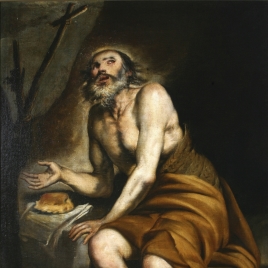
Penitent Saint Jerome
Second quarter of the XVII century. Oil on canvas.Not on display
There were plentiful depictions of Saint Jerome during the Modern Era, including some examples by Polo himself. The works of this Saint and Doctor of the Church worked as a bridge between the ancient classical world and the new Christianity. He devoted his long life to intense study and intellectual work, first in Rome and later in the East. After deciding to retire for four years to the desert of Chalcis, he settled permanently in Bethlehem. There – with his erudite mastery of Latin, Greek and Hebrew – he composed what is known as the Vulgate, or the Latin translation of the Holy Books, which, since the Council of Trent, has become the only authoritative text for the Church amongst the Latin versions.
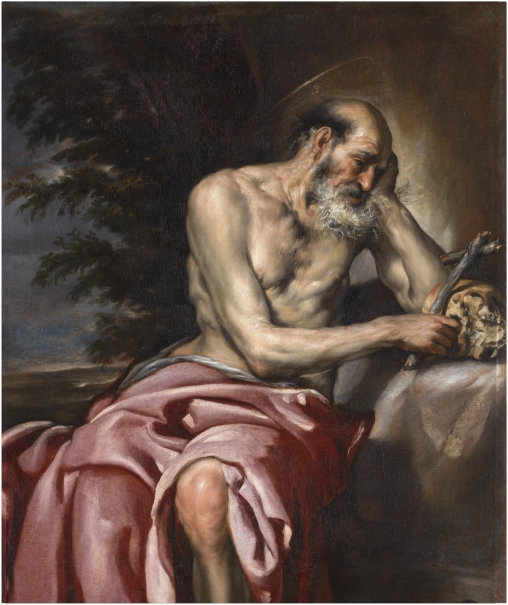
Polo portrays the saint in his years of penance in the desert when he decided to turn away from the world in an act of contrition and amendment. Jerome himself comments on his life in those years as follows: ‘My limbs were deformed by their friction with the coarseness of the hair shirt; my skin, dry and blackened like that of the Ethiopians, with no flesh to cover, adhered to my skeleton, my tears and groans were constant; I tried to withstand sleep, but when, in spite of the resistance I put up to it, it overcame me and I had no choice but to yield, I lay on the bare earth and, as I lay down on the hard ground, all my bones creaked.’ The painter thus depicts him half-naked in a rugged landscape, in a state of meditation and melancholy that conveys to the viewer his disengagement with material things (the skull) and his concentration on spiritual things (the simple wooden cross).
The colouring and loose technique exemplify the Venetian influence, especially in the landscape and in the crackling of the beard, which are executed entirely in blotches, in contrast to the heaviness of the fabrics that barely cover him. However, the monumentality of the saint’s anatomy has led to the suggestion of a possible influence from Ribera.
García López, David, "Diego Polo, San Jerónimo penitente". Esplendores de Espanha de el Greco a Velázquez, Río de Janeiro, Arte Viva, 2000, p.191