Saint Paul the Hermit in the desert
Second quarter of the XVII century. Oil on canvas.On display elsewhere
The former provenance of this painting is unknown. In any case, it must be related to a religious foundation in Madrid or its neighbouring provinces, given that it passed through the Museo Nacional de la Trinidad after the Ecclesiastical Confiscation. With the dissolution of that museum in 1872, the painting became part of the collections of the Museo del Prado and on 3 February 1879 it was transferred as a permanent loan to the Museo de Huesca at the initiative of the Provincial Monuments Commission and of Valentín Carderera, who donated a large part of his private collection and arranged for the arrival of various paintings from the Trinidad to his home city’s museum, which was inaugurated in 1873.
This painting is catalogued only as a depiction of a penitent saint in the desert in the inventory of the Museo de la Trinidad (1856–72) and later in the successive inventories and catalogues of the Museo de Huesca between the late 19th and early 20th centuries. Cruzada Villaamil does not include it in the selection of works in his Provisional Catalogue of 1865, whereas Gaya Nuño maintains the generic description of the painting as a penitent saint in his work on the Museo de la Trinidad of 1947, including it amongst the anonymous works lacking study. In the 1959 catalogue and the 1968 guide to the Museo de Huesca, it is inaccurately identified as a Saint Jerome and is ascribed to an anonymous 17th-century artist in acknowledgment of the painting’s noticeable quality. In the publication of the works from the Museo del Prado in Huesca in 1994, it was identified as Saint Paul in the Desert by an anonymous 17th-century Spanish artist. It was catalogued in this way until it was convincingly attributed to Diego Polo the Younger by Quesada Valera in 1999.
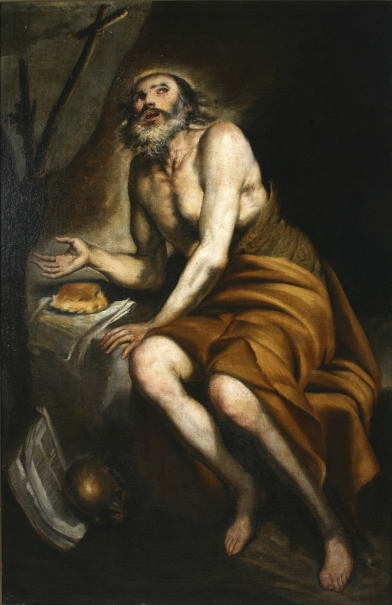
The painter shows the hermit saint full-length, seated on a rock. He appears dressed only in esparto grass that covers his belly and a brown cloth. He raises his head to the sky, and with his right hand he points at a piece of bread (an attribute of the saint) placed on some sheets of parchment. In the upper left corner, a cross is outlined, partially illuminated by the twilight that reveals itself over the rocks. On the ground, an open book and a skull are leaning on a tree trunk.
The whole painting is executed in a technique that is very characteristic of this master. Along with sketched elements – treated with brushstrokes full of pigment, where the brushstrokes are mingled and merged – he prefers to use long brushstrokes in other areas, which builds up the objects in layers of colour, using different hues so as to enhance their volume. The way the hermit’s beard and hair or his torso are depicted clearly demonstrate the first approach, whereas the second is visible in the brown cloak or, to a certain extent, the skull on the ground.
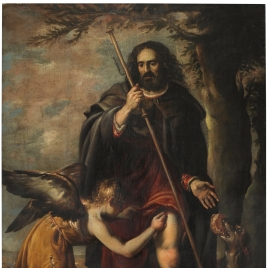
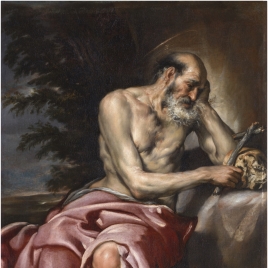
The painting in the Museo de Huesca undoubtedly evokes his well-known depictions of hermit saints such as the different versions of Saint Jerome (Museo del Prado, Leipzig Museum and Alte Pinakothek in Munich) or Saint Jerome scourged by Angels in the monastery of El Escorial. All of them display the loose, cast technique of late Titian, together with an evident knowledge of the prints or paintings of Jusepe Ribera as regards the human type. In fact, Polo’s hermit saint demonstrates a deep and exhaustive study of Ribera’s paintings, some of which he may well have known in Spain, in the royal collections which, according to Lázaro Díaz del Valle, he studied in detail in the monastery of El Escorial.
The canvas with which this painting shows a blatantly conspicuous similarity is Penitent Saint Jerome in the Museo del Prado (P006776). It has a similar torso, slightly turned to the left, the same softness in the execution of the drapery, and the unmistakable tangled, grizzled beard with rough brushstrokes. This model of the elderly saint can be found in other versions of the saint, such as the one at El Escorial or those in the two German museums; especially the one in Leipzig, which is very reminiscent of the effigy of this Saint Paul the Hermit. All of them include details that reveal formal affinities which indeed fit perfectly with the description of his style by both Lázaro Díaz del Valle and Palomino.
Quesada Valera, José María, Nueve pinturas madrileñas inéditas del siglo XVII. Goya, 1999, p.217-218, fig. 5