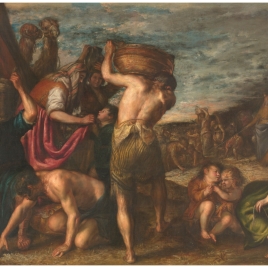
Diego Polo
Becilla de Valderaduey, Valladolid (Spain), 29-12-1604 baut. - Madrid (Spain), ca. 1645Diego Polo the Younger, so called by Palomino to differentiate him from his uncle, a painter of the same name from the previous generation, was born according to his first biographers in the lands of Old Castile. Although it has been thought that he was born in Burgos since Ceán Bermúdez in his Diccionario histórico of 1800, the discovery of his marriage record and baptismal certificate allows us to place his birth in the Tierra de Campos region, in the town of Becilla de Valderaduey (Valladolid). In this municipality, very close to Villalón de Campos and included in the time of Diego Polo in the jurisdictional demarcation of the bishopric of León, his paternal and maternal family is documented since the second half of the 16th century in the parish records of the church of San Miguel Archangel. The painter was baptized in this temple on December 29, 1604, son of Juan Polo and María Merino, and middle brother of Francisco and Juan, baptized respectively in 1602 and 1618 (Cueto Martínez-Pontrémuli, José Luis, "Sobre el origen y biografía de Diego Polo el Menor. Aportación documental y estudio", Archivo Español de Arte, 97, 386, 2024, pp. 1-7).
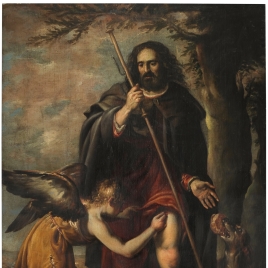
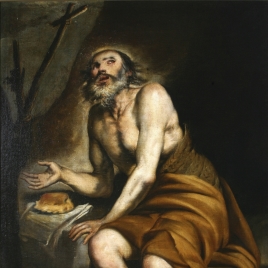
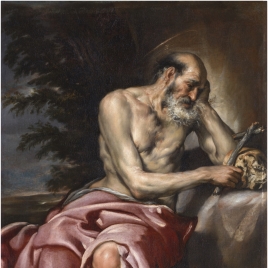
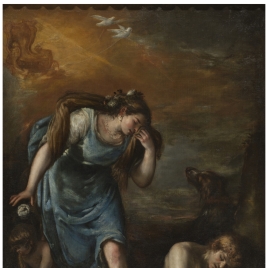
He received training from the painter Antonio de Lanchares, who died in 1630. He then moved to El Escorial, where he continued studying the Venetian canvases on view, achieving a technique so close to that of the old Titian that some of his works have been considered to be by the hand of the master of Cadore, as was the case with his Saint Stephen (Musée des Beaux-Arts de Lille). He is also known to have been commissioned for the Alcázar in Madrid and to have painted a couple of canvases of former monarchs for the gilded hall of the palace that have since been lost. Some of the paintings associated with Diego Polo in the Museo del Prado stand out, such as Penitent Saint Jerome, which used to belong to the collection of Infante Don Sebastián Gabriel de Borbón and was acquired by the Prado in 1982, and Saint Roch, purchased as anonymous in 1965 and subsequently attributed to Polo by Alfonso E. Pérez Sánchez. Nevertheless, his best-known work is The Gathering of the Manna, of which old sources cite praise even from Velázquez himself. It was painted for Alonso Portero, notary of Madrid. In this canvas, his assimilation of Venetian colourism becomes undoubtedly most explicit. For this composition, he used a drawing in the Galleria degli Uffizi in Florence (García López, David, in: Enciclopedia M.N.P., 2006, vol. V, p. 1774).