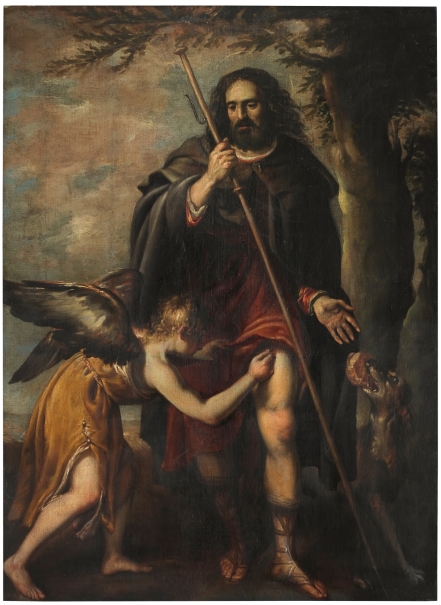
Saint Roch
Second quarter of the XVII century. Oil on canvas.On display elsewhere
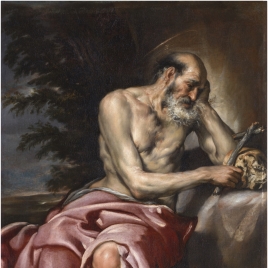
The strong Venetian nature, the richness of colour and the lightness of execution connect this work with Diego Polo’s production. The monumental, solid, massive aura of the figure, which may recall the work of Navarrete el Mudo, is associated with El Escorial. Presumably, Polo not only paid attention to Titian’s work, but also must have seen and studied everything he could find that was in keeping with his Venetian sensibility. First and foremost, these certainly include the monumental figures of apostles that El Mudo painted on the altars of the basilica and Titian’s lesson, executed with unquestionable originality and personality 40 years before Polo’s work at El Escorial. The treatment of Saint Roch’s cloak, in smoother layers than the softness of the angel’s tunic, with the edges emphasised by lighter brushstrokes, indirectly corroborates the attribution of Penitent Saint Jerome in the Museo del Prado (P006776), which could be seen as a final, more refined and synthetic phase, less strictly Titianesque, in the artist’s small production.
Pérez Sánchez, Alfonso E., Diego Polo. Archivo Español de Arte, 1969, p.52-53, lám. 9